Liber XI · Herbal Magick · Chapter IV: Herbal Magic History
The Anglo-Saxon Nine Herbs Charm: Woden, Christ and Healing
The Anglo-Saxon Nine Herbs Charm from the Lacnunga: its nine plants, Woden's glory-twigs, the nine poisons, its Christian elements and modern readings.

The Nine Herbs Charm is an Old English healing poem preserved in the Lacnunga, a collection of remedies in a British Library manuscript (Harley 585) written around the year 1000. It praises nine plants, among them mugwort, plantain, chamomile, nettle, crab-apple, chervil and fennel, as powers against "nine poisons" and "flying venoms," and is famous as one of the very few Old English texts to name the god Woden, set beside Christ in a single remedy.
The Lacnunga Manuscript: Harley 585§
Harley 585 is a small, much-used medical manuscript, usually dated to the late tenth or early eleventh century. It opens with Old English versions of the late antique Herbarium attributed to Apuleius and a treatise on remedies from animals, followed by a miscellany of nearly two hundred recipes, prayers, charms and Latin and Old English formulas. Cockayne gave this miscellany the title Lacnunga when he edited it in the second and third volumes of Leechdoms, Wortcunning, and Starcraft of Early England (1864–66).
The Lacnunga sits beside other Anglo-Saxon medical books, especially Bald's Leechbook, and shares their mixture of practical herbal medicine drawn from Latin sources with charms against elves, sudden stitches, dwarves and swarming bees. It is one of the richest sources for the history of herbal magic in early medieval Europe, and a reminder that its compilers saw no sharp line between pharmacy and prayer.
The Nine Herbs and Their Old English Names§
The poem addresses each plant in turn, often as a living being with its own history and strength. Some identifications are secure, others debated:
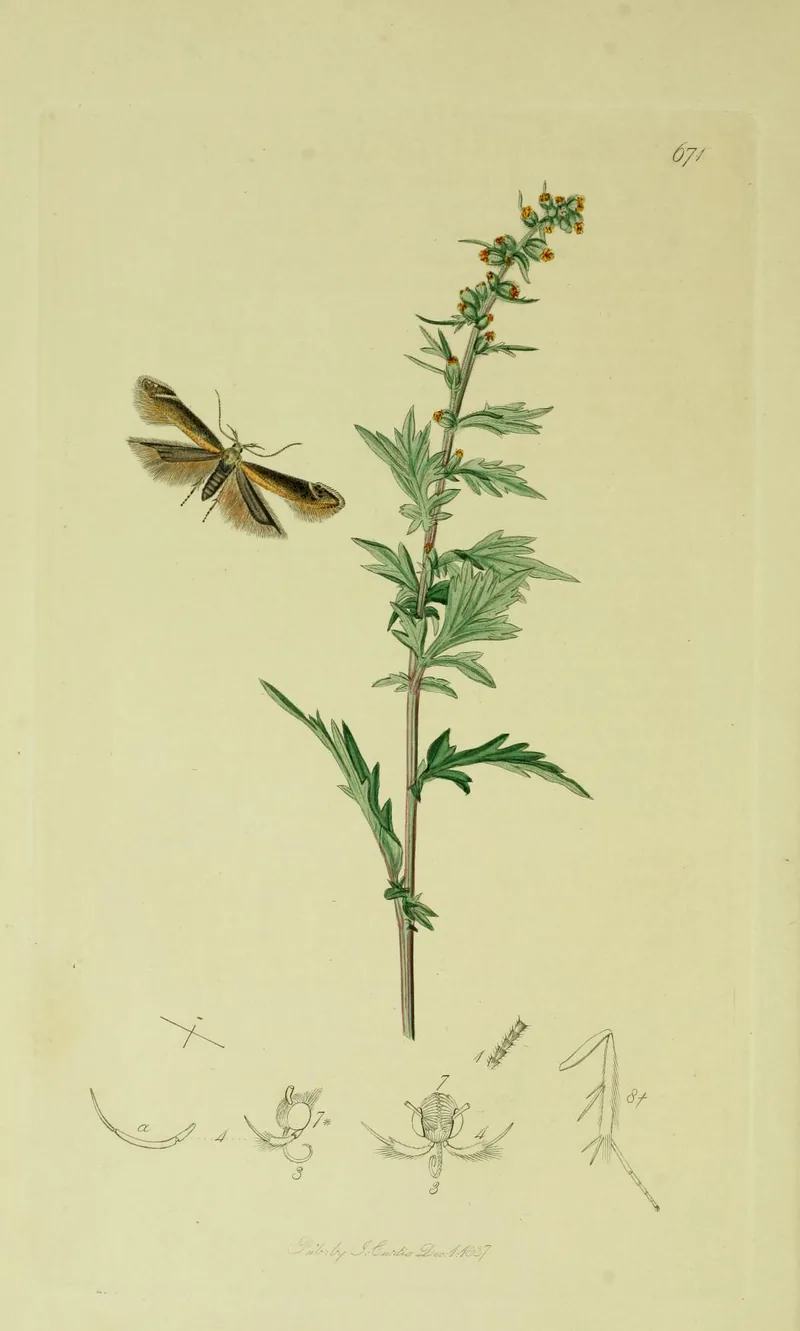
- Mucgwyrt (mugwort), addressed as Una, "oldest of herbs," and told to remember what it revealed at a great proclamation.
- Wegbrade (waybread, greater plantain), "mother of herbs," open to the east, over which carts creaked, women rode and brides cried out, and which withstood them all.
- Stune, perhaps lamb's cress or watercress, said to grow on stone and to resist poison.
- Attorlaðe, "poison-hater," whose identity is uncertain (betony and a kind of grass have been proposed).
- Mægðe (mayweed or chamomile).
- Wergulu, usually taken to be nettle, which a seal is said to have sent across the sea.
- Wudusuræppel (crab-apple), the "wood-sour-apple."
- Fille (chervil) and finule (fennel), the "two very mighty ones."
Several of these plants appear throughout European folk medicine and later lore, and mugwort in particular has a long association with travellers, dreams and protection, discussed in the guide to the witch's garden. The number nine, repeated throughout the poem, was widely significant in Germanic and Christian contexts, as the guide to number symbolism explains.
Woden, the Serpent and the Nine Glory-Twigs§
The poem's most discussed lines interrupt the list of herbs with a short mythic episode. A serpent (wyrm) comes crawling and wounds a man; then Woden takes nine wuldortanas, "glory-twigs," and strikes the adder so that it flies apart into nine pieces. The passage goes on to say that the apple and the poison brought it about that the serpent would never again enter a house.
What the glory-twigs were is uncertain. Some scholars have connected them with twigs carved with runes, used for divination or magic, though the text does not say so; others see simply branches of the healing herbs themselves, or a metaphor for divine power. The episode belongs to a wider Germanic pattern of healing charms that recall a mythic precedent, of which the Old High German Merseburg Charms, where Wodan heals the sprained foot of Balder's foal, are the closest parallel; a modern adaptation appears in the Merseburg healing charm. The broader religious background is described in Norse and Germanic religion.
Nine Poisons and Flying Venoms: Anglo-Saxon Ideas of Disease§
After the herbs, the charm declares that these nine have power against nine poisons and lists the "flying venoms" (onflygnum) and poisons by colour: red, white, purple, yellow, green, livid, blue, brown and crimson. It speaks of the "loathed thing" that travels through the land, and of poisons coming from the east, north and west.
This vocabulary reflects an Anglo-Saxon understanding of illness as something that arrived through the air or was shot into the body, also visible in the charm Wið færstice, "against a sudden stitch," which blames the arrows of elves, witches and gods. Historians such as Karen Jolly and Alaric Hall have shown that these beliefs coexisted with Latin humoral medicine rather than replacing it, and that "elf" diseases were treated with both herbs and Christian prayer. The idea of airborne infection was not peculiar to the English; similar notions of "flying" sickness occur in Scandinavian and Celtic folk medicine.
Christ and the Old Gods: A Christian Charm?§
The charm is often presented as a pagan text with a Christian veneer, but its Christian elements are woven into the poem. Chervil and fennel are said to have been created by "the wise Lord, holy in the heavens, as he hung," a line usually understood as Christ on the cross, though some scholars have compared it with Odin's self-sacrifice on the world-tree in the Old Norse Hávamál. Later the poem states that Christ stood over disease of every kind, and the prose directions that follow use the language of a Christian healer.
Most modern specialists read the Nine Herbs Charm as the work of a literate Christian compiler who drew on older vocabulary and mythic motifs, much as the Æcerbot field remedy combines masses and prayers with older agricultural ritual (adapted in the Æcerbot field blessing). In this sense it is a document of folk Christianity rather than surviving heathen liturgy: Woden appears as a figure of legendary power within a Christian world, not as the object of worship.
The Prose Directions and How the Charm Was Used§
The poem is followed by practical instructions. The herbs, together with the apple, are to be ground to powder and mixed with old soap and apple juice; a paste is to be made with water and ashes, fennel boiled in it, and the mixture applied to the wound. The healer is to sing the charm three times over each herb before preparing it, and into the patient's mouth, both ears and the wound before applying the salve.
These directions show the charm as part of a single healing act combining plant medicine, speech and touch. They should be read as historical evidence of early medieval practice, not as medical advice: the remedy was designed for wounds and infections that modern medicine treats very differently.
Translation, Interpretation and Modern Revival§
Since Cockayne, the charm has been edited by Elliott Van Kirk Dobbie in the Anglo-Saxon Minor Poems (1942), by Godfrid Storms in Anglo-Saxon Magic (1948), and with a full commentary by Edward Pettit (2001). Scholars continue to debate the plant names, the order of the lines (the manuscript text appears disordered in places) and the meaning of the Woden passage.
In the twentieth century the charm found new readers among herbalists, poets and practitioners of contemporary Heathenry, described in Heathenry and runes, who recite it as a healing invocation or use its herbs in blessings, such as the modern Nine Herbs Charm sachet. These are modern adaptations of a medieval text whose original setting was the monastic and lay medicine of late Anglo-Saxon England.
Frequently asked questions§
What are the nine herbs in the Nine Herbs Charm?§
They are usually identified as mugwort, waybread (plantain), stune (perhaps lamb's cress), attorlothe (uncertain), mayweed or chamomile, nettle, crab-apple, chervil and fennel. Several of the Old English names are uncertain, and scholars differ on some identifications.
Is the Nine Herbs Charm pagan?§
It mentions Woden, but it was written down in a Christian manuscript and names Christ and "the wise Lord" as the creator of the herbs. Most scholars see it as a Christian-era composition preserving older motifs.
What are Woden's nine glory-twigs?§
The poem says Woden took nine wuldortanas and struck a serpent into nine pieces. Their meaning is uncertain: they may be branches, rune-carved twigs or a poetic image of divine power.
Where can the Nine Herbs Charm be read?§
The original is in British Library Harley 585. Editions include Cockayne's Leechdoms (1864–66), Dobbie's Anglo-Saxon Minor Poems (1942), Storms's Anglo-Saxon Magic (1948) and Pettit's edition of the Lacnunga (2001).
Sources and further reading§
- Leechdoms, Wortcunning, and Starcraft of Early England — Oswald Cockayne, 1864
- The Anglo-Saxon Minor Poems — Elliott Van Kirk Dobbie, 1942
- Anglo-Saxon Magic — Godfrid Storms, 1948
- Anglo-Saxon Magic and Medicine — J. H. G. Grattan & Charles Singer, 1952
- Anglo-Saxon Medicine — M. L. Cameron, 1993
- Popular Religion in Late Saxon England: Elf Charms in Context — Karen Louise Jolly, 1996
- Anglo-Saxon Remedies, Charms, and Prayers from British Library MS Harley 585: The Lacnunga — Edward Pettit, 2001
- Elves in Anglo-Saxon England: Matters of Belief, Health, Gender and Identity — Alaric Hall, 2007