Liber XI · Herbal Magick · Chapter VIII: The Witch's Garden
The Witch's Garden: Folklore of Poison, Protection and Dreams
The witch's garden in history and folklore: henbane, belladonna, mandrake, aconite and hemlock, protective vervain, rue and rowan, mugwort and yarrow, with toxicity notes.

"The witch's garden" is a modern name for the group of plants that European folklore, demonology and later Pagan revival have associated with witches: poisonous nightshades such as henbane, belladonna and mandrake; deadly aconite and hemlock; and protective or visionary herbs such as vervain, rue, rowan, mugwort and yarrow. The idea mixes genuine folk-plant knowledge with the fears of witch-hunters and the imagination of nineteenth- and twentieth-century writers.
The Idea of the Witch's Garden§
No medieval or early modern witch left a list of the plants she grew. The witch's garden is a composite built from several sources: classical literature, which gave sorceresses such as Medea and Circe a knowledge of potent herbs; early modern demonology and trial records, which accused witches of poisoning and of making flying ointments; the folk plant names recorded by herbalists and folklorists; and the twentieth-century revival of witchcraft, which embraced the image positively.
Two very different groups of plants result. The first are the "baneful" herbs, poisons and narcotics believed to give witches power to harm, fly or see visions. The second, often overlooked, are the apotropaic herbs that ordinary people used to protect homes, livestock and children from witchcraft. A genuine history of the witch's garden must hold both together, as does the broader survey in what is herbal magic?.
The Nightshades: Henbane, Belladonna, Mandrake and Datura§
The most notorious witches' plants belong to the nightshade family (Solanaceae) and contain tropane alkaloids such as atropine, hyoscyamine and scopolamine. These substances can cause dilated pupils, racing heart, hallucinations, confusion and, in larger amounts, coma and death. Folk accounts of their effects often record real poisonings, accidental or deliberate.
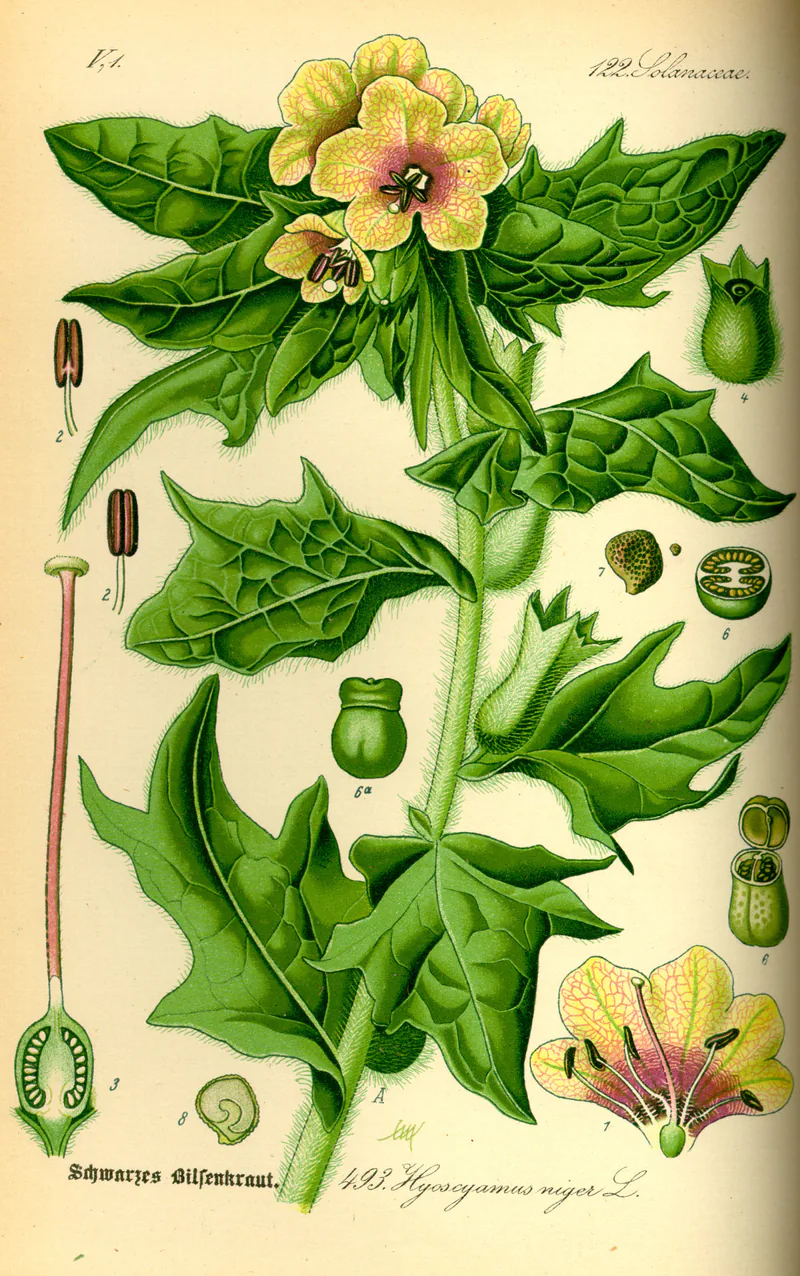
Henbane (Hyoscyamus niger) was known to the Greeks and Romans as a medicine and poison; medieval and early modern writers associated it with witches, and its German name, Bilsenkraut, has been linked with older brewing traditions, though the extent of its use in beer is debated. Belladonna or deadly nightshade (Atropa belladonna) takes its genus name from Atropos, the Fate who cuts the thread of life, and its species name, "beautiful lady," traditionally from Italian women's use of its juice to dilate their pupils. Mandrake (Mandragora), with its human-shaped root, has the richest folklore of all, told in the guide to mandrake and plant lore. Datura, or thornapple, is often added to the list, though the presence of the common species in Europe before the sixteenth century is uncertain.
All of these plants are highly toxic. Even handling or burning them can be dangerous, and their cultivation is restricted in some places; they should never be ingested or applied on the strength of folklore.
Aconite, Hemlock and the Poisons of Legend§
Aconite, also called monkshood or wolfsbane (Aconitum), is among the most poisonous plants in Europe. In Ovid's Metamorphoses, it springs from the foam of the hell-hound Cerberus and is the poison Medea prepares for Theseus; Hecate, goddess of witchcraft, was later linked with it. Hemlock (Conium maculatum) is famous as the poison given to Socrates in 399 BCE, and appears in the witches' cauldron in Shakespeare's Macbeth, together with "root of hemlock digged i' the dark."
The witches' brew in Macbeth (c. 1606) shows how literature fixed these associations: its ingredients include slips of yew, another poisonous plant of churchyards. Foxglove (Digitalis purpurea), with folk names such as "witches' gloves" and "fairy fingers," was used in folk medicine before William Withering's Account of the Foxglove (1785) introduced digitalis to medicine; it is also deadly in the wrong amount.
Protective Herbs: Vervain, Rue, Rowan and St John's Wort§
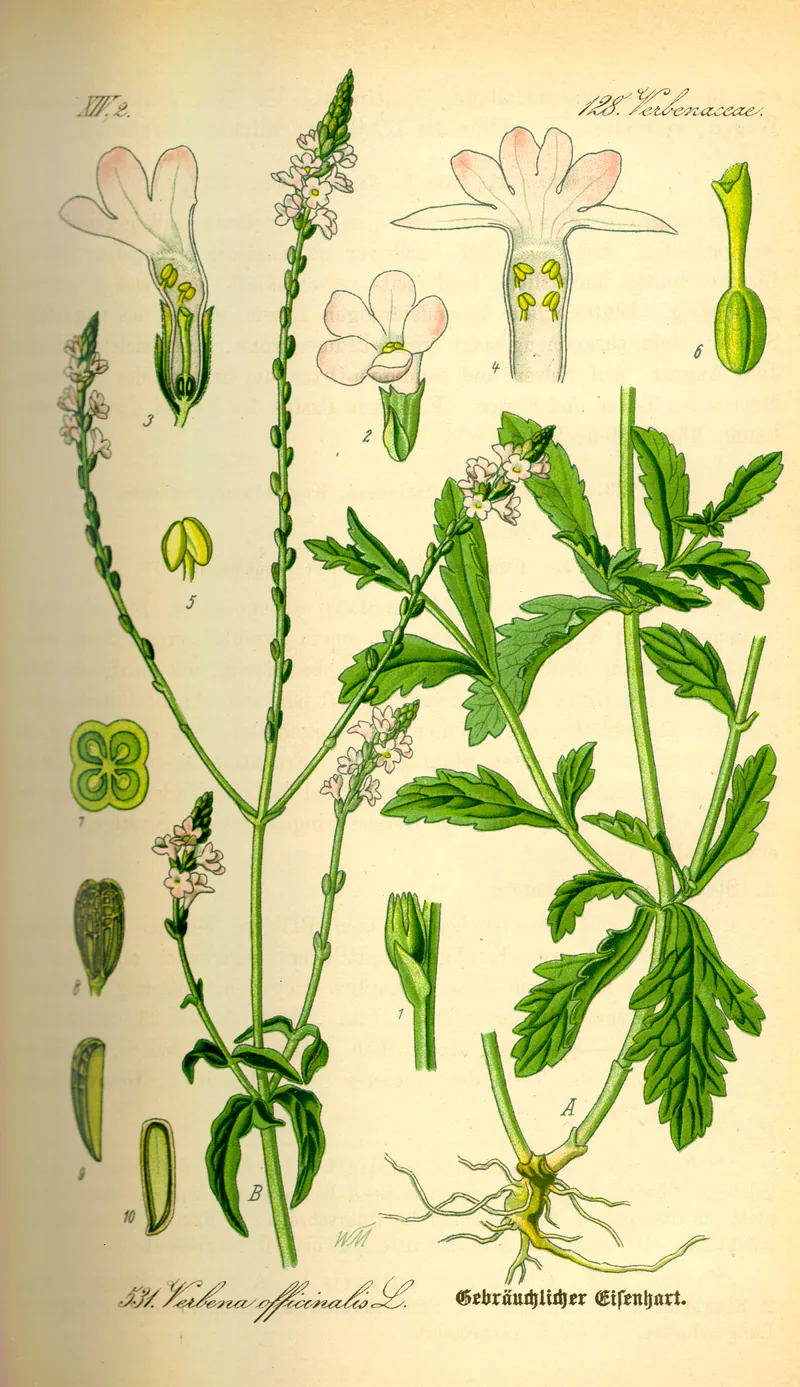
Much of the plant magic of ordinary people aimed at keeping witches away. Vervain (Verbena officinalis) was called herba sacra by the Romans and used in purification; Pliny reported that the Gauls used it in divination and that the Magi made extravagant claims for it. In later Christian folklore it was said to have staunched Christ's wounds on Calvary, and it was gathered with prayers for protection. Rue (Ruta graveolens), the "herb of grace," was valued against the evil eye; the Italian cimaruta amulet takes the form of a sprig of rue hung with symbols.
Rowan (mountain ash) was perhaps the most widespread protection in Britain and Scandinavia: sprigs were fixed over doors and byres, and a Scottish saying held that rowan and red thread put witches to flight. St John's wort (Hypericum perforatum), gathered on Midsummer Eve, was known as fuga daemonum, "devil's flight." Garlic, elder, bay and holly also feature in protective lore across Europe.
Mugwort, Yarrow and Plants of Dreams and Divination§
A third group of plants was used in divination, dreams and seasonal rites. Mugwort (Artemisia vulgaris), named for the goddess Artemis, was worn as a girdle on St John's Eve in parts of Europe and was believed to protect travellers; modern practitioners associate it with dreams. Yarrow (Achillea millefolium) was used in British love divination, and its dried stalks, as milfoil, are the traditional instruments for consulting the Chinese Yijing.
Midsummer was the great time for plant magic. Fern "seed," supposedly gathered at midnight on St John's Eve, was believed to confer invisibility, and many herbs were thought most potent when picked that night. These customs blur into the Wheel of the Year celebrated by modern Pagans.
The Witch's Garden in Modern Witchcraft§
When Gerald Gardner and Doreen Valiente shaped modern Wicca in the mid-twentieth century, herbs became part of the witch's craft: incense, ritual baths and charms drew on Culpeper and folklore. Traditional witchcraft writers later embraced the darker plants more explicitly; Daniel Schulke's Veneficium (2012) explores the "poison path" as a spiritual relationship with baneful plants, while stressing their danger. Public "poison gardens," such as the one at Alnwick Castle in England opened in 2005, now display these plants behind locked gates.
Most modern practitioners work with poisonous plants symbolically, by growing them, depicting them or using them in amulets, rather than consuming them. The historical record supports that caution: the folklore of the witch's garden is, among other things, a record of how dangerous these plants are.
Frequently asked questions§
What plants are associated with witches?§
Folklore links witches with poisonous plants such as henbane, belladonna, mandrake, aconite, hemlock and datura, and with herbs such as mugwort, vervain, rue and yarrow. Many protective herbs, including rowan and St John's wort, were used against witchcraft rather than by witches.
Is belladonna poisonous?§
Yes. All parts of Atropa belladonna contain alkaloids that can cause hallucinations, a dangerously fast heartbeat and death, and its berries are a known cause of accidental poisoning in children. It should never be eaten or used on the strength of folklore.
Why is aconite called wolfsbane?§
The name reflects its historical use as a poison for wolves and other animals, recorded in classical and medieval sources. It is one of the most toxic plants in Europe and can be dangerous even through handling.
What herbs protect against witchcraft in folklore?§
Across Europe, rowan, St John's wort, vervain, rue, garlic, elder and bay were widely used. They were hung over doors, worn as amulets or fixed in byres to protect people and animals.
Sources and further reading§
- Natural History — Pliny the Elder, 77
- Metamorphoses — Ovid, c. 8
- The English Physitian — Nicholas Culpeper, 1652
- A Modern Herbal — Maud Grieve, 1931
- The Englishman's Flora — Geoffrey Grigson, 1955
- Witchcraft Medicine: Healing Arts, Shamanic Practices, and Forbidden Plants — Claudia Müller-Ebeling, Christian Rätsch & Wolf-Dieter Storl, 1998
- Veneficium: Magic, Witchcraft and the Poison Path — Daniel A. Schulke, 2012
- The Witch: A History of Fear — Ronald Hutton, 2017