Liber XI · Herbal Magick · Chapter VI: Mandrake & Plant Lore
Vervain: Sacred Herb of Rome, Gaul, the Cross and the Grimoires
Vervain (Verbena officinalis) in history and lore: Roman sacred boughs, Pliny's Gauls and Magi, the herb of the cross, grimoires and charms against witches.

Vervain (Verbena officinalis) is a slender, unassuming plant of roadsides and waste ground that carries one of the longest magical reputations in European plant lore. Romans used the word verbena for the sacred greenery of their altars and embassies, Pliny the Elder reported that the Gauls used vervain for divination and the Magi for every kind of wish, medieval Christians called it the herb of the cross, and Renaissance magicians placed it under Venus and the Sun. In folklore it became a herb against witches, and in modern witchcraft one of the most cited herbs of protection.
Verbena officinalis: The Plant Behind the Name§
Common vervain is a perennial with stiff, square, branching stems, deeply cut lower leaves and long spikes of tiny pale lilac flowers. It grows across Europe, North Africa and western Asia, often near paths and settlements. It is bitter but not one of the dangerous plants of the witch's garden, and herbalists from Dioscorides to the twentieth century used it for fevers, wounds, headaches and nervous complaints.
The plant has many names. The Greek peristereon, "dove plant," was explained by the claim that doves liked to rest near it, and hiera botane, "holy herb," marks its religious standing. Dioscorides distinguished an upright kind and a reclining kind, a division that reappears in Renaissance tables linking upright vervain to Taurus and bending vervain to Gemini, discussed in the article on zodiac herbs. The German Eisenkraut, "iron herb," and similar names in other languages connect it with iron and the healing of wounds.
Verbenae: Sacred Boughs of Roman Religion§
In Latin, verbenae originally did not mean a single species. The word referred to the leafy branches and tufts of sacred plants, such as laurel, olive and myrtle, that were used to wreathe altars and to mark persons and acts as holy. In Roman religion the fetial priests, who declared war and concluded treaties, carried sagmina, tufts of herb taken from the Capitol, and Pliny tells us that one of them was called the verbenarius because he bore these sacred plants. Embassies sent to enemies carried them as a sign of inviolability.
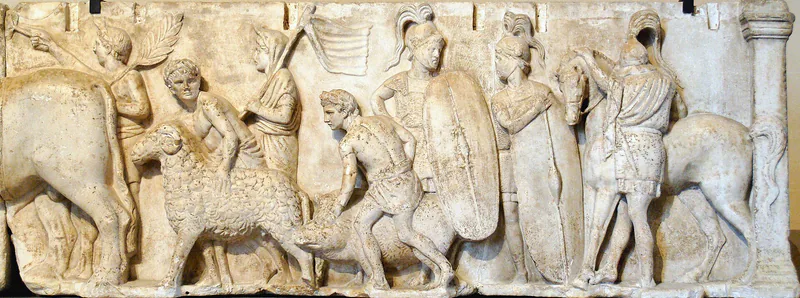
Roman poets used verbena in this broad sense of ritual greenery. In Virgil's eighth Eclogue, a woman performing a love spell calls for the altar to be wreathed and for "rich vervain and male frankincense" to be burned, a scene that later magicians knew well; Agrippa quotes it when discussing the plants of Venus. Over time, and especially in the medical and botanical writers, the name narrowed to the plant we now call vervain, which inherited the sacred associations of the older word.
Pliny, the Gauls and the Magi§
The most influential ancient account of vervain is a passage in Pliny the Elder's Natural History, completed in 77 CE. Pliny says no plant is more honoured among the Romans, and he reports what others said of it. The people of Gaul, he writes, used both kinds of vervain for casting lots and pronouncing prophecies. The Magi, by whom Pliny means the Persian or pseudo-Persian magicians whose lore he distrusted, made extravagant claims: that those rubbed with it obtained what they wished, that it cured fevers, made friendships and banished disease.
Pliny also records how the Magi said vervain should be gathered: at the rising of the Dog Star, at a moment when neither sun nor moon was visible, after an offering of honey to the earth in compensation, with a circle traced around the plant with iron, and with the root drawn up by the left hand and raised aloft. The leaves, stem and root were then dried apart in the shade. Pliny clearly found such rites absurd, but by recording them he preserved them for later readers.
It was from this passage that modern writers made vervain a "sacred herb of the Druids." Pliny himself does not mention Druids here; he speaks of the Gauls in general. The Druidic attribution grew in the eighteenth and nineteenth centuries, alongside the more securely sourced Druidic ritual of mistletoe, and it passed into the literature of modern Druidry.
Herb of the Cross: Vervain in Christian Folklore§
Christian Europe gave vervain a new story. A legend recorded in England and elsewhere held that vervain grew on the mount of Calvary and was used to staunch the wounds of Christ, which explained its holiness and its power over wounds and evil. Several versions of a gathering charm survive in which the plant is hallowed as having been first found on Calvary and then picked "in the name of" the Father, Son and Holy Spirit, often with the sign of the cross. Such charms are typical of late medieval and early modern folk religion, in which Christian prayer and older plant ritual were fully joined.
Vervain was hung in houses, sewn into clothing and worn around the neck as a protective amulet, especially for children. It was said to guard against the evil eye, fever and enchantment, a use that connects it with the wider history of protective magic. Clerical critics sometimes condemned the gathering charms as superstition, while others treated them as harmless piety.
Vervain in Grimoires and Renaissance Magic§
Learned magic took vervain seriously. The thirteenth-century Book of Secrets attributed to Albertus Magnus, one of the most widely printed books of popular magic, includes vervain among its sixteen marvellous herbs, giving it Greek and "Chaldean" names and attributing a range of wonderful properties to it. Agrippa's Three Books of Occult Philosophy (1533) lists vervain among the plants of the Sun, notes that it is used "in prophecying, and expiations, as also driving away evill spirits," and elsewhere assigns it to Venus following an older Hermetic list (Agrippa, Book I, chapters 19–24). Its place among planetary herbs therefore varies from author to author.
The Key of Solomon, in the form edited by S. L. MacGregor Mathers in 1889 (catalogue entry), includes vervain among the fragrant herbs bound together to make the sprinkler for holy water used to purify the magician, the place and the instruments. In this setting vervain functions exactly as it did in Roman ritual: as a plant of purification that makes things fit for sacred use.
Vervain Against Witches and in Modern Witchcraft§
In English folklore vervain was above all a defence against witchcraft. A rhyme recorded in the seventeenth century, in one version by the antiquary John Aubrey, pairs vervain with dill as herbs that hinder witches from their will, and similar sayings were current in other parts of Britain and Europe. Paradoxically, the same reputation for power led some writers to link vervain with witches themselves, and it appears in literary witches' charms and in nineteenth-century collections of plant lore.
Modern Wicca and other forms of contemporary witchcraft draw on both strands. Vervain is used in ritual baths, incense, consecration and protection work, and it is often called an herb of the Goddess or of Venus. Practitioners frequently cite Pliny and the "Druids," which shows how ancient sources and later romantic additions have merged into one tradition. As with all herbal magic, these are symbolic and devotional uses, and a herb is no substitute for medical care.
Frequently asked questions§
Why is vervain called a sacred herb?§
The Latin word verbena originally meant the sacred boughs used on Roman altars and by priests and ambassadors, and the Greeks called the plant hiera botane, "holy herb." Pliny reported elaborate rites for gathering it, and Christian legend said it grew on Calvary. Together these gave vervain a lasting reputation for holiness.
Did the Druids use vervain?§
Pliny says that the Gauls used vervain for casting lots and prophesying, but he does not mention the Druids in that passage. The idea that vervain was the special herb of the Druids was developed by later writers, especially in the eighteenth and nineteenth centuries.
What was vervain used for in magic?§
Ancient sources link it with divination, purification and wish-granting; grimoires used it in holy water and consecrations; and folk tradition used it as an amulet against witches, the evil eye and fever. Renaissance magicians placed it under Venus or the Sun.
Is vervain the same as lemon verbena?§
No. Common vervain is Verbena officinalis, the plant of European lore. Lemon verbena (Aloysia citrodora) is a South American shrub, related but in a different genus, introduced to Europe in the eighteenth century.
Sources and further reading§
- Natural History — Pliny the Elder, 77
- Eclogues — Virgil, c. 38 BCE
- De materia medica — Pedanius Dioscorides, c. 70
- The Book of Secrets of Albertus Magnus — Michael R. Best & Frank H. Brightman, 1973
- Three Books of Occult Philosophy — Heinrich Cornelius Agrippa, 1533
- The Key of Solomon the King — S. L. MacGregor Mathers, 1889
- Plant-Lore, Legends, and Lyrics — Richard Folkard, 1884
- A Modern Herbal — Maud Grieve, 1931