Liber XI · Herbal Magick · Chapter VI: Mandrake & Plant Lore
Mistletoe and the Druids: Pliny's Golden Sickle and After
Mistletoe and the druids: Pliny's golden sickle and white bulls, Baldr's death, Virgil's golden bough, Frazer, Christmas kissing and the Druid revival.

Mistletoe owes its fame in Western folklore to a single passage in Pliny the Elder's Natural History (77 CE), which describes Gaulish druids in white robes cutting mistletoe from a sacred oak with a golden sickle on the sixth day of the moon and sacrificing two white bulls beneath the tree. That brief account, together with the Norse myth of Baldr's death and Virgil's golden bough, made mistletoe the emblem of the druids, the subject of James Frazer's Golden Bough and, by way of eighteenth-century England, a Christmas custom.
Viscum album: The Plant Between Earth and Sky§
European mistletoe is a semi-parasitic shrub that roots in the branches of host trees, drawing water and minerals from them while making its own food through photosynthesis. It forms rounded evergreen clumps that stand out in winter when the host is bare, and its white, sticky berries ripen in the darkest months. Birds spread the seeds, so that mistletoe seems to appear in the treetops without ever touching the earth.
These features made it a natural object of wonder: green in winter, fruiting at the solstice, growing between sky and ground. Mistletoe is common on apple, poplar, lime and hawthorn but rare on oak, a rarity that Pliny himself noted and that gave oak mistletoe its special value. Its berries and leaves are poisonous if eaten, a point worth remembering when it hangs in homes at Christmas.
Pliny's Account: The Golden Sickle and the Sixth Day of the Moon§
In Book 16 of the Natural History, discussing trees and their parasites, Pliny turns to the druids of Gaul. They hold nothing more sacred, he says, than mistletoe and the tree on which it grows, provided that tree is a hard oak; they choose oak groves for their rites and perform no ceremony without oak leaves. Whatever grows on an oak they regard as sent from heaven, a sign that the tree has been chosen by the god.
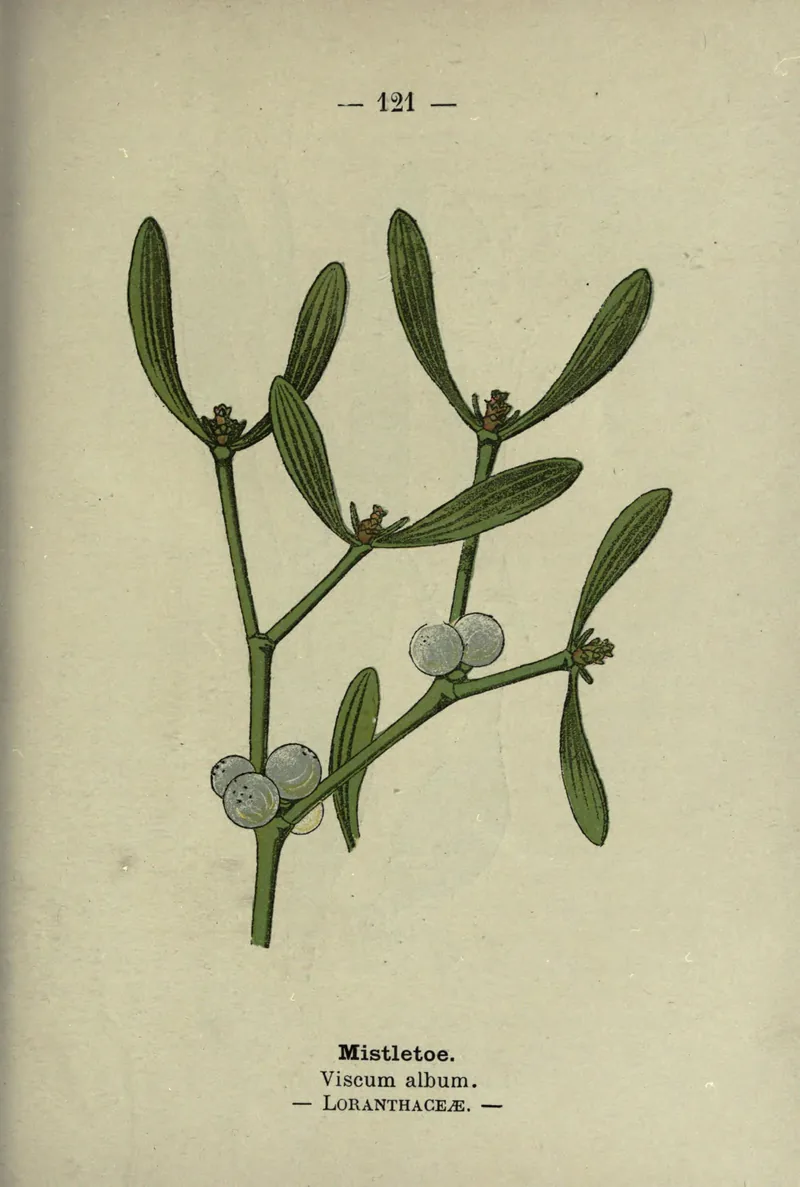
Oak mistletoe is rarely found, and when found it is gathered with great ceremony on the sixth day of the moon, which for the druids marks the beginning of months, years and their thirty-year cycles. They call it, in their own language, by a name meaning "all-healing." A sacrifice and feast are prepared beneath the tree, and two white bulls are brought whose horns are being bound for the first time. A priest in a white robe climbs the tree and cuts the mistletoe with a golden sickle, and it is caught in a white cloak. The victims are then sacrificed, with prayers that the god will make his gift propitious to those to whom he has given it. The druids believed, Pliny adds, that mistletoe taken in drink made barren animals fertile and was a remedy for all poisons, and he closes with a remark on how much religious awe peoples feel for trifling things.
Pliny also suggests that the druids took their name from the Greek drus, "oak." Modern linguists generally derive the word from a Celtic compound meaning something like "oak-knower" or "very wise," so the oak association may be genuine even though Pliny's Greek etymology is not.
Druids, Oaks and the Problem of Evidence§
Pliny's account is vivid but stands alone. Caesar, Strabo, Diodorus and Tacitus describe the druids without mentioning mistletoe, and archaeology has found nothing that confirms the ritual. There is no sign that Pliny witnessed druidic rites himself, which Roman emperors had moved to suppress by his day, and he may have relied on earlier written sources or hearsay. Historians such as Stuart Piggott and Ronald Hutton have therefore treated the passage with caution, while accepting that oak groves and plant lore probably did have a place in Gaulish religion, discussed in the article on Celtic religion. A sickle of solid gold would be too soft to cut wood, which has led some to suggest a gilded or symbolic blade.
One much-discussed find seemed to offer support. The body of Lindow Man, a man killed and placed in a bog in Cheshire around the first century CE and discovered in 1984, was reported to have a few grains of mistletoe pollen in his gut. Anne Ross and Don Robins argued in The Life and Death of a Druid Prince (1989) that he was a druidic sacrifice; most specialists consider the pollen evidence too slight to bear that interpretation.
Baldr and the Mistletoe Dart§
In northern Europe mistletoe appears in a very different story. In the Gylfaginning section of Snorri Sturluson's Prose Edda (c. 1220), the god Baldr dreams of his own death, and his mother Frigg makes every thing in the world swear not to harm him, except a young shoot of mistletoe growing west of Valhalla, which seemed too small to matter. The gods amuse themselves by throwing weapons at Baldr, who cannot be hurt. Loki finds the mistletoe and puts it in the hand of Baldr's blind brother Höd, who throws it and kills him.

Scholars have long noted the oddity of a dart made from a soft, non-woody plant, and of the episode's absence from Saxo Grammaticus's Latin version of the story, in which Baldr dies by a sword. Iceland has no native mistletoe, and some have suggested that the mistilteinn of the poems was originally the name of a weapon. The myth is placed in its setting in the article on Norse and Germanic religion.
The Golden Bough: Virgil, Frazer and Myth-Making§
In Book 6 of Virgil's Aeneid (19 BCE), the hero Aeneas must pluck a golden bough from a dark tree before he can enter the underworld. Virgil compares the bough to mistletoe, which in winter's cold puts out fresh leaves on a tree that did not bear it. From this simile the Scottish anthropologist James George Frazer built a vast theory. In The Golden Bough (1890, expanded to twelve volumes by 1915), he linked the priest-king of Diana's grove at Nemi, Baldr and Pliny's druids, arguing that mistletoe was believed to contain the life of the oak and of an oak god, and that ritual killings re-enacted that god's death.
Frazer's comparative method and his scheme of magic, religion and science were enormously influential, shaping writers from T. S. Eliot to Robert Graves and the founders of modern witchcraft, but anthropologists have since abandoned most of his conclusions. His mistletoe theory is now read as an episode in the history of scholarship rather than a key to ancient religion.
Christmas Kissing and the Druid Revival§
Mistletoe's place in Christmas is more recent than often supposed. The custom of kissing beneath a hanging bunch is first documented in eighteenth-century England, and Washington Irving described it in his sketches of an English Christmas (1820), noting that a berry was plucked for each kiss until none remained. Victorian writers attributed the custom to the druids, but no ancient or medieval evidence connects them.
The druid association was itself a product of the antiquarian revival. In the eighteenth century the antiquarian William Stukeley, who styled himself an archdruid, saw Pliny's mistletoe as a prefiguring of Christ, and the Druid societies founded from 1781 onward adopted it as an emblem. Modern Druid orders, described in the guide to Druidry, honour mistletoe at the winter solstice, one of the festivals of the Wheel of the Year, sometimes cutting it with a sickle in deliberate homage to Pliny. In a different modern setting, Rudolf Steiner promoted mistletoe extracts in anthroposophical medicine from the 1920s; their use in cancer care remains controversial, and clinical evidence for benefit is limited. Like the mandrake, mistletoe shows how a few ancient lines can grow into a tradition of their own.
Frequently asked questions§
Why did the druids hold mistletoe sacred?§
According to Pliny, the druids believed that anything growing on an oak was sent from heaven and that oak mistletoe, which is rare, marked a tree chosen by the god. They called it "all-healing" and gathered it with sacrifice. Pliny is the only ancient source for this.
What did the druids cut mistletoe with?§
Pliny says a priest in a white robe cut it with a golden sickle and caught it in a white cloak. Because pure gold is too soft for cutting, some historians suspect a gilded or ceremonial blade, or a detail embellished in transmission.
Where does kissing under the mistletoe come from?§
The custom is first recorded in eighteenth-century England and was popularised in the nineteenth century, partly through Washington Irving's descriptions. Its supposed druidic origin is a Victorian assumption without ancient evidence.
Is mistletoe poisonous?§
Yes. Its berries and leaves contain toxic compounds and can cause illness if eaten, especially by children and pets. It should be kept out of reach when used as a decoration.
Sources and further reading§
- The Aeneid — Virgil, 19 BCE
- Natural History — Pliny the Elder, 77
- The Prose Edda — Snorri Sturluson, c. 1220
- The Golden Bough — James George Frazer, 1890
- The Druids — Stuart Piggott, 1968
- The Life and Death of a Druid Prince — Anne Ross & Don Robins, 1989
- The World of the Druids — Miranda J. Green, 1997
- Blood and Mistletoe: The History of the Druids in Britain — Ronald Hutton, 2009