Liber XI · Herbal Magick · Chapter VII: Planetary & Astrological Herbs
Zodiac Herbs: Plants of the Twelve Signs from Thessalos to Today
Zodiac herbs, the plants assigned to the twelve signs: the zodiac man, Thessalos of Tralles, Agrippa's lists, Culpeper and modern astrological herb tables.

Zodiac herbs are plants assigned to the twelve signs of the zodiac, either because a sign was thought to govern them directly or because they were believed to heal the part of the body that the sign rules. The idea comes from Hellenistic astrology and Hermetic plant lore of the first centuries CE, reached the Renaissance through texts such as Agrippa's Three Books of Occult Philosophy, and survives in modern astrological herb lists. Unlike the better-known planetary herbs, the zodiacal lists have always varied widely from one author to another.
What Are Zodiac Herbs?§
Astrological botany worked with two kinds of heavenly ruler. The seven planets, from Saturn to the Moon, were the main powers, and the classic tables of planetary herbs assign plants to them by colour, taste, temperament and form. The twelve signs of the zodiac, described in the guide to the zodiac and the planets, formed a second framework. A plant could belong to a sign in three main ways: because ancient Hermetic texts simply declared it so; because it was gathered or used when the Sun or Moon stood in that sign; or because it treated the part of the body over which the sign presided.
These approaches did not always agree, and authors combined them freely. The result is a tradition in which certain associations, such as upright and bending vervain for Taurus and Gemini, recur across centuries, while others shift from list to list.
Melothesia: The Zodiac Man and the Body§
The foundation of zodiacal medicine was melothesia, the assignment of parts of the body to the signs. In its standard form Aries governs the head, Taurus the neck and throat, Gemini the shoulders and arms, Cancer the chest, Leo the heart and back, Virgo the belly, Libra the kidneys and lower back, Scorpio the genitals, Sagittarius the thighs, Capricorn the knees, Aquarius the shins and Pisces the feet. The scheme appears in the Roman poet Manilius's Astronomica in the early first century CE and in later astrological writers, and the Tetrabiblos of Ptolemy reflects the wider theory of celestial influence on the body.
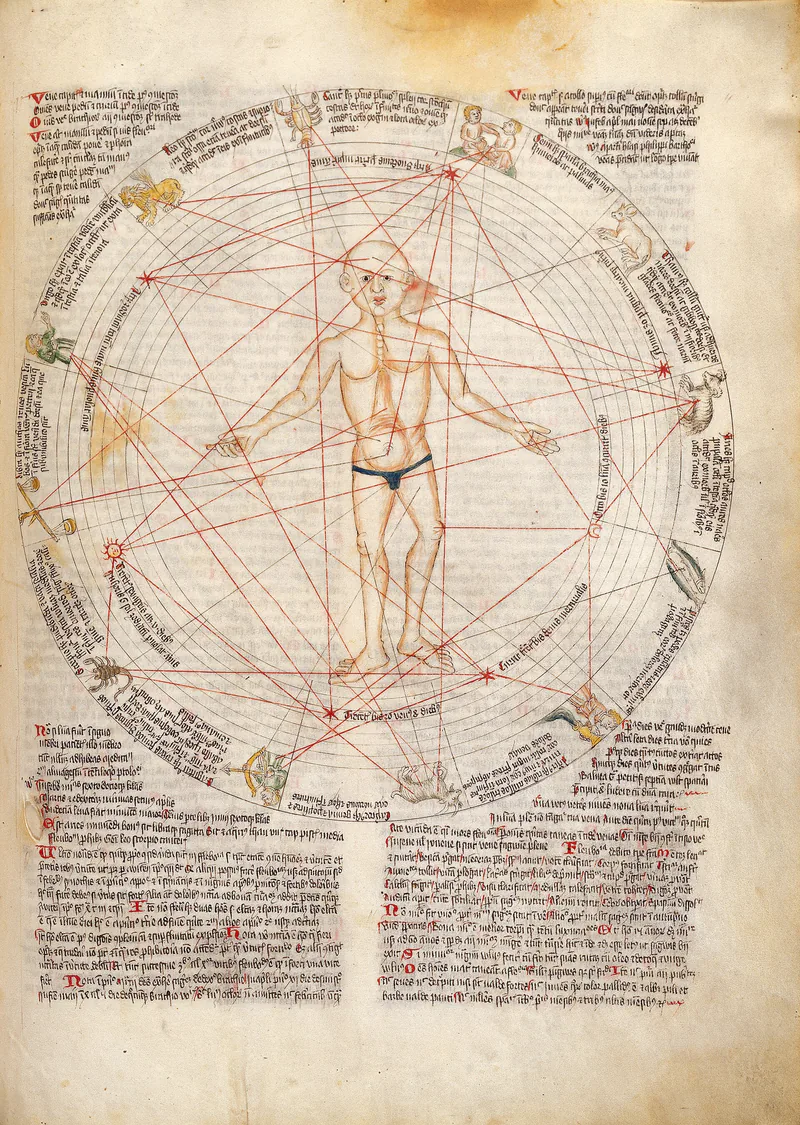
In medieval Europe the scheme became the "zodiac man" (homo signorum), a naked figure with the signs placed on the parts they rule. It was painted in calendars, books of hours, almanacs and physicians' folding manuals; the version in the Très Riches Heures of the Duke of Berry, from the early fifteenth century, is the most famous. Its chief practical purpose was timing: physicians were warned not to bleed or operate on a part of the body when the Moon was passing through the sign that governed it. Herbs entered this system as remedies for particular parts, so that a plant good for the head could be thought of as belonging to Aries, though this logic was applied unevenly.
Thessalos of Tralles and the Plants of the Twelve Signs§
The oldest systematic list of zodiacal plants comes from a Greek treatise On the Virtues of Plants attributed to Thessalos, a physician of Tralles in Asia Minor, usually dated to the first century CE. It survives in Greek and Latin versions and opens with a famous autobiographical letter addressed to an emperor. The author says he studied medicine in Alexandria and found a book of Nechepso, a legendary Egyptian king-astrologer, promising wondrous cures by plants and the zodiac. When its remedies failed, he travelled to Diospolis (Thebes) in Upper Egypt, where an old priest arranged for him a private vision of the god Asclepius, who revealed the true teaching.
The revelation that follows assigns one plant to each zodiac sign and one to each of the seven planets, with instructions on when to gather them, chiefly while the Sun is in the appropriate sign, and the conditions they cure. Whether the author was the historical physician Thessalus of Tralles known from Roman medical writers is debated, and the letter is a literary frame as much as a memoir. Historians of Hermetism, notably Garth Fowden, have used it as a vivid example of how Greek-speaking seekers sought authoritative wisdom from Egyptian priests. The text illustrates a central belief of the technical Hermetica: that herbs work through a sympathy with the stars that only revelation can disclose.
Decans, Hermes and the Lists Agrippa Inherited§
Alongside the twelve signs, Hermetic writers divided the zodiac into thirty-six decans of ten degrees each, inherited from Egyptian star lore. A Greek work known as the Sacred Book of Hermes to Asclepius assigns to each decan a stone, a plant and an image to be engraved for a protective ring. These finer divisions passed into Arabic and Latin magic, though they never achieved the fame of the planetary tables.

The Renaissance encountered zodiac herbs chiefly through Heinrich Cornelius Agrippa. In the first book of his Three Books of Occult Philosophy (1533), he says that "Apuleius" distributes particular herbs to the signs: among them upright vervain to Taurus, bending vervain to Gemini, comfrey to Cancer, sowbread (cyclamen) to Leo, calamint to Virgo, mugwort to Libra, scorpion-grass to Scorpio, pimpernel to Sagittarius, dock to Capricorn and dragonwort to Aquarius (Agrippa, Book I, chapters 25–34). In the same chapter he gives two rival lists of planetary plants, one attributed to Apuleius and one to "Hermes, whom Albertus follows."
In his second book Agrippa prints a great table of the number twelve, linking the signs to angels, tribes of Israel, apostles, months, stones, parts of the body and twelve plants (Agrippa, Book II, chapters 12–15). Here the plants for Leo, Libra, Scorpio and Pisces differ from the list in his first book: scorpion-grass is now under Libra and mugwort under Scorpio, Leo receives "Lady's seal," and Pisces aristolochy instead of hartwort. The discrepancy is revealing. Even in the most authoritative Renaissance source, zodiacal plant lore was a compilation of inherited lists rather than a single coherent system.
Culpeper and Medical Astrology in Practice§
In seventeenth-century England, astrological medicine reached a wide public through Nicholas Culpeper, whose English Physitian (1652) assigned each plant to a ruling planet and occasionally to a sign as well. Culpeper's method combined the planets with the zodiac man. A physician would cast a chart for the moment the patient fell ill or the urine was brought, identify the sign and planet afflicting the relevant part of the body, and then choose a herb either by sympathy, a plant of the same ruler to strengthen the part, or by antipathy, a plant of the opposing planet to counter the disease.
Zodiacal timing also governed the gathering and preparation of herbs. Almanacs, which sold in huge numbers in early modern England, printed the Moon's daily passage through the signs, and readers used them to decide when to sow, harvest, purge, bleed and pick medicinal plants. Astrologer-physicians such as Culpeper and his contemporary William Lilly treated these practices as a learned science, while critics in the Royal College of Physicians and, later, the new experimental philosophers dismissed them. By the eighteenth century astrological medicine had largely left learned practice, surviving in almanacs and folk custom.
Modern Zodiac Herb Lists, Birth Flowers and Tree Signs§
Twentieth-century popular astrology revived zodiac herbs in a new form. Most modern lists that recommend "herbs for your sign" derive them from the sign's planetary ruler: a Mars-ruled sign such as Aries receives the hot, sharp plants of Mars, a Venus-ruled sign such as Taurus or Libra the fragrant plants of Venus. Some authors add herbs for the body parts of the zodiac man, and others mix in modern associations of colour and personality. These lists are useful to understand contemporary practice, but they are modern compilations and seldom match Thessalos or Agrippa. Readers who wish to explore the signs themselves can consult the Western horoscope pages.
Two other popular traditions are often confused with zodiac herbs. Birth flowers, one for each calendar month, grew from the Victorian language of flowers and twentieth-century custom and have no astrological basis. The so-called Celtic tree calendar, presented on the site's Celtic tree horoscope pages, is a modern construction that grew largely from Robert Graves's The White Goddess (1948) and his interpretation of the Irish tree alphabet; it is not an ancient Celtic zodiac. Distinguishing these layers, ancient, Renaissance and modern, is the first step to reading any table of plant correspondences, a theme shared with the history of the doctrine of signatures.
Frequently asked questions§
What are zodiac herbs?§
Zodiac herbs are plants associated with the twelve signs of the zodiac. Ancient Hermetic texts assigned a plant to each sign, medieval medicine linked signs to parts of the body and the herbs that treated them, and modern astrology often derives sign herbs from each sign's ruling planet.
What is the zodiac man?§
The zodiac man, or homo signorum, is a medieval diagram showing which sign governs each part of the body, from Aries at the head to Pisces at the feet. It was used mainly to time bloodletting and medical treatment according to the Moon's position in the signs.
Who first assigned plants to the zodiac signs?§
The earliest surviving systematic list is in the Greek treatise On the Virtues of Plants attributed to Thessalos of Tralles, usually dated to the first century CE. It claims to record a revelation from the god Asclepius received in Egyptian Thebes.
Are modern herb lists for each zodiac sign ancient?§
Mostly not. Modern lists are usually built from the planetary ruler of each sign and from twentieth-century associations. A few plants, such as vervain for Taurus and Gemini, do reflect older Hermetic lists transmitted through Agrippa.
Sources and further reading§
- Astronomica — Manilius, c. 14
- Tetrabiblos — Claudius Ptolemy, c. 150
- Three Books of Occult Philosophy — Heinrich Cornelius Agrippa, 1533
- The English Physitian — Nicholas Culpeper, 1652
- Thessalos von Tralles: Griechisch und lateinisch — Hans-Veit Friedrich, 1968
- The Egyptian Hermes: A Historical Approach to the Late Pagan Mind — Garth Fowden, 1986
- Astro-Medicine: Astrology and Medicine, East and West — Anna Akasoy, Charles Burnett & Ronit Yoeli-Tlalim, 2008
- The White Goddess — Robert Graves, 1948