Liber XI · Herbal Magick · Chapter VII: Planetary & Astrological Herbs
Culpeper's Complete Herbal: Astrology, Plants and Politics
Culpeper's Complete Herbal explained: Nicholas Culpeper's life, The English Physitian of 1652, its planetary rulers, and its long afterlife in herbalism.

Culpeper's Complete Herbal is the popular name of The English Physitian, first published in London in 1652 by the apothecary and astrologer Nicholas Culpeper (1616–1654). Written in plain English for people who could not afford physicians, it described several hundred native plants and assigned each to a ruling planet, explaining its "government and virtues"; it became one of the most reprinted books in the English language and the main source of the planetary herb correspondences still used in Western magic.
Nicholas Culpeper: Apothecary, Astrologer and Radical§
Culpeper was born in October 1616 at Ockley in Surrey, shortly after the death of his father, a clergyman, and grew up in Sussex in the household of his grandfather, a Puritan minister. He studied at Cambridge without taking a degree and was then apprenticed to a London apothecary. According to his early biographers, his plans to elope with a young woman ended when she died on the way to meet him, a story that may have been embellished.
In about 1640 he set up his own practice in Spitalfields, just outside the jurisdiction of the City of London, where he treated the poor of the district, often without charge, and combined medicine with astrology. When civil war broke out he served on the Parliamentary side and was wounded in the chest, probably at the first battle of Newbury in 1643, an injury that may have weakened his health. He belonged to the lively world of London astrologers that included William Lilly, and his religious and political views were radical: he distrusted monopolies of learning held by clergy, lawyers and physicians alike. He died of tuberculosis in January 1654, aged thirty-seven.
The London Dispensatory and the War with the College of Physicians§
The College of Physicians of London regulated medicine in the capital and in 1618 had issued the Pharmacopoeia Londinensis, the official list of remedies that apothecaries were required to prepare. It was written in Latin. In 1649 Culpeper published an unauthorised English translation, A Physicall Directory, adding his own blunt commentary on the remedies and on the physicians who prescribed them.

For Culpeper this was an act of public service and of Protestant principle: just as the Bible should be available in English, so should the knowledge on which people's lives depended. For the College it was an attack on its authority and income, and royalist pamphleteers mocked Culpeper as a drunken, atheistical quack. The quarrel made him famous. His publisher Peter Cole kept his works in print and, after his death, continued to issue books under his name, some of them by other hands.
The English Physitian of 1652 and the Complete Herbal§
The English Physitian: or an Astrologo-physical Discourse of the Vulgar Herbs of this Nation appeared in 1652. Culpeper's aim was to show that English people could treat themselves with plants growing in their own fields and hedges, rather than paying for exotic imported drugs. An enlarged edition followed in 1653, and later editions, often titled The Complete Herbal, added his translation of the dispensatory and other material.
Each plant entry follows a regular pattern: a description of the plant, the place where it grows, the time of its flowering, and its "government and virtues," which names its ruling planet (and sometimes sign) and lists its medical uses. Culpeper often wrote with sharp humour and open contempt for rival authorities; his entry on wormwood, a herb of Mars discussed in the article on wormwood and absinthe, is among the longest and most combative in the book. He drew heavily on earlier herbals, especially those of John Gerard (1597) and John Parkinson (1640), but replaced their learned apparatus with direct, practical English. The broader development of such books is told in the history of herbal magic.
How the Herbal Works: Planets, Sympathy and Antipathy§
Culpeper's medical framework was the Galenic theory of four humours, linked to the four elements of Empedocles and their qualities of hot, cold, moist and dry. To this he joined astrology. Each planet ruled certain parts of the body, certain diseases and certain plants, and the planetary rulers of the herbs determined how they acted.
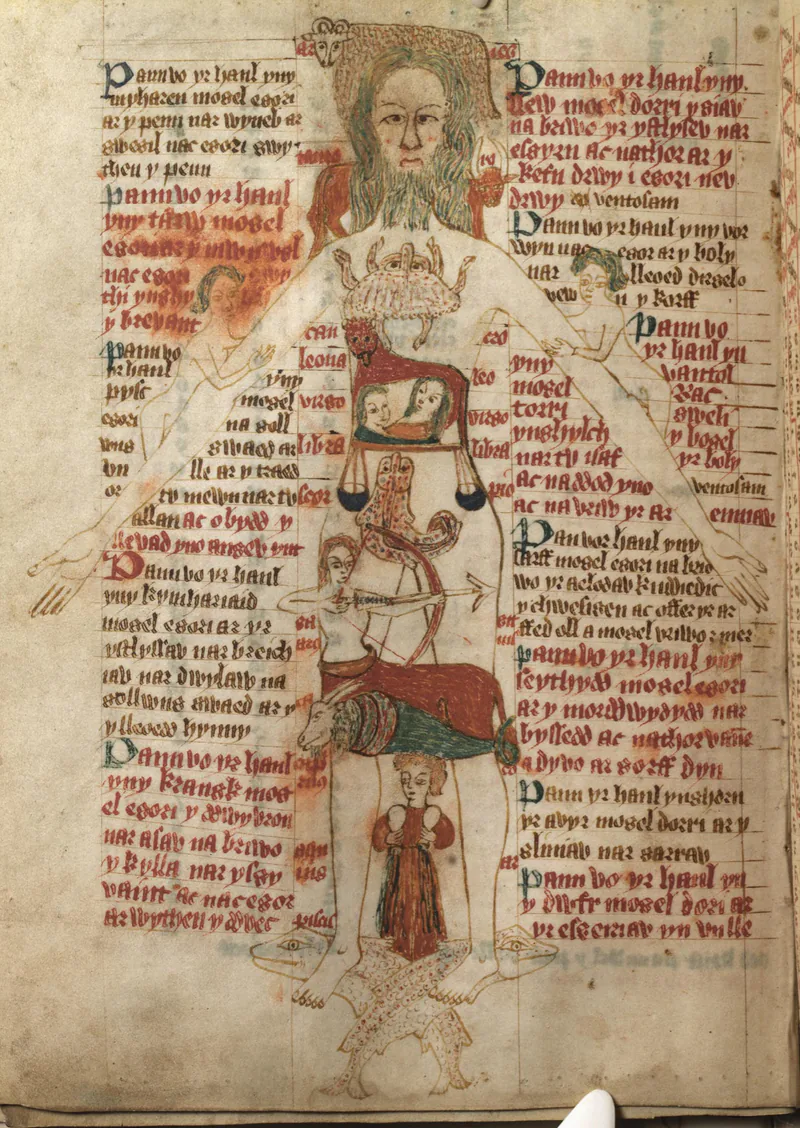
Culpeper explains two ways in which a herb could heal. By sympathy, a herb of the same planet as the afflicted part strengthens it: a herb of the Sun comforts the heart, which the Sun rules. By antipathy, a herb of an opposing planet counters a disease caused by a hostile planet: an illness caused by Saturn might be treated with a herb of the Sun or Jupiter. So Culpeper places rosemary and St John's wort under the Sun, sage and borage under Jupiter, wormwood and nettle under Mars, vervain and yarrow under Venus, and hemlock and henbane under Saturn. The fuller list, and the older Hellenistic and Arabic systems behind it, are discussed in the guide to planetary and astrological herbs.
Culpeper did not invent the idea of planetary plants, which appears in Agrippa and earlier sources, but he applied it consistently to hundreds of ordinary English plants and gave it to a mass readership. His system is a theory of correspondences in the sense explored in the guide to correspondences.
Astrological Diagnosis: Decumbiture and the Judgement of Diseases§
The herbal was only part of Culpeper's astrological medicine. In Semeiotica Uranica, or An Astrological Judgement of Diseases (1651), he explained how to cast a chart for the moment a patient fell ill and took to bed, the decumbiture. From the positions of the Moon and planets in this chart the practitioner judged the nature of the disease, the critical days on which it would turn for better or worse, and the planets to be strengthened or opposed with herbs.
This method was not unique to Culpeper; it continued medieval and Renaissance traditions of medical astrology, described in astrology. What distinguished him was the effort to make the whole process accessible to readers who knew no Latin. Historians such as Patrick Curry have placed Culpeper within the broad culture of seventeenth-century English astrology, which flourished during the Civil War and declined among the educated after 1660.
The Herbal's Afterlife: From Colonial America to Modern Herbalism§
The English Physitian outlived its author by centuries. It was reprinted many times in the seventeenth and eighteenth centuries, and an edition printed in Boston in 1708 made it one of the earliest medical books published in British North America. Nineteenth-century publishers issued cheap illustrated editions, often with added hand-coloured plates, and the book became a household reference in Britain and the United States.
In the twentieth century the herbalist Hilda Leyel founded the Culpeper shops in London in 1927, and Culpeper's name became a brand for herbal products. His planetary attributions passed into modern astrology, into books on magical herbs and into contemporary witchcraft, where his "government" of a plant is often taken as its magical correspondence. Scholars such as Graeme Tobyn have studied his medicine on its own terms, and the biographies by Olav Thulesius and Benjamin Woolley have revived interest in his life.
Readers should remember that The English Physitian is a historical text. Some of its plants, including several under Saturn, are poisonous, and its remedies reflect seventeenth-century medical theory, not modern knowledge; it is no substitute for qualified medical advice.
Frequently asked questions§
What is Culpeper's Complete Herbal?§
It is the popular title of Nicholas Culpeper's The English Physitian (1652), an English herbal that describes native plants, their medical uses and the planets that rule them. It has been reprinted continuously, often with additions.
Why did Culpeper assign planets to herbs?§
He followed an older astrological medicine in which planets ruled parts of the body, diseases and plants. Herbs could heal by sympathy, strengthening the part ruled by the same planet, or by antipathy, opposing a disease caused by a hostile planet.
Why was Culpeper unpopular with physicians?§
In 1649 he translated the College of Physicians' Latin pharmacopoeia into English without permission and criticised the physicians' fees and learning. The College saw this as an attack on its authority, and royalist writers ridiculed him.
Is Culpeper's herbal safe to use today?§
It should be read as history. Some plants it lists are toxic, and its medical ideas predate modern science. Anyone considering herbal treatment should consult a qualified practitioner.
Sources and further reading§
- The Herball or Generall Historie of Plantes — John Gerard, 1597
- Theatrum Botanicum — John Parkinson, 1640
- A Physicall Directory — Nicholas Culpeper, 1649
- Semeiotica Uranica, or An Astrological Judgement of Diseases — Nicholas Culpeper, 1651
- The English Physitian — Nicholas Culpeper, 1652
- Prophecy and Power: Astrology in Early Modern England — Patrick Curry, 1989
- Nicholas Culpeper: English Physician and Astrologer — Olav Thulesius, 1992
- Culpeper's Medicine: A Practice of Western Holistic Medicine — Graeme Tobyn, 1997
- The Herbalist: Nicholas Culpeper and the Fight for Medicine — Benjamin Woolley, 2004