Liber XII · Hermeticism · Chapter III: Correspondences
Correspondences in Esotericism: Sympathy, Signatures and Tables
The doctrine of correspondences explained: cosmic sympathy, macrocosm and microcosm, chains of being, signatures, Agrippa's scales and Crowley's 777.

In esotericism, correspondences are the hidden links believed to connect different levels of reality, so that a planet, a metal, a plant, a colour, a part of the body and a divine name can all "correspond" to one another and act upon one another. The idea draws on ancient theories of cosmic sympathy and of the human being as a small world (microcosm) reflecting the great world (macrocosm), and it became the organising principle of Renaissance magic and of modern ritual systems.
Cosmic sympathy in the ancient world§
The roots of the doctrine of correspondences lie in Greek philosophy. The Stoics taught that the cosmos is a single living organism pervaded by a fiery breath (pneuma), so that all its parts are in sympathy (sympatheia): what affects one part affects others, as the moon affects the tides. Plato's Timaeus described the cosmos as a living being with a world soul, and later Platonists developed this into a vision of a universe whose levels mirror one another.
The Neoplatonist Plotinus (third century) explained magic itself through sympathy: a magician does not command the gods but exploits the natural attunement of the cosmos, as a plucked string sets another vibrating. Ancient medicine, astrology and magic shared the notion of sympathy and antipathy, natural attractions and repulsions between things, such as the lodestone's attraction of iron. These ideas underlie the theory of astral magic and the theurgy described in Neoplatonism and theurgy.
Macrocosm and microcosm§
A second root is the analogy between the universe (macrocosm, "great world") and the human being (microcosm, "small world"). Already present in Greek thought, it became widespread in late antiquity and the Middle Ages. Medical astrology assigned the signs of the zodiac to parts of the body from head (Aries) to feet (Pisces), producing the "zodiac man" familiar from medieval almanacs. The four humours of the body corresponded to the four elements and the four seasons.
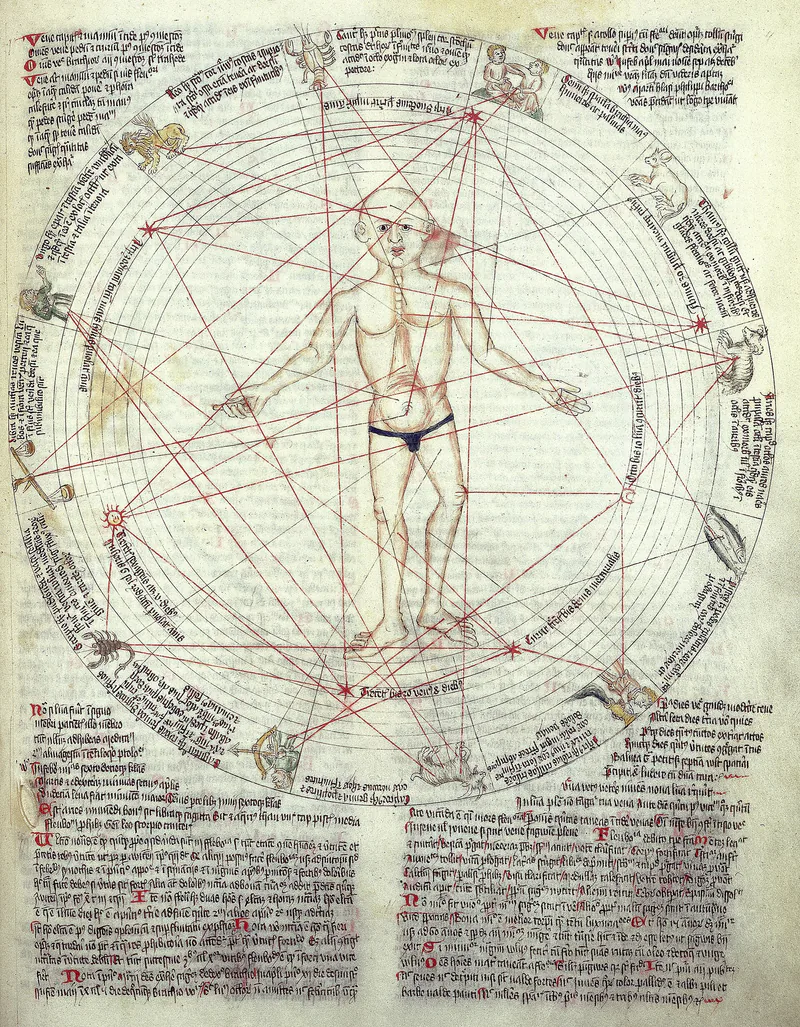
The short Hermetic text known as the Emerald Tablet gave this idea its most famous formulation, usually paraphrased as "as above, so below". In the Renaissance the analogy took on a new dignity: the human being, made in God's image and containing all levels of creation, could act as a link between heaven and earth. Paracelsus and the English physician Robert Fludd built entire philosophies on the correspondence of the greater and lesser worlds.
Chains of being: Proclus and the series of the gods§
The later Neoplatonists developed a more precise theory of correspondences. The fifth-century philosopher Proclus described "chains" or "series" (seirai) descending from each god through daemons, souls, animals, plants and stones. A short treatise attributed to him, on the hieratic art, gives the example of the heliotrope, the sunflower that turns toward the sun, as a plant belonging to the solar chain; the lion and the cockerel belong to the same series. By assembling objects of a single chain, the theurgist could attune the soul to the corresponding god.
This model, in which everything in nature belongs to a divine series, was transmitted to the Renaissance through Ficino's translations and became the backbone of learned magic.
The doctrine of signatures§
A related idea held that God or nature had marked things with visible signatures revealing their hidden virtues. A plant shaped like an organ might heal that organ; a yellow flower might treat jaundice. Paracelsus gave the doctrine wide currency in the sixteenth century, and Giambattista della Porta's Phytognomonica (1588) catalogued resemblances between plants and parts of the body. Jacob Boehme's De signatura rerum ("The Signature of All Things", 1622) transformed the idea into a mystical theology in which everything outwardly expresses its inner spiritual nature.

The French philosopher Michel Foucault, in The Order of Things (1966), argued that "resemblance" was the dominant form of knowledge in the sixteenth century and that its collapse marked the birth of modern science; historians have debated this broad thesis, but it captures how pervasive correspondence thinking once was.
Agrippa's scales and Renaissance tables§
The most systematic Renaissance treatment of correspondences is Cornelius Agrippa's Three Books of Occult Philosophy, published in full in 1533. Agrippa divided the cosmos into the elemental, celestial and intellectual worlds and set out, in his second book, "scales" of the numbers one to twelve. Under the number seven, for example, he listed the seven planets, the seven metals, the seven archangels, the seven days and other septenaries; under twelve, the signs of the zodiac with their associated tribes, apostles, months and stones. He also tabulated the plants, animals and stones belonging to each planet.
These scales gave magicians a practical reference: to work with Venus, one would choose copper, the colour green, the dove, the rose and Friday. The structure combined Neoplatonic sympathy, astrology and Christian Kabbalah, with Hebrew divine names attached to each level.
Swedenborg, Baudelaire and a different sense of correspondence§
In the eighteenth century the Swedish scientist and visionary Emanuel Swedenborg developed a distinct "science of correspondences", according to which every natural thing corresponds to a spiritual reality and the literal sense of Scripture corresponds to an inner spiritual sense. His idea concerned meaning rather than magical influence, but it fed into Romanticism and nineteenth-century literature. Charles Baudelaire's sonnet "Correspondances", in Les Fleurs du mal (1857), evoked a nature in which perfumes, colours and sounds answer one another, and inspired the Symbolist movement.
Modern correspondence tables: the Golden Dawn and 777§
Nineteenth-century occultism made correspondences the grammar of ritual. Eliphas Lévi linked the twenty-two Hebrew letters to the twenty-two trumps of the tarot. The Hermetic Order of the Golden Dawn built a vast system relating the ten sefirot and twenty-two paths of the Kabbalistic Tree of Life to planets, signs, elements, tarot cards, colours, gods of many pantheons, perfumes and gems.
In 1909 Aleister Crowley published much of this material in 777, a book of tables in which each column gives a set of correspondences for the thirty-two "paths" of the Tree. Many modern magical handbooks reproduce or adapt such tables. It is important to remember that much of this material is a nineteenth- and twentieth-century synthesis: the assignment of Egyptian or Hindu gods, particular incenses or tarot cards to Kabbalistic paths reflects the Golden Dawn's own system, not ancient tradition.
Correspondences in the study of esotericism§
The historian Antoine Faivre placed correspondences first among the four intrinsic characteristics by which he defined Western esotericism as a "form of thought" (1992), alongside living nature, imagination and mediations, and the experience of transmutation. He distinguished correspondences within nature from those between nature and revealed texts. Other scholars, notably Wouter Hanegraaff, prefer to speak of "causal" versus "correspondential" thinking, while noting that correspondence thinking was once part of mainstream science and religion before it was marginalised.
Frequently asked questions§
What are magical correspondences?§
They are associations linking things that are believed to share a common nature or influence, such as a planet with a metal, colour, plant, day of the week and divine name. Practitioners use them to choose materials and timing so that every element of a ritual works toward the same end.
Where does "as above, so below" come from?§
It is a paraphrase of the opening of the Emerald Tablet, a short alchemical text attributed to Hermes Trismegistus and first attested in Arabic. It expresses the correspondence between the heavens and the earth, and between the universe and the human being.
Are correspondence tables ancient?§
Some elements are ancient, such as the links between the planets, the metals and the days of the week. Many modern tables, however, especially those combining Kabbalah, tarot, Egyptian and Hindu gods and specific incenses, were assembled in the nineteenth and twentieth centuries by groups such as the Golden Dawn.
Sources and further reading§
- Three Books of Occult Philosophy — Heinrich Cornelius Agrippa, 1533
- 777 — Aleister Crowley, 1909
- Access to Western Esotericism — Antoine Faivre, 1994
- The Order of Things — Michel Foucault, 1966
- The Signature of All Things — Jacob Boehme, 1622
- Esotericism and the Academy — Wouter J. Hanegraaff, 2012