Liber XI · Herbal Magick · Chapter VIII: The Witch's Garden
Wormwood and Absinthe: Bitter Herb, Star and Green Fairy
Wormwood and absinthe in history: the bitter herb of the Bible, Revelation's falling star, Culpeper's herb of Mars, the Green Fairy and the absinthe bans.

Wormwood (Artemisia absinthium) is a silvery, intensely bitter herb that has stood for bitterness and sorrow since biblical times, served ancient and medieval medicine as a remedy against worms and fleas, and gave its name and flavour to absinthe, the green spirit of nineteenth-century Paris. Its history runs from the prophets of Israel and the "star called Wormwood" of Revelation through Culpeper's herb of Mars to the Belle Époque cafés, the absinthe bans of 1905–1915 and the drink's modern revival.
Artemisia absinthium: The Bitter Herb§
Wormwood is a hardy perennial native to Europe, western Asia and North Africa, with finely divided grey-green leaves covered in silky hairs and small yellow flower heads. It belongs to the genus Artemisia, which also includes mugwort, southernwood and tarragon. Pliny the Elder reports that the genus was named either after Artemisia, queen of Caria, or after the goddess Artemis, and the association with Artemis has been embraced by modern pagans. The English name descends from Old English wermod, the same word as German Wermut, which gave vermouth its name; its link with "worms" is a folk etymology, though an apt one.
The plant's bitterness comes from compounds such as absinthin, while its aromatic oil contains thujone, a substance that in large amounts can cause convulsions. Wormwood is one of the plants of the witch's garden whose history is best approached as lore; this article does not describe preparations or uses.
Wormwood in the Bible: Bitterness and the Falling Star§
In the Hebrew Bible, the plant translated "wormwood" in English Bibles, la'anah, is probably a Middle Eastern species of Artemisia, and it appears always as a figure of bitterness. Deuteronomy warns against a "root that beareth gall and wormwood" among the people; Proverbs says that the end of the seductive woman is "bitter as wormwood" (Proverbs 5); Jeremiah prophesies that God will feed the faithless with wormwood; and the poet of Lamentations 3 remembers his affliction as "the wormwood and the gall." Amos accuses those who turn justice to wormwood.

The most famous reference is in the Book of Revelation. When the third angel sounds his trumpet, a great star burning like a lamp falls from heaven onto the rivers and springs: "And the name of the star is called Wormwood" (Revelation 8). A third of the waters become bitter and many die. Christian interpreters have read the star as a fallen angel, a heresy or a coming judgement. After the nuclear disaster of 1986, many connected it with Chornobyl, whose name comes from the Ukrainian word for a species of Artemisia, usually mugwort rather than wormwood, a coincidence that gave the passage new apocalyptic currency.
Wormwood in Classical and Medieval Lore§
Greek and Roman physicians valued wormwood as a bitter tonic and a remedy against intestinal worms, and the Roman poet Lucretius used it for a celebrated simile: as doctors smear honey on the rim of a cup to persuade children to drink bitter wormwood, so he sweetens hard philosophy with poetry. Pliny records that at the Latin Festival the victor in the four-horse chariot race on the Capitol was given a drink of wormwood, perhaps because health was thought the best of prizes. Dioscorides catalogued its medical uses, and through his De materia medica they passed into medieval herbals.
In medieval and early modern households wormwood was strewn on floors and laid among clothes and bedding to drive away fleas and moths; the Elizabethan writer Thomas Tusser advised gathering its seed to keep fleas at bay. Its bitterness also had domestic uses that literature remembers: in Romeo and Juliet, the Nurse recalls weaning the infant Juliet by putting wormwood on her breast. Hamlet's muttered "Wormwood, wormwood" during the play-within-the-play uses it as a byword for bitter truth.
Wormwood in Magic and the Witch's Garden§
Astrological herbalism gave wormwood to Mars, the planet of heat, dryness and conflict. Nicholas Culpeper devoted one of the longest entries of his 1652 herbal to it, and his attribution became standard in later lists of planetary herbs. In European folklore, wormwood shared some of the protective associations of its cousin mugwort: hung in houses or carried, it was thought to ward off harmful influences as well as insects, and in some regions bitter herbs were burned or hung at Midsummer.
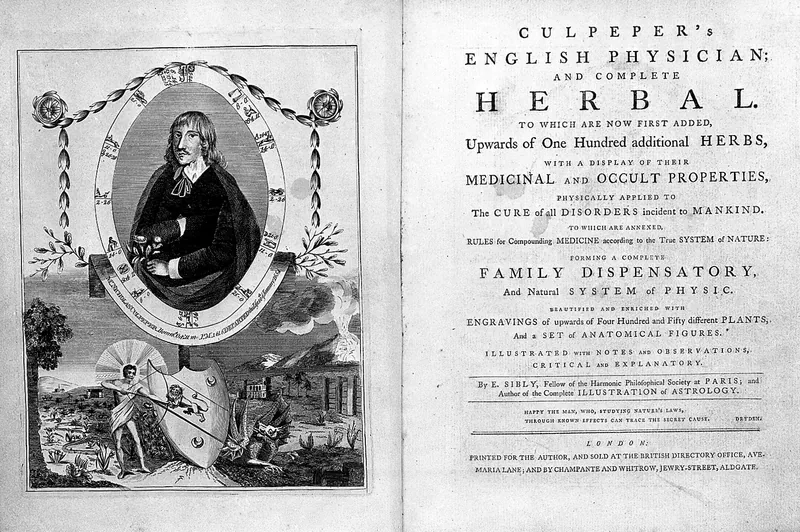
In twentieth-century occult literature, wormwood appears among the herbs of Mars and in incense mixtures attributed to divination and spirit contact, attributions that owe more to modern compilers than to ancient sources. Because it is toxic in quantity, such books are a record of modern belief rather than a guide to practice; the cautious treatment of dangerous plants is discussed in what is herbal magic.
Absinthe: The Green Fairy of the Belle Époque§
Absinthe, a high-strength spirit distilled with wormwood, anise and fennel, emerged in the Val-de-Travers in the Swiss Jura in the late eighteenth century. A popular legend credits a French exile, Dr Pierre Ordinaire, with the original elixir; better documented is the role of local producers, from whom Major Dubied and his son-in-law Henri-Louis Pernod acquired a recipe, founding distilleries at Couvet around 1798 and at Pontarlier, just over the French border, in 1805.
Absinthe's great age came after the phylloxera blight devastated French vineyards from the 1860s, making wine scarce and expensive. In the cafés of Paris the early evening became l'heure verte, the green hour, when absinthe was diluted with water, turning the emerald spirit milky. Nicknamed la fée verte, the Green Fairy, it became the emblem of bohemian Paris. Édouard Manet painted The Absinthe Drinker (1859) and Edgar Degas L'Absinthe (1876); Paul Verlaine, Arthur Rimbaud, Vincent van Gogh, Henri de Toulouse-Lautrec and Oscar Wilde were all associated with it. The same milieu nourished the occult revival described in French occultism, and Aleister Crowley wrote a lyrical essay, "Absinthe: The Green Goddess," published in 1918.
Thujone, Prohibition and Revival§
From the 1860s the French psychiatrist Valentin Magnan argued that absinthe caused a distinct syndrome, "absinthism," with seizures and hallucinations, worse than ordinary alcoholism, partly on the basis of experiments with concentrated wormwood oil on animals. Temperance campaigners, physicians and the wine industry, eager to recover its market, united against the Green Fairy.
The turning point came in 1905, when a Swiss labourer, Jean Lanfray, murdered his wife and two daughters after a day of heavy drinking that included two glasses of absinthe. The case was blamed on absinthe alone. Belgium banned the drink in 1905, Switzerland after a referendum in 1908 (in force from 1910), the Netherlands in 1909, the United States in 1912 and France in 1915, in the midst of the First World War. Anise-flavoured drinks without wormwood, such as pastis, took its place.
Modern chemical analyses of surviving pre-ban bottles have found thujone levels far lower than once assumed, and researchers now generally attribute absinthism to the very high alcohol content of the drink. European Union regulations from 1988 allowed wormwood spirits with limited thujone, and absinthe returned to legal sale in much of Europe, in Switzerland in 2005 and in the United States in 2007. Its revival has brought with it a revival of the Belle Époque legend.
Frequently asked questions§
What does wormwood symbolise?§
In the Bible and Western literature, wormwood symbolises bitterness, grief and divine judgement. The Book of Revelation names a falling star "Wormwood" that poisons the waters, and the herb became a byword for sorrow.
Is wormwood the star in Revelation?§
Revelation 8 calls a falling star "Wormwood" because it makes the waters bitter. Interpreters have read it as a fallen angel, a heresy or a judgement; its popular link with Chornobyl rests on a Ukrainian plant name for mugwort.
Why was absinthe banned?§
Absinthe was blamed for madness and crime in the late nineteenth century, a view promoted by physicians, temperance campaigners and wine producers. After a notorious Swiss murder in 1905, several countries banned it between 1905 and 1915.
Does absinthe cause hallucinations?§
Modern research suggests that pre-ban absinthe contained too little thujone to cause hallucinations and that its effects were mainly those of strong alcohol. The legend of the hallucinatory Green Fairy owes much to nineteenth-century campaigns and literature.
Sources and further reading§
- De materia medica — Pedanius Dioscorides, c. 70
- Natural History — Pliny the Elder, 77
- The English Physitian — Nicholas Culpeper, 1652
- A Modern Herbal — Maud Grieve, 1931
- The Englishman's Flora — Geoffrey Grigson, 1955
- Absinthe: History in a Bottle — Barnaby Conrad III, 1988
- Absinthe: The Cocaine of the Nineteenth Century — Doris Lanier, 1995
- Hideous Absinthe: A History of the Devil in a Bottle — Jad Adams, 2004