Liber XIX · Judaism · Chapter III: The Hebrew Bible
The Prophets of Israel: Elijah, Isaiah, Jeremiah and Ezekiel
The prophets of Israel in the Hebrew Bible: prophecy in the Near East, Elijah and Elisha, Amos, Isaiah, Jeremiah, Ezekiel, the Twelve and their message.

The prophets of Israel were men and women who, according to the Hebrew Bible, spoke in the name of the God of Israel to kings and people, announcing judgement, calling for justice and fidelity to the covenant, and promising restoration. They range from figures known through stories, such as Samuel, Nathan, Elijah and Elisha, to the "writing prophets" whose oracles fill the books of Isaiah, Jeremiah, Ezekiel and the Twelve Minor Prophets, active from the eighth to the fifth centuries BCE. Together these books form the Nevi'im, the Prophets, the second division of the Jewish Bible.
Prophecy in Ancient Israel and the Ancient Near East§
The Hebrew Bible uses several words for prophets. The most common, navi, is usually explained from an Akkadian root meaning "to call", so that the prophet is either "one called" by God or "one who calls out". Older terms were ro'eh and chozeh, both meaning "seer", and ish ha-elohim, "man of God"; the narrator of 1 Samuel 9 pauses to explain that the one now called a prophet used to be called a seer. Prophets could serve at court or sanctuaries, live in groups ("the sons of the prophets") or act alone.
Israel's prophets belonged to a wider world. Letters from the city of Mari on the Euphrates, from the eighteenth century BCE, report messages delivered by ecstatics and "answerers" in the name of gods to the king. Neo-Assyrian collections preserve oracles of encouragement given to kings Esarhaddon and Ashurbanipal in the seventh century BCE, many by women prophets of the goddess Ishtar. A plaster inscription from Deir Alla in Jordan, of about 800 BCE, tells of a vision of "Balaam son of Beor, a seer of the gods" — the same name as the foreign prophet of Numbers 22–24. What distinguishes the biblical prophets is less the form of their activity than the preservation of their words in books, and the intensity of their criticism of their own kings, priests and people (see ancient Israel and the Temple).
Elijah, Elisha and the Former Prophets§
In Jewish tradition the books of Joshua, Judges, Samuel and Kings are the Former Prophets, a history of Israel from the conquest to the Babylonian exile viewed through the lens of prophetic judgement. Prophets appear in it at decisive moments. Samuel anoints Saul and then David as king; Nathan confronts David with the parable of the poor man's lamb after his adultery with Bathsheba; Ahijah announces the division of the kingdom; Micaiah son of Imlah, alone against four hundred court prophets, foretells the death of King Ahab. Women are counted among the prophets as well: Miriam, Deborah and Huldah, whom King Josiah consulted when a book of the law was found in the Temple.
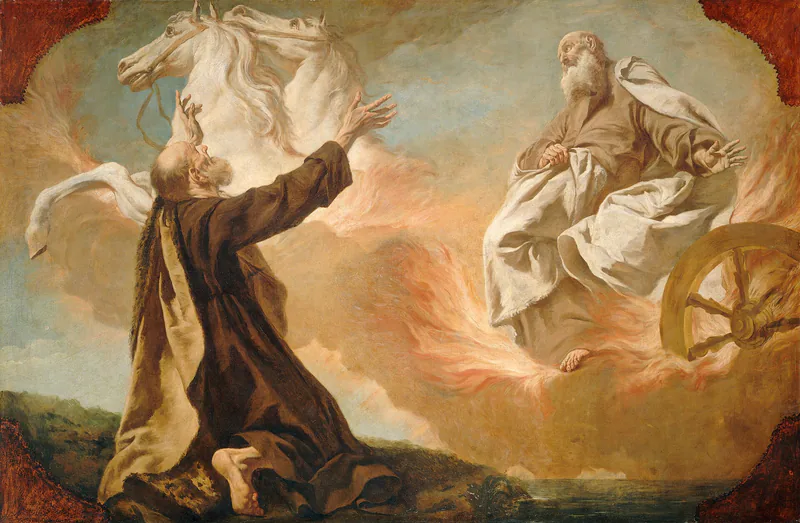
The most vivid figures are Elijah and his disciple Elisha in the northern kingdom in the ninth century BCE. Elijah opposes King Ahab and Queen Jezebel over the worship of Baal, confronts the prophets of Baal on Mount Carmel (1 Kings 18), hears God not in wind, earthquake or fire but in "a still small voice" at Horeb, and is taken up to heaven in a chariot of fire. Elisha's story is full of wonders, from multiplying oil to healing the Aramean general Naaman. Because Elijah did not die, later tradition expected his return: the last of the prophetic books promises that God will send "Elijah the prophet before the coming of the great and dreadful day of the LORD" (Malachi 4). In Jewish folklore Elijah became a wandering helper of the poor and the teacher of mystics, a guest at every circumcision and at the Passover Seder, where a cup is poured for him.
Amos, Hosea, Isaiah and Micah: The Eighth-Century Prophets§
The Latter Prophets begin with men whose words were collected in books named after them. The earliest, active in the eighth century BCE as Assyria threatened the kingdoms of Israel and Judah, are Amos, Hosea, Isaiah and Micah. Amos, a herdsman from Tekoa in Judah, preached in the prosperous northern kingdom around 760–750 BCE, denouncing the rich who sold the innocent for silver and the needy for a pair of sandals, and rejecting sacrifices offered without justice: "let judgment run down as waters, and righteousness as a mighty stream" (Amos 5). Hosea portrayed Israel's worship of other gods as a wife's unfaithfulness, using his own troubled marriage as a symbol of God's wounded but persistent love.
Isaiah of Jerusalem received his call in a vision of God enthroned in the Temple, surrounded by seraphim crying "Holy, holy, holy" (Isaiah 6), a scene that entered the daily liturgy. Over four decades from about 740 BCE he counselled kings Ahaz and Hezekiah to trust in God rather than foreign alliances, through the fall of the northern kingdom to Assyria in 722 BCE and the Assyrian siege of Jerusalem in 701 BCE. His oracles include the vision of nations beating "their swords into plowshares" and the promise of a righteous king from the stock of Jesse. His contemporary Micah, a villager, predicted that even Jerusalem would become a heap of ruins and summed up the demands of God as doing justice, loving mercy and walking humbly.
Jeremiah, Ezekiel and the Prophets of Exile§
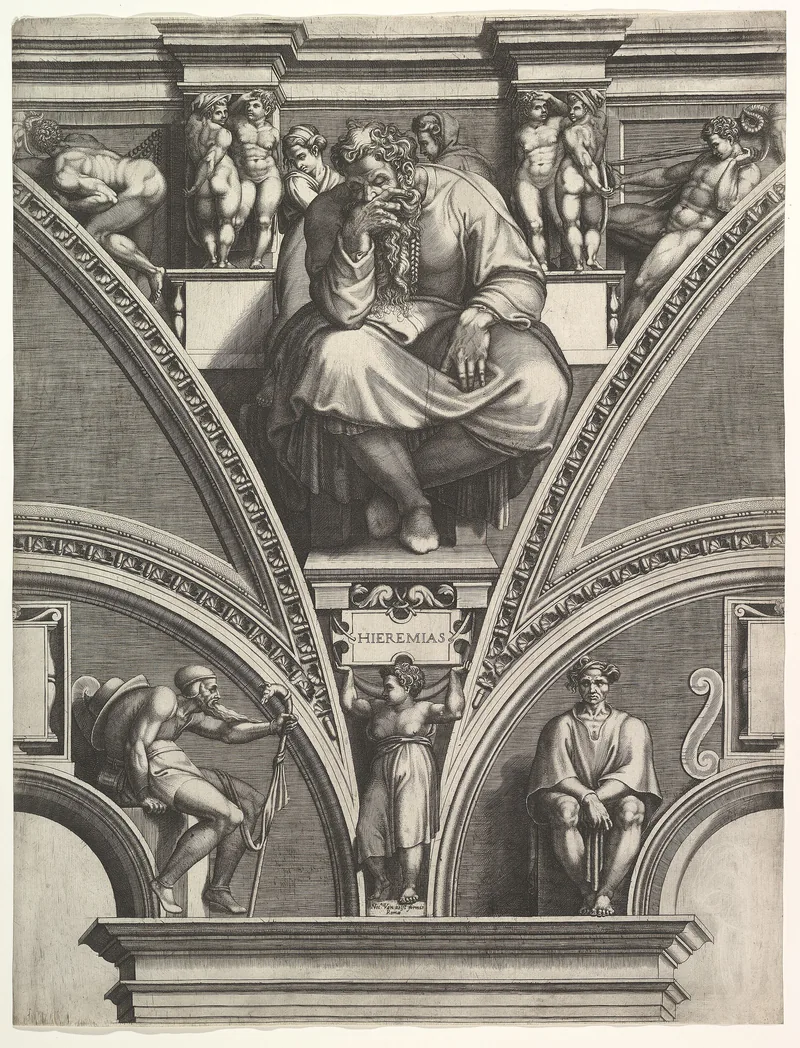
Jeremiah, from a priestly family of Anathoth, prophesied from about 627 BCE until after the destruction of Jerusalem by the Babylonians in 586 BCE. His book, partly composed by his scribe Baruch, is the most personal of the prophetic books, including laments (the "confessions") in which he accuses God of having deceived him. He warned that the Temple would not save a people that did not practise justice, was beaten, imprisoned and thrown into a cistern, and wrote to the exiles urging them to seek the welfare of Babylon. He also promised a "new covenant" written on the heart. After the fall of Jerusalem he was taken to Egypt, where tradition says he died.
Ezekiel, a priest deported to Babylonia in 597 BCE, prophesied among the exiles between about 593 and 571 BCE. His book opens with a vision of the divine throne-chariot borne by four living creatures with wheels full of eyes, which became the foundation of Jewish throne mysticism, described in Merkavah and Hekhalot mysticism. Ezekiel performed strange symbolic acts, saw the glory of God leave the Temple, and after the catastrophe proclaimed restoration in the vision of the valley of dry bones.
Most modern scholars attribute chapters 40–55 of Isaiah to an anonymous prophet of the Babylonian exile, often called Second Isaiah, writing around 540 BCE. These chapters announce comfort to Jerusalem, proclaim the one God as creator of all, and hail the Persian king Cyrus as God's "anointed" who will let the exiles return. Chapters 56–66 are often assigned to later authors in Judah. Traditional Jewish and Christian interpretation has regarded the whole book as the work of Isaiah son of Amoz. The complete Great Isaiah Scroll from Qumran, copied around the second century BCE, is one of the most important of the Dead Sea Scrolls.
The Twelve and the End of Prophecy§
The Book of the Twelve, counted as one book in the Hebrew canon, gathers short collections from Hosea, Joel, Amos, Obadiah, Jonah, Micah, Nahum, Habakkuk, Zephaniah, Haggai, Zechariah and Malachi. Their dates span roughly three centuries. Jonah stands apart as a story about a reluctant prophet sent to Nineveh, read in the synagogue on the afternoon of Yom Kippur as a lesson in repentance. Haggai and Zechariah urged the rebuilding of the Temple after the return from exile around 520 BCE, and Malachi, probably in the fifth century, closes the collection. The Book of Daniel, with its apocalyptic visions, is placed among the Writings in the Jewish Bible rather than among the Prophets, as the article on the Hebrew Bible explains.
Rabbinic tradition taught that with the death of the last prophets the holy spirit departed from Israel, leaving only the bat kol, an echo of the heavenly voice; the Talmud counts forty-eight prophets and seven prophetesses whose prophecies were recorded for later generations. Maimonides later made prophecy a central theme of Jewish philosophy, explaining it as a perfection of intellect and imagination (see Maimonides).
The Message and Legacy of the Prophets§
Recurring themes run through the prophetic books: the covenant between God and Israel and the consequences of breaking it; the demand for justice for the poor, the widow and the orphan; the critique of worship divorced from ethics; the rejection of idolatry; the "day of the LORD" as a day of judgement; and hope for a restored Zion, a righteous ruler from the house of David and the eventual knowledge of God among all nations. Jewish tradition reads these hopes as promises still awaiting fulfilment in the messianic age.
In the synagogue, a passage from the Prophets, the haftarah, is chanted after the Torah reading on Sabbaths and festivals, a custom already attested in the first century CE (see Jewish prayer and the synagogue). Christianity read many prophetic passages as foretelling Jesus, and Islam honours many of the same figures as prophets. Abraham Joshua Heschel, who marched with Martin Luther King Jr. in 1965, described in The Prophets (1962) their sensitivity to the "divine pathos", God's concern for human suffering.
Frequently asked questions§
Who are the major prophets of the Hebrew Bible?§
Isaiah, Jeremiah and Ezekiel are often called the "major" prophets because of the length of their books; the twelve shorter books, from Hosea to Malachi, are the "minor" prophets. In the Jewish canon the Prophets also include the historical books of Joshua, Judges, Samuel and Kings.
Were there women prophets in the Bible?§
Yes. The Bible names Miriam, Deborah, Huldah and Noadiah as prophetesses, and Isaiah's wife is called "the prophetess". The Talmud lists seven prophetesses: Sarah, Miriam, Deborah, Hannah, Abigail, Huldah and Esther.
Is Daniel a prophet in Judaism?§
Daniel is honoured in Jewish tradition, but his book is placed among the Writings rather than the Prophets, and the Talmud does not count him among the prophets. Christian Bibles place Daniel among the Prophets.
When did prophecy end according to Judaism?§
Rabbinic tradition holds that prophecy ceased after Haggai, Zechariah and Malachi in the early Second Temple period. Many Jews believe that prophecy will be restored in the messianic age.
Sources and further reading§
- The Prophets — Abraham Joshua Heschel, 1962
- A History of Prophecy in Israel — Joseph Blenkinsopp, 1983
- Prophecy and Society in Ancient Israel — Robert R. Wilson, 1980
- Prophets and Prophecy in the Ancient Near East — Martti Nissinen, 2003
- The Jewish Study Bible — Adele Berlin and Marc Zvi Brettler (eds.), 2004