Liber XVI · Indigenous & Ancient Religions · Chapter V: Mesoamerican Religion
Popol Vuh: The K'iche' Maya Book of Council and Hero Twins
The Popol Vuh, the K'iche' Maya Book of Council: its 16th-century origin and the Ximénez manuscript, the creation, the Hero Twins in Xibalba and maize people.

The Popol Vuh, "Book of Council" or "Book of the Community", is the sacred narrative of the K'iche' (Quiché) Maya of highland Guatemala, written down in the K'iche' language in the Latin alphabet in the mid-sixteenth century. It tells of the creation of the world and of humanity, the adventures of the Hero Twins Hunahpu and Xbalanque in the underworld of Xibalba, the making of the first people from maize, and the migrations and kings of the K'iche' nation up to the Spanish conquest. It is the most complete surviving work of Maya mythology and remains a living source of identity for Maya communities today.
Origins of the Popol Vuh Manuscript§
The K'iche' kingdom, with its capital at Q'umarkaj (Utatlán), was the most powerful state in the Guatemalan highlands when Pedro de Alvarado's Spanish forces and their Mexican allies conquered it in 1524 and burned the city. A generation later, members of the K'iche' nobility, who had learned to write their own language in Latin letters from missionaries, set down their community's traditions. The authors do not name themselves, but they explain that they are writing in the new Christian order, after the preaching of the friars, because the original Popol Vuh, a painted or hieroglyphic book that rulers once consulted, was no longer to be seen. Internal references to rulers allow the composition to be dated to about the 1550s.
That alphabetic manuscript is lost. Around 1701–1703 Francisco Ximénez, parish priest of Santo Tomás Chichicastenango, copied a version he found there and added a Spanish translation in a parallel column. His manuscript passed through Guatemalan libraries and the hands of the French abbé Charles Étienne Brasseur de Bourbourg, who published a French translation in 1861, and is now held by the Newberry Library in Chicago. Modern translations by Adrián Recinos (1947), Munro Edmonson (1971), Dennis Tedlock (1985) and Allen J. Christenson (2003) differ considerably in interpretation, reflecting the difficulty of the poetic K'iche' text, which is composed largely in parallel couplets.
The Creation of the World and the Failed Humans§
The book opens in silence and stillness, with only the sky and the calm sea. In the water are the Framer and the Shaper, among them Tepew and Q'ukumatz, the Sovereign Plumed Serpent, a K'iche' counterpart of the Mesoamerican Quetzalcoatl. With them is the Heart of Sky, called Juraqan, whose name is often connected with the word "hurricane", though the derivation is debated. Through speech and thought the gods call forth the earth, mountains, waters and plants.
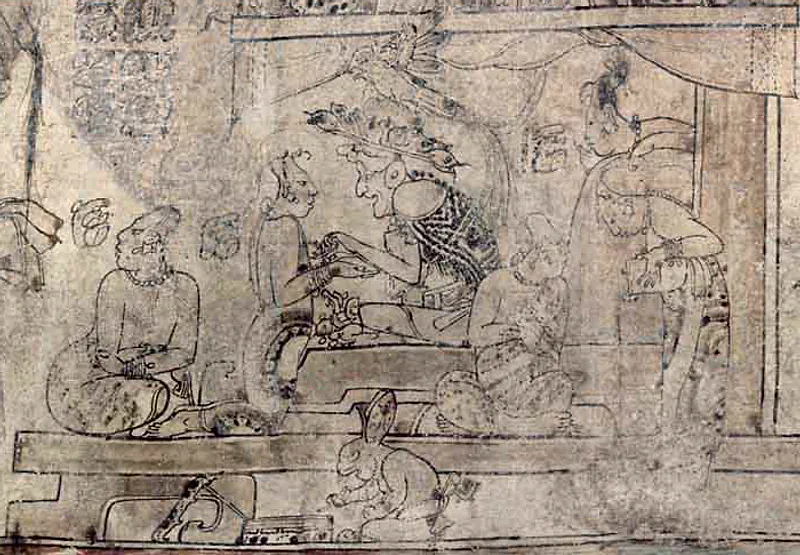
The gods want beings who will speak their names, keep the days and nourish them with offerings. Their first creations, the animals, can only squawk and howl, so they are condemned to be eaten. Next they make a person of mud, which crumbles and dissolves. Then they carve people of wood, who multiply and speak but have no hearts or memory of their makers. The gods send a flood and a rain of resin, and the wooden people's own dogs, grinding stones and cooking pots rise against them in revenge for ill-treatment. Their descendants, the book says, are the monkeys of the forest. Comparisons with other ancient creation accounts, such as the Babylonian Enuma Elish, highlight a shared concern with the purpose of humanity: to serve and remember the gods.
Seven Macaw and the Hero Twins§
Before the true dawn, a proud bird called Seven Macaw (Wuqub' Kaqix) claims to be the sun and moon, glittering with jewels and metal teeth. Two youths, Hunahpu and Xbalanque, shoot him with blowguns, and then, disguised as healers, replace his jewelled teeth with grains of maize, stripping him of his glory. They also defeat his two sons, the earth-shaking giants Zipacna and Cabracan. The episode establishes the twins as the enemies of false pride and prepares the world for the real sun.
Xibalba: The Ballgame with the Lords of Death§
The heart of the book goes back a generation. The twins' father and uncle, One Hunahpu and Seven Hunahpu, were great ballplayers whose noisy games above the underworld annoyed the lords of Xibalba, chief among them One Death and Seven Death. Summoned below, the brothers failed a series of tests and were sacrificed. One Hunahpu's head was placed in a calabash tree, which immediately bore fruit. When Blood Moon (Xkik'), the daughter of an underworld lord, came to see it, the skull spat into her hand and she became pregnant. Condemned by her father, she escaped to the earth's surface and was taken in, after trials of her own, by her mother-in-law, the grandmother Xmucane, where she bore the twins.
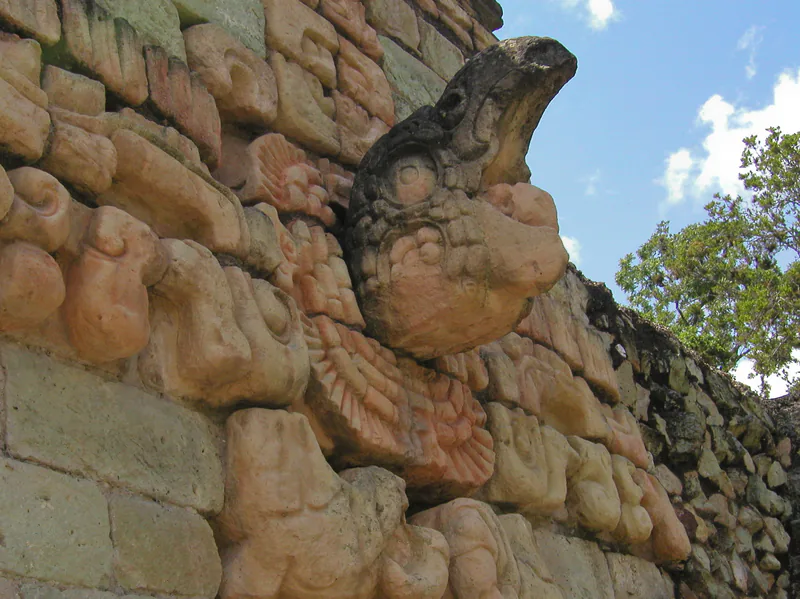
The twins grow up in rivalry with their elder half-brothers, One Monkey and One Artisan, whom they turn into monkeys; these become patrons of artists and scribes. Discovering their father's ballgame equipment, the twins in turn are summoned to Xibalba. They outwit the lords at every step: they pass through the Dark House, Razor House, Cold House, Jaguar House and Fire House, and survive the Bat House except for a moment in which Hunahpu's head is cut off by a killer bat and used by the lords as a ball, until Xbalanque substitutes a squash.
Knowing they are meant to die, the twins leap into an oven. The lords grind their bones and throw them into a river, from which they return as fishlike beings and then as wandering performers who can sacrifice a person and bring them back to life. Fascinated, the lords of death ask to be sacrificed themselves. The twins kill them and do not revive them, reducing the power of Xibalba and decreeing that its people will receive only lesser offerings. The twins then attempt to restore their father and rise into the sky as the sun and the moon, according to the text, though some scholars argue that Venus was originally involved.
Scholars have linked the story with the Mesoamerican ballgame and its courts, with the movements of the sun, moon and Venus tracked in Maya calendars (see Maya astrology and the day-keepers), and with the cycle of maize, which is buried as seed and rises again.
The Maize People and the Dawn of the K'iche'§
After the twins' victory the gods try once more. With help from animals who show them the mountain of food, Xmucane grinds yellow and white maize nine times, and from the dough the gods form four men: Balam Quitze, Balam Acab, Mahucutah and Iqi Balam. These first fathers are wise and grateful, but their sight is too perfect; they can see to the ends of the world. Fearing rivals, the gods cloud their vision, as breath clouds a mirror. Wives are then made for them, and from them the lineages of the K'iche' descend.
The final part of the book moves from myth into history. The ancestors travel to a city called Tulan Zuyva, where they receive their patron gods, including Tohil, who gives them fire. They wait in darkness for the first dawn and, when the sun rises, the gods turn to stone. The K'iche' then found their towns, conquer neighbours and build Q'umarkaj, and the book closes with lists of ruling lords and great houses down to the generations who lived under Spanish rule.
Older Roots and the Living Tradition§
The Popol Vuh is a colonial document, and some passages show Christian influence, but much of its content is demonstrably older. In 1973 the archaeologist Michael Coe showed that scenes on Classic Maya painted vases (about 600–900 CE) depicted versions of the Hero Twins and the maize god's death and rebirth, and the San Bartolo murals in Guatemala, painted around the first century BCE, include imagery that scholars connect with the same mythic cycle. The written book is therefore one late expression of a tradition more than a thousand years deep, as explained in the overview of Mesoamerican religion.
For many Maya today the Popol Vuh is not merely an ancient text. K'iche' and other Maya communities read it in schools and ceremonies, Maya intellectuals and the Maya cultural revitalisation movement since the 1980s have made it a symbol of continuity, and Guatemala has declared it a national book. Maya day-keepers (ajq'ij) continue to count the 260-day calendar, though their practice belongs to their communities and is not set out in the book as instructions.
Frequently asked questions§
What does Popol Vuh mean?§
It is usually translated "Book of Council" or "Book of the Community", from K'iche' popol, council or mat (a symbol of authority), and vuh, book or paper. The authors used the name for the older book they were reconstructing.
Who wrote the Popol Vuh?§
It was written by anonymous members of the K'iche' Maya nobility in the 1550s, using the Latin alphabet. The surviving copy was made around 1701–1703 by the Dominican friar Francisco Ximénez.
Who are the Hero Twins?§
Hunahpu and Xbalanque are twin brothers who defeat the arrogant Seven Macaw and then the lords of death in the underworld of Xibalba through skill in the ballgame and trickery. Afterwards they rise into the sky as the sun and the moon.
What is Xibalba?§
Xibalba, "place of fear", is the underworld of K'iche' Maya myth, ruled by lords such as One Death and Seven Death. It is reached by a road descending through rivers and crossroads and contains houses of trials.
Sources and further reading§
- Popol Vuh: The Definitive Edition of the Mayan Book of the Dawn of Life and the Glories of Gods and Kings — Dennis Tedlock, 1985
- Popol Vuh: The Sacred Book of the Maya — Allen J. Christenson, 2003
- Popol Vuh: The Sacred Book of the Ancient Quiché Maya — Adrián Recinos, 1950
- The Book of Counsel: The Popol Vuh of the Quiche Maya of Guatemala — Munro S. Edmonson, 1971
- The Maya Scribe and His World — Michael D. Coe, 1973
- Maya Cosmos: Three Thousand Years on the Shaman's Path — David Freidel, Linda Schele and Joy Parker, 1993
- Time and the Highland Maya — Barbara Tedlock, 1982