Liber XXX · Symbols · Chapter I: Alchemical Symbols
Alchemical Symbols: Metals, Elements and Emblems Explained
Alchemical symbols explained: the seven planetary metals, the four elements, sulphur, mercury and salt, the green lion, the Rebis and the great emblem books.

Alchemical symbols are the signs and images alchemists used to name substances, describe operations and convey the philosophy of their art. They range from compact signs, such as ☉ for gold and ☿ for mercury, which functioned as a working notation in laboratory manuscripts, to elaborate allegorical emblems of kings, queens, lions, dragons and hermaphrodites that portrayed the stages of the Great Work. Some symbols were practical shorthand, others deliberate concealment, and many carried both chemical and spiritual meanings.
Why Alchemists Wrote in Symbols§
Alchemy was both a practical craft, concerned with metals, dyes, medicines and the dream of transmutation, and a philosophy of nature in which matter could be perfected. Its writers had several reasons to use symbols. Signs were convenient shorthand in laboratory notes and recipe collections. Secrecy protected valuable knowledge from the unworthy, the greedy and the authorities, and alchemical authors repeatedly warned that their words were not to be taken literally. And many alchemists believed that the processes of nature could best be expressed in images, since the transformations they sought paralleled the creation of the world and the redemption of the soul.
The result is a layered vocabulary. A single word such as "mercury" could mean the liquid metal, a philosophical principle of fluidity and volatility, or a hidden universal substance, the "mercury of the wise". Historians such as Lawrence Principe and William Newman have shown that many seemingly mystical images can be decoded as precise chemical procedures, while others are best read as spiritual or philosophical allegory.
The Seven Metals and Their Planetary Signs§
From late antiquity, the seven metals known to the ancients were associated with the seven classical planets, and they shared the same signs:
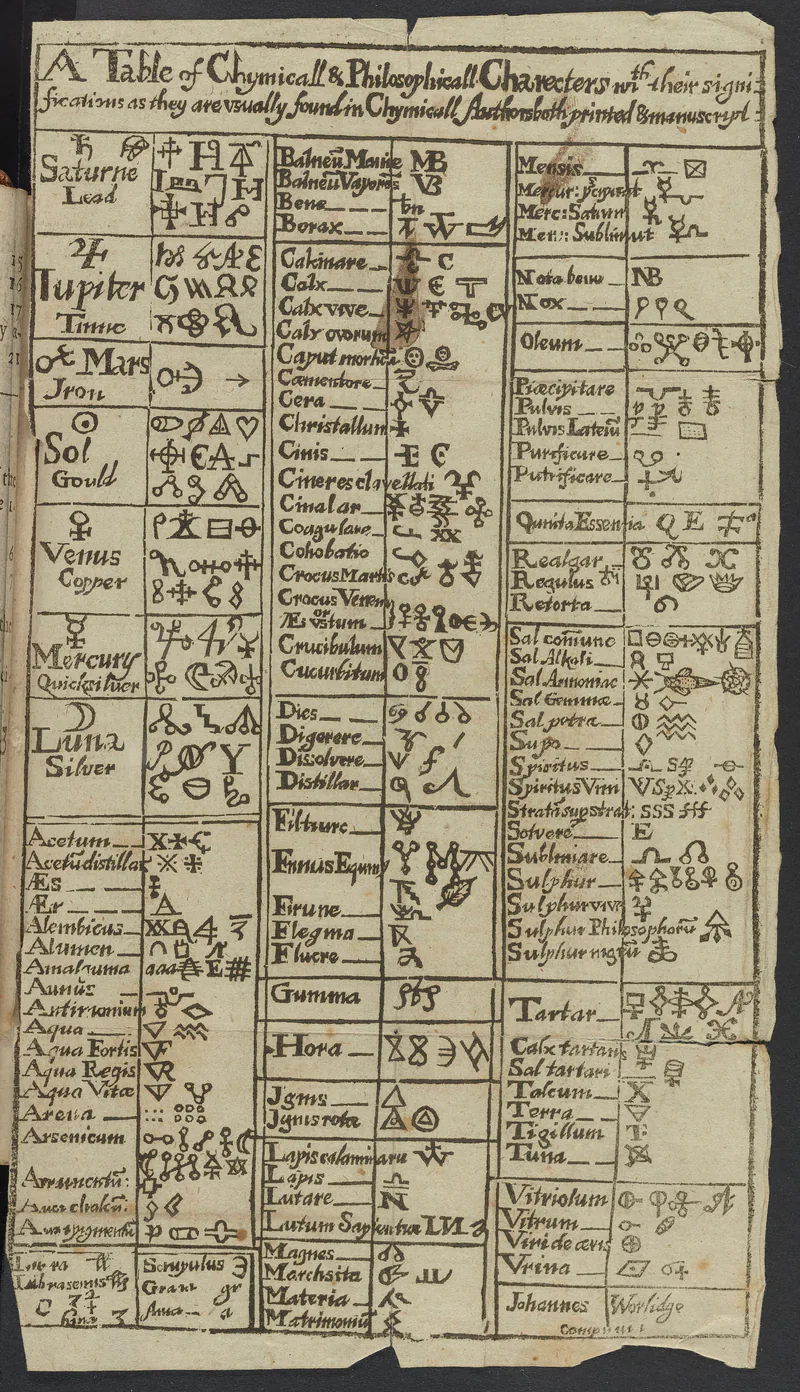
- Gold — the Sun ☉, a circle with a central point, the perfect metal;
- Silver — the Moon ☽, the crescent;
- Quicksilver (mercury) — Mercury ☿;
- Copper — Venus ♀, perhaps from the island of Cyprus, a source of copper;
- Iron — Mars ♂, the shield and spear of the war god;
- Tin — Jupiter ♃;
- Lead — Saturn ♄, the heaviest and "oldest" metal, starting point of many transmutations.
Signs for metals and substances appear in Greek alchemical manuscripts of the Byzantine period, such as the tenth- or eleventh-century codex Marcianus graecus 299 in Venice, which preserves lists of symbols. The signs evolved over the centuries, and the forms used today were standardised largely in printed books of the sixteenth and seventeenth centuries. The planet–metal pairing expressed the belief that celestial influences governed the generation of metals in the earth, and it ties alchemy closely to astrology and to the Hermetic principle summarised in the Emerald Tablet: "as above, so below".
Elements, the Tria Prima and Process Signs§
The four elements§
Following Aristotle, alchemists held that all matter was composed of four elements, each defined by two qualities: fire (hot and dry), air (hot and wet), water (cold and wet) and earth (cold and dry). By the seventeenth century they were commonly shown as triangles: fire as an upward triangle, water as a downward triangle, air as an upward triangle with a horizontal bar and earth as a downward triangle with a bar. Combined, the upward and downward triangles form the hexagram, interpreted as the union of opposites.
Sulphur, mercury and salt§
Medieval Arabic and Latin alchemy taught that metals were composed of two principles, sulphur (combustibility, the "male" or fixed principle) and mercury (fluidity and volatility, the "female" principle). In the sixteenth century Paracelsus added salt (solidity and fixity), forming the tria prima, the three principles, which he linked to spirit, soul and body. Sulphur was commonly drawn as a triangle above a cross, salt as a circle divided by a horizontal line, and mercury with its planetary sign.
Process signs§
Laboratory operations also had signs: calcination, sublimation, dissolution, distillation, coagulation and others, along with signs for apparatus, quantities and time (hour, day, month). Seventeenth- and eighteenth-century tables of chemical symbols, including Étienne-François Geoffroy's table of affinities (1718), used these signs systematically.
The Allegorical Bestiary: Lions, Crows, Pelicans and the Rebis§
Alongside signs, alchemists developed a cast of symbolic creatures and figures, catalogued in Lyndy Abraham's Dictionary of Alchemical Imagery (1998):
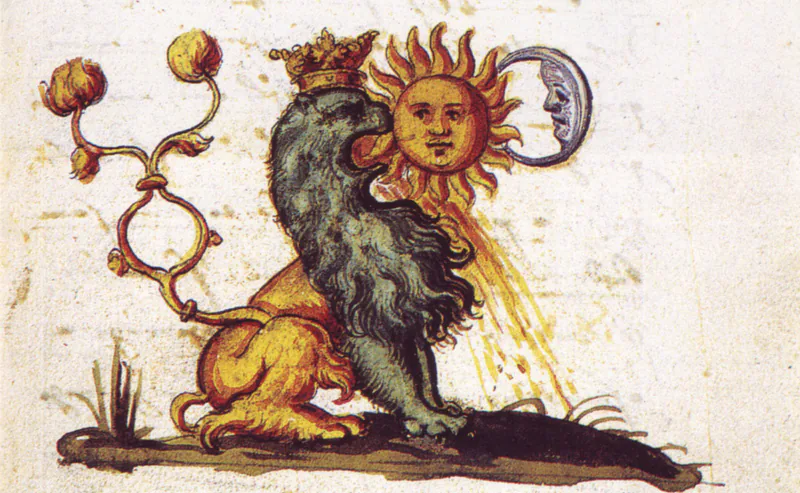
- The green lion devouring the sun often signifies a corrosive solvent, such as an acid or a mineral like vitriol, dissolving gold.
- The black crow or raven represents the nigredo, the blackening or putrefaction at the beginning of the Work.
- The peacock's tail signals the play of colours in the vessel before whitening.
- The pelican, believed to feed its young with its own blood, stands for a circulating vessel and for self-sacrificing love, linking alchemy with Christ.
- The phoenix represents the final stage, the reddening (rubedo) and the Philosophers' Stone itself.
- The red king and white queen, whose marriage (coniunctio) produces the Rebis, a crowned hermaphrodite uniting sun and moon, sulphur and mercury.
- The dragon and the ouroboros stand for raw matter and for the cyclical unity of all things.
The colour sequence of the Work, usually given as black, white, yellow and red (nigredo, albedo, citrinitas, rubedo), structured many allegories, though authors differ on the number and order of stages.
The Great Emblem Books of the Sixteenth and Seventeenth Centuries§
The richest alchemical imagery appears in a series of illustrated works:
- Rosarium philosophorum (printed 1550), a series of woodcuts showing the union of king and queen in a bath, their death and resurrection as the Rebis. C. G. Jung analysed it in The Psychology of the Transference.
- Splendor Solis (c. 1532–1535), a lavishly painted manuscript of twenty-two images, the finest copy now in the British Library.
- The Twelve Keys of Basil Valentine, first printed in 1599 and soon illustrated with a sequence of allegorical images, attributed to a supposed fifteenth-century Benedictine monk whose existence is doubted.
- Atalanta fugiens (1617) by Michael Maier, fifty emblems each with an epigram, a discourse and a musical fugue.
- Musaeum Hermeticum (1625, enlarged 1678), an anthology including the emblems of Lambsprinck.
- Mutus Liber (1677), the "silent book", conveying the work entirely in fifteen plates without text.
These works were collected and reinterpreted by later esotericists and artists, and Jung's Psychology and Alchemy (1944) made them famous as images of psychological transformation.
From Alchemical Sign to Chemical Formula§
In the eighteenth century, as chemistry separated from alchemy, the old signs became inadequate for a growing number of substances. Antoine Lavoisier and his colleagues reformed chemical nomenclature in 1787; John Dalton proposed circular symbols for atoms in 1808; and in 1813–1814 Jöns Jacob Berzelius introduced the letter-based symbols still used today (Au for gold, Ag for silver, Hg for mercury, Fe for iron). The alchemical signs survive nonetheless: the planet signs in astronomy and astrology, ♂ and ♀ in biology, and the full repertoire in esoteric art and modern occultism (see Occult Symbols). For the parallel symbolism of Chinese inner alchemy, see Taoist Internal Alchemy.
Frequently asked questions§
What is the alchemical symbol for gold?§
Gold is represented by the sign of the Sun, a circle with a dot at its centre (☉). The Sun was considered the most perfect celestial body, and gold the most perfect metal.
What are the four alchemical elements?§
Fire, air, water and earth. In later alchemical notation fire is an upward triangle, water a downward triangle, and air and earth the same triangles crossed by a horizontal line.
What is the tria prima?§
The tria prima, or three principles, are sulphur, mercury and salt, formulated by Paracelsus in the sixteenth century. Alchemists held that all substances were composed of these principles in varying proportions.
What does the green lion mean in alchemy?§
The green lion usually represents a powerful solvent capable of dissolving metals, often depicted devouring the sun, that is, dissolving gold. It can also stand for raw, unpurified matter at an early stage of the Work.
Sources and further reading§
- A Dictionary of Alchemical Imagery — Lyndy Abraham, 1998
- The Secrets of Alchemy — Lawrence M. Principe, 2013
- Alchemy & Mysticism — Alexander Roob, 1997
- Psychology and Alchemy — C. G. Jung, 1944
- Alchemy: The Medieval Alchemists and Their Royal Art — Johannes Fabricius, 1976
- Promethean Ambitions: Alchemy and the Quest to Perfect Nature — William R. Newman, 2004
- The Hermetic Museum — A. E. Waite, 1893