What Is Sacred Symbolism? Signs, Meaning and History
What is sacred symbolism? How religious and esoteric symbols work, from the Greek symbolon and Renaissance hieroglyphs to Jung, Eliade and modern iconography.

Sacred symbolism is the use of images, shapes, numbers and objects to point beyond themselves to religious or spiritual realities that cannot be fully expressed in ordinary language. A cross, a lotus, a hexagram or a circle may carry layers of meaning built up over centuries, and in esoteric traditions symbols are often treated not merely as reminders but as keys to hidden knowledge or as vehicles of power. Understanding a symbol means knowing both what it has meant to its users and how its meanings have changed.
From Symbolon to Symbol: Defining the Term§
In ancient Greece a symbolon was a token, such as a knucklebone or tablet broken in half, given to two parties so that the matching pieces could later confirm a contract or friendship. The image is apt: a symbol joins something visible to something invisible, and its meaning is complete only when the two halves are brought together by someone who knows how they fit. Early Christians used the same word for the creed, the "symbol of faith" that identified believers.
Philosophers have distinguished symbols from other kinds of sign. The American logician Charles Sanders Peirce separated icons (which resemble what they signify), indices (which are causally connected to it, as smoke to fire) and symbols (whose meaning rests on convention). In religious studies "symbol" is usually used more richly, for an image that participates in what it represents and evokes more than can be stated. The theologian Paul Tillich made this distinction central: a sign points to something, while a symbol shares in the reality it points to.
Symbols in Religious Traditions§
Every religion uses symbols, but in different ways and to different degrees.

- Identity and community. The cross for Christians, the Star of David for Jews, the crescent for many Muslims, the khanda for Sikhs and the wheel for Buddhists signal belonging, although several of these acquired their role as emblems only in recent centuries.
- Sacred story. Symbols condense narrative: the lamb recalls sacrifice, the fish (ichthys) a Greek acrostic for "Jesus Christ, Son of God, Saviour", the bodhi leaf the Buddha's awakening.
- Cosmic order. Circles, squares and axes map the structure of the universe in mandalas, temple plans and the Kabbalistic Tree of Life.
- Presence and power. In some traditions an image or sign is believed to embody or channel the sacred, as with consecrated icons, Hindu yantras or the ground drawings of Vodou, discussed in Vèvè and Sacred Symbols.
Some traditions are wary of images. Judaism and Islam forbid images of God and have often limited figurative art in sacred space, developing instead rich traditions of calligraphy, geometry and pattern. Our survey of Religious Symbols treats these differences in detail.
The theology of symbols§
Christian thinkers built theories of symbolic meaning early. Augustine's On Christian Teaching discussed signs and how scripture conveys spiritual truths through things. The sixth-century writer known as Pseudo-Dionysius argued that "dissimilar" symbols, even lowly or strange images of God, could lead the mind upward more effectively than flattering ones. Medieval exegetes read scripture in four senses, literal, allegorical, moral and anagogical, an approach that made almost every object a potential symbol.
Renaissance Hieroglyphs, Emblems and Occult Philosophy§
A decisive moment for Western esoteric symbolism came in the fifteenth century. In 1419 a Greek manuscript of the Hieroglyphica of Horapollo, a late antique treatise claiming to explain Egyptian hieroglyphs as symbolic images, was brought to Florence. Renaissance humanists concluded that the Egyptians had written in a sacred picture-language that conveyed divine truths directly to the mind. The Hermetic texts, translated by Marsilio Ficino in 1463, reinforced the idea of an ancient Egyptian wisdom (see Corpus Hermeticum).
This belief inspired new symbolic genres. Andrea Alciato's Emblemata (1531) launched the emblem book, in which an image, motto and verse together conveyed a moral lesson; Cesare Ripa's Iconologia (1593) became a dictionary of personifications for artists. Esoteric authors used images as compressed doctrine: John Dee's Monas Hieroglyphica (1564) built a single sign from the symbols of the planets and elements (see The Hieroglyphic Monad), and alchemical emblem books filled the following century. In the 1650s the Jesuit Athanasius Kircher attempted to decode the hieroglyphs as mystical symbols; his decipherments were wrong, as Champollion's work of the 1820s showed, but his illustrations shaped occult imagery for centuries.
Modern Theories: Jung, Eliade and Iconography§
In the twentieth century three influential approaches emerged.
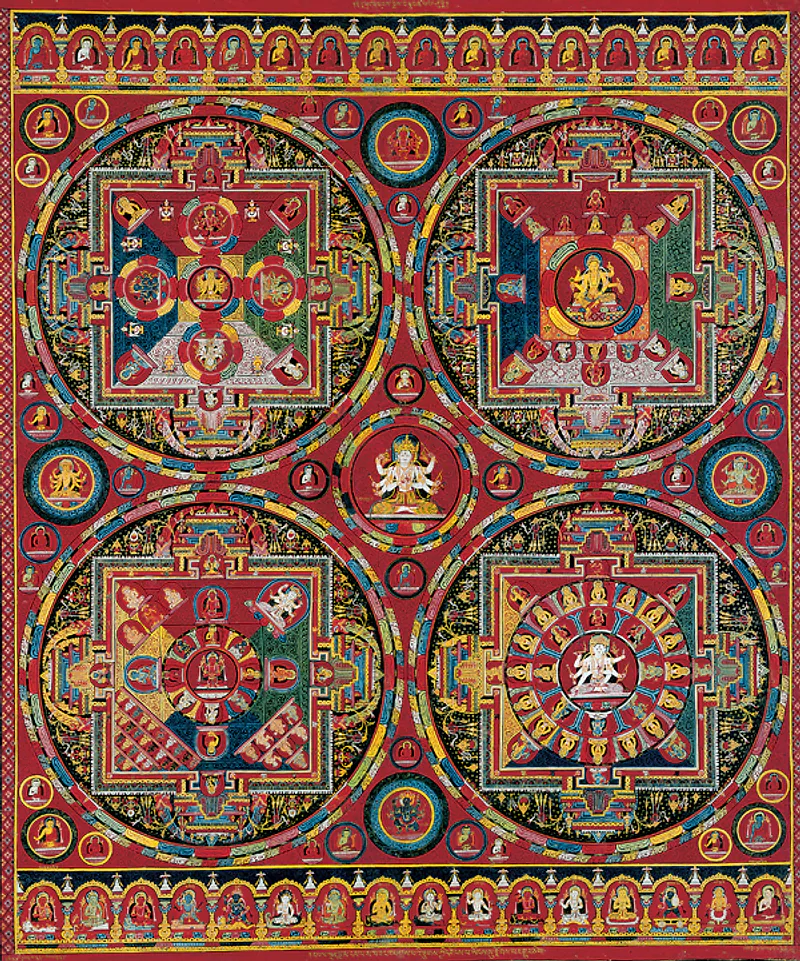
C. G. Jung argued that certain symbols, such as the mandala, the hero, the wise old man or the divine child, arise spontaneously from a collective unconscious shared by all humans, and that alchemical and religious images express psychological processes. His Man and His Symbols (1964) brought these ideas to a wide public. Critics note that Jung often ignored historical context in pursuit of universal patterns.
Mircea Eliade, the historian of religions, treated symbols such as the world-axis, the centre and the sacred tree as expressions of a religious way of being in the world, recurring across cultures. His work has been praised for its range and criticised for generalising too freely.
Erwin Panofsky, an art historian, set out a method of iconography and iconology in Studies in Iconology (1939), insisting that the meaning of an image be reconstructed from the texts and conventions of its own time. This historical approach underlies most scholarly study of symbols today.
How Symbols Change Meaning: The Swastika, Pentagram and Hexagram§
Symbols are not fixed. Three examples show how dramatically meanings can shift.
The swastika is an ancient auspicious sign in Hinduism, Buddhism and Jainism, and appears in many ancient cultures; in the twentieth century its adoption by the Nazi party made it, in the West, a symbol of genocide, while it remains sacred across South and East Asia.
The pentagram served the Pythagoreans as a sign of health, medieval Christians as a sign of Christ's five wounds and Agrippa as an image of the human microcosm, before the occultist Eliphas Lévi associated the inverted form with evil in the 1850s; today it is the emblem of Wicca.
The hexagram was a decorative and magical sign used by Jews, Christians and Muslims, known as the Seal of Solomon, before becoming the distinctive emblem of Judaism and of the State of Israel. These histories are traced in Occult Symbols.
Reading a Symbol Responsibly§
Popular books often present symbols as having a single "true" meaning valid for all times and places. Historians suggest more careful questions: Who used this sign, when, and for what? What texts explain it? How did its meaning change as it moved between cultures? Is a claimed ancient origin documented, or a modern invention?
This approach does not reduce symbols to dry facts. On the contrary, it reveals their richness as carriers of memory. The other sections of this book explore particular families of signs: Alchemical Symbols, Sacred Geometry and Number Symbolism.
Frequently asked questions§
What is the difference between a sign and a symbol?§
A sign usually points to a single, conventional meaning, like a road sign. A symbol, in the religious sense, carries multiple layers of meaning and is often felt to participate in the reality it represents, as the cross does for Christians.
Are symbols universal?§
Some shapes, such as the circle, cross and spiral, appear in many cultures, but their meanings differ. Jung and Eliade emphasised universal patterns, while most historians stress that a symbol's meaning depends on its cultural context.
What is esoteric symbolism?§
Esoteric symbolism is the use of symbols to convey hidden or initiatory knowledge, as in alchemy, Kabbalah, Rosicrucianism and ceremonial magic. Their full meaning is often said to be accessible only to those trained in the tradition.
Sources and further reading§
- Man and His Symbols — C. G. Jung, 1964
- Images and Symbols — Mircea Eliade, 1952
- Studies in Iconology — Erwin Panofsky, 1939
- The Migration of Symbols — Count Goblet d'Alviella, 1894
- The Hieroglyphics of Horapollo — George Boas (trans.), 1950
- Egyptian Oedipus: Athanasius Kircher and the Secrets of Antiquity — Daniel Stolzenberg, 2013
- Dynamics of Faith — Paul Tillich, 1957