Liber XXX · Symbols · Chapter III: Occult Symbols
Occult Symbols: History and Meaning of Esoteric Signs
Occult symbols explained: the pentagram, hexagram, seals and sigils, the Monad, Rosy Cross, Baphomet and inverted cross, with their real histories.

Occult symbols are the signs used in Western esoteric traditions such as ritual magic, astrology, alchemy, Rosicrucianism and modern witchcraft to express hidden teachings or to serve as instruments of magical practice. The best known include the pentagram, the hexagram, planetary seals and sigils, the Rosy Cross, the Eye in the triangle and the figure of Baphomet. Most have documented histories that are far more interesting, and often more recent, than the legends attached to them.
What Makes a Symbol "Occult"§
The Latin occultus means "hidden". In the Renaissance, "occult philosophy" referred to the study of hidden forces in nature, such as the sympathies between planets, stones and plants, and the term did not yet carry sinister overtones. Occult symbols worked in two ways. Some were concealing: they wrapped doctrine in images that only the trained could read, as in alchemical emblems or Rosicrucian diagrams. Others were operative: they were believed to have power in themselves, as with seals engraved on talismans or characters drawn in a magic circle. Both uses rest on the old idea, explored in What Is Sacred Symbolism?, that a sign can participate in the reality it represents.
The Pentagram and the Hexagram§
The pentagram§
The five-pointed star appears in Mesopotamian writing and Greek art. The Pythagoreans are said to have used it as a sign of recognition and of health (hygieia). In medieval Christianity it could signify the five wounds of Christ, and in the fourteenth-century English romance Sir Gawain and the Green Knight it is Gawain's emblem of virtue. Renaissance magicians gave it a new meaning: in Agrippa's Three Books of Occult Philosophy (1533) a human figure is inscribed in a pentagram as an image of the microcosm (see Agrippa).
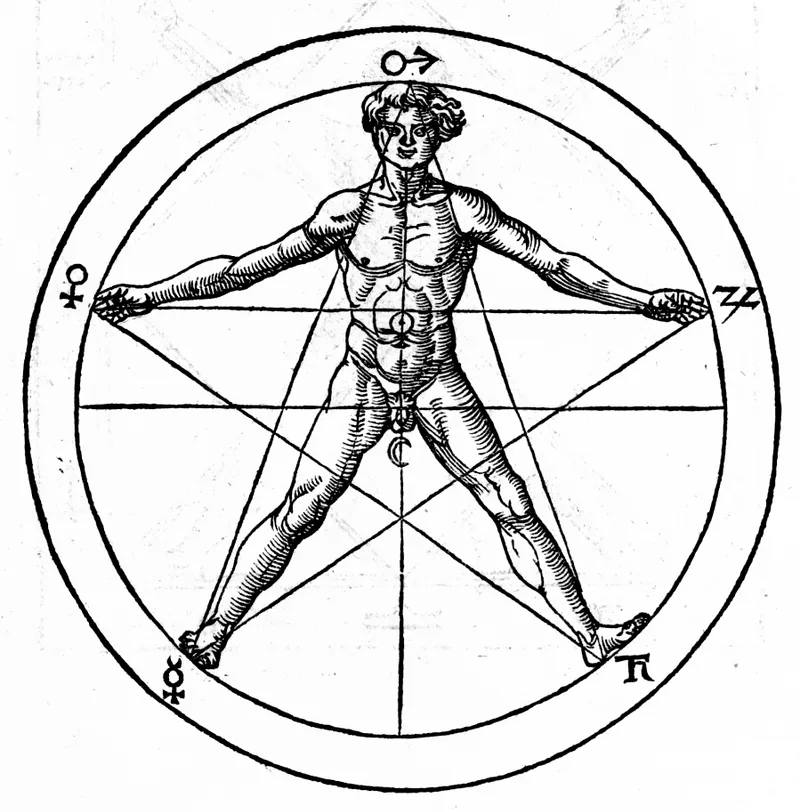
The association of point orientation with good and evil is modern. In his Dogme et rituel de la haute magie (1854–1856), Eliphas Lévi presented the upright pentagram as the sign of spirit governing the elements and the inverted pentagram as an image of the goat of the sabbath. The Hermetic Order of the Golden Dawn developed elaborate pentagram rituals, and in the twentieth century the upright pentagram within a circle, the pentacle, became the principal emblem of Wicca.
The hexagram§
The six-pointed star, two interlaced triangles, was used across the medieval Mediterranean in Jewish, Christian and Islamic contexts, often as the magical Seal of Solomon on amulets and in grimoires. In Western occultism the two triangles came to represent the union of opposites, fire and water, macrocosm and microcosm, "as above, so below". The Golden Dawn used the hexagram in planetary rituals, and Aleister Crowley popularised a unicursal hexagram that can be drawn in a single line, now an emblem of Thelema. Its separate history as a Jewish symbol is traced in Religious Symbols.
Seals, Sigils and Magic Squares§
Much occult symbolism is operative. Medieval and early modern grimoires such as the Key of Solomon provide pentacles to be engraved on metal or drawn on parchment, and the Ars Goetia gives each of its seventy-two spirits a seal. Agrippa published the magic squares (kameas) of the seven planets, number grids whose rows, columns and diagonals sum to the same total, and from them derived the seals of planetary intelligences and spirits by tracing lines through the numbers of their names.
Other complex seals include the Sigillum Dei, the "Seal of God", known from fourteenth-century manuscripts and redesigned by John Dee in 1582 for his angelic magic (see Sigillum Dei Aemeth and Enochian Magic). In the early twentieth century the English artist Austin Osman Spare developed a method of creating personal sigils by reducing a written statement of intent to a monogram, described in his Book of Pleasure (1913). This technique became central to Chaos Magick.
Rosicrucian and Hermetic Emblems§
The early modern period produced a rich repertory of esoteric emblems.
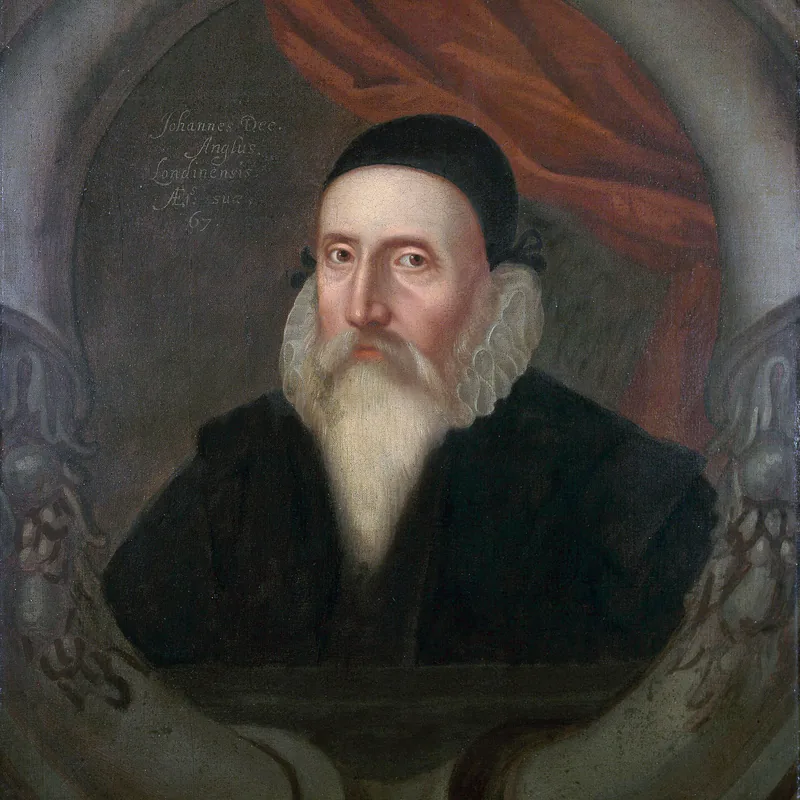
- The Hieroglyphic Monad. John Dee's Monas Hieroglyphica (1564) combined the signs of the Moon, Sun, the cross of the elements and the sign of Aries into one figure claimed to contain the whole of cosmology (see The Hieroglyphic Monad).
- The Rosy Cross. The Rosicrucian manifestos, published in 1614–1616, linked a rose and cross to a secret brotherhood of reform; later Rosicrucian and Golden Dawn orders elaborated the Rose Cross into a complex lamen bearing the Hebrew letters, elements and planets.
- The Tree of Life. The Kabbalistic diagram of ten sefirot, given its familiar Western form in the seventeenth century by Athanasius Kircher, became the master map of the Golden Dawn; see The Tree of Life.
- The ouroboros. The serpent devouring its tail, drawn in the Greek alchemical manuscript known as the Chrysopoeia of Cleopatra, signifies the unity and cyclical renewal of matter; see Alchemical Symbols.
- The Eye in the triangle. A Christian image of the all-seeing Trinity, adopted in Masonic imagery from the late eighteenth century and later in occult art.
Baphomet, the Inverted Cross and the Modern Left-Hand Path§
Baphomet first appears as the name of an idol the Knights Templar were accused of worshipping during their trials (1307–1312); the name is probably a medieval corruption of "Mahomet". Lévi's 1856 frontispiece of a winged, goat-headed androgyne with a torch between its horns and the words solve and coagula on its arms gave the figure its modern form. Lévi meant it as a symbol of the balance of opposites, not of Satan, but it became popularly identified with the Devil.
In 1969 the Church of Satan used the Sigil of Baphomet, a goat's head within an inverted pentagram surrounded by the Hebrew letters of Leviathan, on the cover of The Satanic Bible, adapting a design first published by the French occultist Stanislas de Guaita in 1897. The inverted cross has an older Christian meaning as the cross of St Peter, who according to tradition asked to be crucified upside down, but since the twentieth century it has also been used as an anti-Christian sign in popular culture. The Leviathan cross, an alchemical sign for sulphur, was adopted by LaVey as a Satanic emblem. For the wider context see The Temple of Set and the Left-Hand Path.
Occult Symbols in Popular Culture and Conspiracy Theory§
Since the late twentieth century, occult symbols have been everywhere: on album covers, fashion, film posters and tattoos. They are also misread. During the Satanic panic of the 1980s and early 1990s, police seminars and pamphlets taught that pentagrams, peace signs and heavy-metal logos were evidence of secret cults, claims later shown to be groundless. Conspiracy theories about "Illuminati symbols" frequently treat the Eye of Providence, pyramids and owls as hidden codes of a ruling elite, though their documented histories are mundane.
A historical approach respects these symbols better than either sensationalism or hidden-code theories. Each sign has a traceable story, and the same symbol may mean devotion to a Wiccan, protection to a medieval Christian and rebellion to a heavy-metal fan. Knowing which story applies depends on context.
Frequently asked questions§
Is the pentagram a satanic symbol?§
Not inherently. The pentagram has served as a Pythagorean sign of health, a Christian sign of Christ's wounds and the main emblem of Wicca. The inverted pentagram with a goat's head, the Sigil of Baphomet, is a Satanic emblem adopted by the Church of Satan in 1969.
What is a sigil?§
A sigil is a symbol used in magic to represent a spirit or intention. Traditional grimoires give fixed seals for spirits, while modern practitioners following Austin Osman Spare create personal sigils from written statements of intent.
Who created the image of Baphomet?§
The famous winged goat-headed figure was drawn by the French occultist Eliphas Lévi and published in 1856. The name itself comes from accusations against the Knights Templar in the early fourteenth century.
What does the unicursal hexagram mean?§
It is a six-pointed star that can be drawn in one continuous line, popularised by Aleister Crowley. In Thelema it serves as an emblem of the union of opposites and of the tradition itself.
Sources and further reading§
- Three Books of Occult Philosophy — Heinrich Cornelius Agrippa, 1533
- Transcendental Magic: Its Doctrine and Ritual — Eliphas Lévi, 1896
- The Golden Dawn — Israel Regardie, 1937
- The Hieroglyphic Monad — John Dee, 1564
- The Rosicrucian Enlightenment — Frances A. Yates, 1972
- The Book of Pleasure — Austin Osman Spare, 1913
- Seeing the Word: John Dee and Renaissance Occultism — Håkan Håkansson, 2001
- Western Esotericism: A Guide for the Perplexed — Wouter J. Hanegraaff, 2013