Liber XXIV · Satanism · Chapter I: Church of Satan
LaVeyan Satanism: Anton LaVey and the Church of Satan
LaVeyan Satanism explained: Anton LaVey, the Church of Satan (1966), The Satanic Bible, the Nine Satanic Statements, ritual as psychodrama and scholarship.

LaVeyan Satanism is the atheistic, symbolic form of Satanism founded by Anton Szandor LaVey (1930–1997), who established the Church of Satan in San Francisco in 1966 and set out its philosophy in The Satanic Bible (1969). It does not worship a literal Devil; instead it uses Satan as a symbol of human nature, pride, carnality and individualism, and treats ritual as a form of psychological drama. Scholars regard it as the first organised, publicly visible Satanic religion and the foundation of most later Satanic movements.
Anton LaVey: Life and Self-Presentation§
Anton LaVey was born Howard Stanton Levey in Chicago in 1930, and his family moved to the San Francisco Bay Area when he was young. In his own accounts and in the authorised biography by Burton H. Wolfe, The Devil's Avenger (1974), LaVey described a colourful youth: working as a lion tamer's assistant and organist in carnivals, playing organ in burlesque houses, and serving as a police photographer who witnessed the worst of human behaviour. He also claimed brief relationships with celebrities, including Marilyn Monroe.
Later investigators, notably the journalist Lawrence Wright in a 1991 Rolling Stone profile, could not confirm several of these claims and found evidence contradicting some of them. LaVey's daughter Zeena Schreck, who broke with her father in 1990, has also publicly disputed parts of his biography. Scholars generally treat LaVey's life story as partly a deliberate exercise in myth-making, which fits his own view of the value of showmanship and what he called "lesser magic". What is well documented is that by the early 1960s LaVey was a known figure in San Francisco, giving lectures on the occult, hosting a circle sometimes called the "Magic Circle" at his black-painted Victorian house on California Street, and cultivating an image as a local eccentric and expert on the bizarre.
Founding the Church of Satan in 1966§
LaVey announced the founding of the Church of Satan on the night of 30 April 1966, Walpurgisnacht, declaring it "Year One" of the Satanic age. He shaved his head, in imitation of executioners and carnival performers as he explained it, and adopted the title High Priest. The church attracted extensive press coverage over the following years, which LaVey actively encouraged.
Several events made headlines. In 1967 LaVey performed a Satanic wedding for the journalist John Raymond and socialite Judith Case, and a Satanic baptism for his three-year-old daughter Zeena; the same year he conducted a Satanic funeral, with military honours, for a sailor who had been a church member. Celebrities linked with the church in its early years included the actress Jayne Mansfield, and the entertainer Sammy Davis Jr. was reportedly an honorary member for a time. LaVey also claimed to have advised on the film Rosemary's Baby (1968) and to have appeared in it as the Devil, claims that later researchers have not been able to support.
During the late 1960s and 1970s, the church organised local branches called grottos. In 1975 LaVey disbanded the grotto system and moved to a more decentralised model, a decision that prompted several members, including Michael Aquino, to leave and form the Temple of Set, discussed in the Temple of Set and the left-hand path.
The Satanic Bible (1969) and Other Writings§
The Satanic Bible, published as a mass-market paperback by Avon Books in 1969, is the central text of LaVeyan Satanism. It is divided into four books named after the four elements and four infernal "crown princes":
- The Book of Satan (Fire) — a polemical prologue adapted largely from Might Is Right (1896), a social-Darwinist tract published under the pseudonym Ragnar Redbeard, often attributed to Arthur Desmond.
- The Book of Lucifer (Air) — essays on Satanic philosophy, covering topics such as indulgence, love and hate, sex, the meaning of Satan, and the Satanic view of death.
- The Book of Belial (Earth) — LaVey's theory of magic, both ritual ("greater magic") and everyday manipulation ("lesser magic").
- The Book of Leviathan (Water) — invocations and the "Enochian Keys", LaVey's adaptation of the angelic calls recorded by John Dee and Edward Kelley, discussed in Enochian magic.
Scholars have traced other borrowings and influences, including Ayn Rand's individualism, Friedrich Nietzsche's critique of Christian morality, the human-potential psychology of the period and the showmanship of carnival culture. LaVey followed it with The Compleat Witch (1971, later reissued as The Satanic Witch), The Satanic Rituals (1972), and collections of essays including The Devil's Notebook (1992) and the posthumous Satan Speaks! (1998).
James R. Lewis has analysed The Satanic Bible as a source of authority functioning rather like scripture for many Satanists, including those outside the Church of Satan, noting its enduring importance despite LaVey's own scepticism toward sacred texts.
Core Beliefs: Atheistic and Symbolic Satanism§
LaVeyan Satanism is atheistic in the sense that it denies the existence of God, the Devil and any supernatural beings. Satan is understood as a symbol of the qualities that Christianity has historically condemned: pride, sensuality, self-interest, scepticism and rebellion against imposed authority. LaVey described his religion as a philosophy of rational self-interest that celebrates the carnal self, a position informed by the Romantic image of Satan as rebel traced in the history of Satan and the Devil.
Core emphases include:
- Indulgence instead of abstinence, though LaVey distinguished indulgence from compulsion: the Satanist is meant to choose pleasures consciously.
- Individualism and self-deification, in which the self is the centre of one's moral universe.
- Responsibility to the responsible, rather than universal altruism.
- Lex talionis, a principle of proportionate retaliation against those who do harm.
- Scepticism and materialism, alongside an appreciation of the aesthetic and emotional power of ritual.
The Nine Satanic Statements (Paraphrased)§
The Nine Satanic Statements open The Satanic Bible and summarise the philosophy. In paraphrase, they assert that Satan represents: indulgence rather than abstinence; vital existence rather than spiritual fantasy; undefiled wisdom rather than hypocritical self-deceit; kindness toward those who deserve it rather than love wasted on ingrates; vengeance rather than turning the other cheek; responsibility to the responsible rather than concern for "psychic vampires"; humanity as simply another animal, often worse than the others; all the so-called sins, as leading to physical, mental or emotional gratification; and finally, that Satan has been the Church's best friend, since he has kept it in business.
LaVey and the church later added the Eleven Satanic Rules of the Earth (written in 1967) and the Nine Satanic Sins (published 1987), which list faults such as stupidity, pretentiousness, self-deceit and herd conformity. These texts also prohibit harming children and non-human animals and emphasise respect for others' property and personal boundaries.
Ritual as Psychodrama§
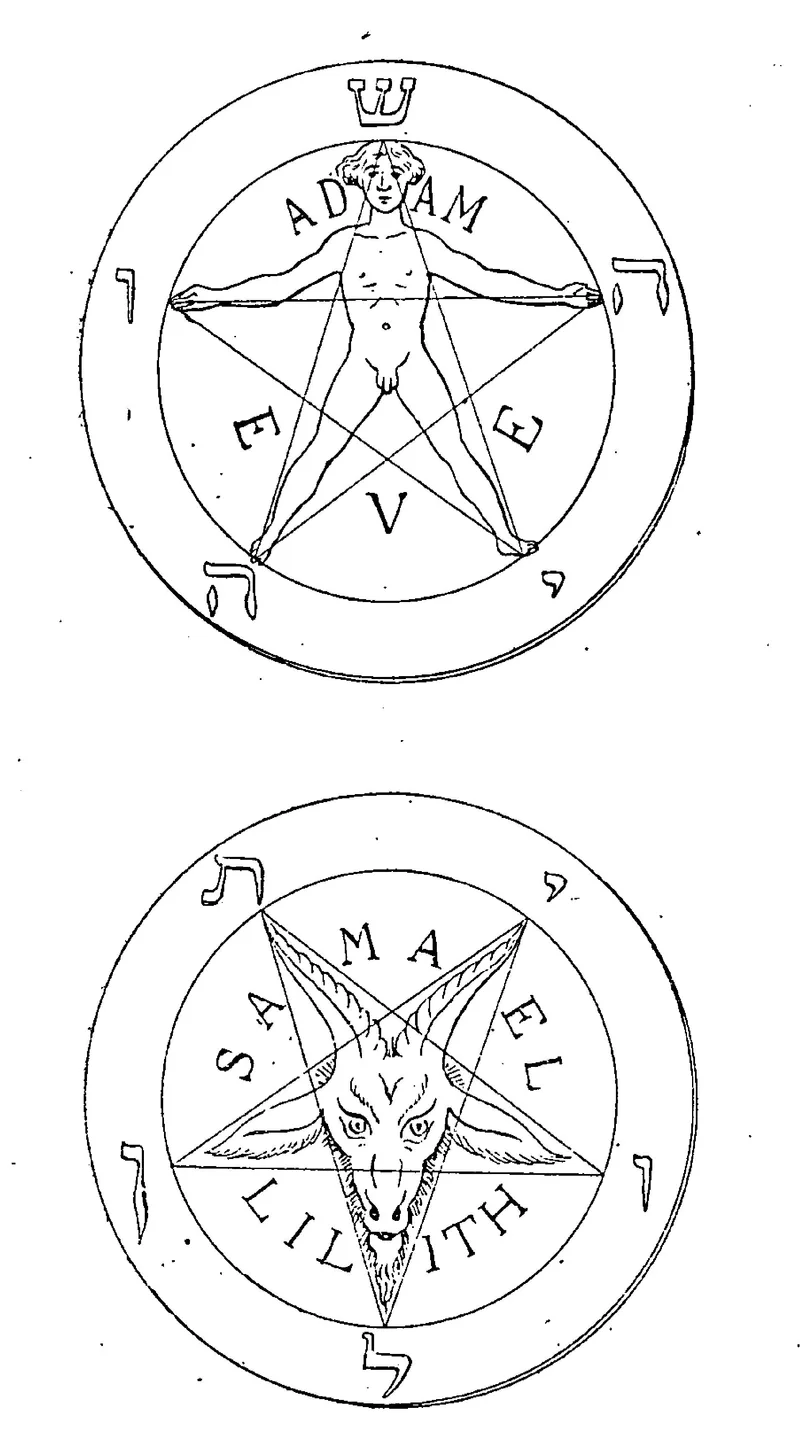
Although atheistic, LaVeyan Satanism retains ritual. LaVey called the ritual chamber an "intellectual decompression chamber", a space where the participant could set aside rational restraint and release powerful emotions through theatrical means. The Satanic Bible describes three types of "greater magic" ritual: for lust (sexual desire), for compassion (helping oneself or others) and for destruction (venting anger toward an enemy). The ritual paraphernalia includes black robes, an altar, the Sigil of Baphomet (a goat's head in an inverted pentagram), a bell, a chalice, a sword, candles and a gong.
LaVey's concept of "lesser magic" refers to everyday influence through appearance, charm, timing and an understanding of human psychology, drawing on his experience as a performer. Scholars such as Jesper Aagaard Petersen have described this combination as an "esoteric" use of psychology, in which supernatural language is reinterpreted in terms of emotion and will. LaVey's ritual vocabulary also draws on ceremonial magic, including Aleister Crowley, even though LaVey was sharply critical of Crowley.
LaVeyan rituals were sometimes misrepresented in later decades, especially during the Satanic panic, when claims of human or animal sacrifice were attributed to Satanists. The Church of Satan's own texts explicitly forbid such acts, and investigations found no evidence linking the church to organised violence of that kind.
The Church of Satan After LaVey§
LaVey's later years were relatively reclusive. His partner Blanche Barton, mother of his son Satan Xerxes Carnacki LaVey (born 1993), became High Priestess and led the church after LaVey's death in October 1997. In 2001 Peter H. Gilmore was appointed High Priest and Peggy Nadramia High Priestess. Gilmore, a writer and composer, has articulated the church's philosophy in The Satanic Scriptures (2007) and in numerous essays and interviews, emphasising Satanism as a demanding, elitist philosophy for self-directed individuals and rejecting both theistic interpretations and political activism in the church's name.
The Church of Satan today is administered primarily online, with membership by application, and does not publish membership numbers. It has frequently distanced itself from other groups that use the name Satanism, including theistic Satanists and The Satanic Temple, arguing that LaVey's formulation is the authentic definition of the religion. Other scholars and groups dispute this claim to exclusive authority.
What Scholars Say About LaVeyan Satanism§
Academic study of Satanism developed seriously from the 2000s. Key works include Contemporary Religious Satanism: A Critical Anthology (2009), edited by Jesper Aagaard Petersen; The Devil's Party: Satanism in Modernity (2013), edited by Per Faxneld and Jesper Aa. Petersen; and The Invention of Satanism (2016) by Asbjørn Dyrendal, James R. Lewis and Petersen.
These scholars generally describe LaVeyan Satanism as a genuinely new religious movement that emerged from the American counterculture, combining the Romantic literary tradition of Satan as rebel, popular occultism, secular humanism, libertarian individualism and the entertainment culture of mid-century America. Dyrendal, Lewis and Petersen argue that LaVey effectively "invented" Satanism as a self-declared religion: before 1966, the term mostly described an accusation against others rather than a self-identity. They also distinguish between "rationalist" Satanism of the LaVeyan type and "esoteric" or theistic Satanisms, and note the movement's continuing reliance on The Satanic Bible.
Critics, both religious and secular, have objected to the church's elitism, its social-Darwinist elements and LaVey's provocative statements, while sympathetic observers emphasise its anti-dogmatic stance and its ethic of personal responsibility. Most scholars agree that the church's public image owes much to LaVey's skill as a showman, and that its real influence has been cultural as well as religious.
Frequently asked questions§
Do LaVeyan Satanists worship the Devil?§
No. LaVeyan Satanism is atheistic and does not believe in a literal Satan or God. Satan is treated as a symbol of human nature, individualism and rebellion against imposed morality. Rituals are understood as psychological rather than supernatural.
What is The Satanic Bible?§
The Satanic Bible is a 1969 book by Anton LaVey that sets out the philosophy, magical theory and rituals of the Church of Satan. It contains the Nine Satanic Statements, essays on Satanic ethics, a theory of "greater" and "lesser" magic, and adapted Enochian invocations. It remains the most widely read text of modern Satanism.
Who leads the Church of Satan today?§
Peter H. Gilmore has served as High Priest of the Church of Satan since 2001, with Peggy Nadramia as High Priestess. Before that, Blanche Barton led the church following Anton LaVey's death in 1997.
Is the Church of Satan the same as The Satanic Temple?§
No. The Church of Satan was founded in 1966 by Anton LaVey and follows his philosophy. The Satanic Temple is a separate organisation founded in 2013 that focuses on religious pluralism and political activism. The two groups have publicly disagreed about the meaning of Satanism.
Sources and further reading§
- The Satanic Bible — Anton Szandor LaVey, 1969
- The Satanic Rituals — Anton Szandor LaVey, 1972
- The Satanic Scriptures — Peter H. Gilmore, 2007
- The Devil's Avenger: A Biography of Anton Szandor LaVey — Burton H. Wolfe, 1974
- The Secret Life of a Satanist — Blanche Barton, 1990
- Contemporary Religious Satanism: A Critical Anthology — Jesper Aagaard Petersen (ed.), 2009
- The Devil's Party: Satanism in Modernity — Per Faxneld and Jesper Aa. Petersen (eds.), 2013
- The Invention of Satanism — Asbjørn Dyrendal, James R. Lewis and Jesper Aa. Petersen, 2016