Liber I · Alchemy · Chapter V: History of Alchemy
History of Western Alchemy: From Zosimos to Newton
The history of Western alchemy: Zosimos, the Jabir corpus, Latin translations, the Philosopher's Stone, Paracelsus, Newton, Boyle and Jung's spiritual reading.

Western alchemy is the tradition, running from Greco-Roman Egypt through the medieval Islamic world to early modern Europe, that sought to transform matter, above all to turn base metals into gold and to prepare medicines, by means of the Philosopher's Stone. It was at once a practical laboratory craft, a body of natural philosophy and, for many of its writers, a spiritual discipline; modern historians now see it as a direct ancestor of chemistry rather than its superstitious opposite.
Greco-Egyptian origins: Zosimos of Panopolis§
Alchemy in the West emerges in Roman Egypt, where Greek philosophy met Egyptian metallurgical and dyeing crafts. Early recipe collections, such as the Leiden and Stockholm papyri (third century CE), give practical instructions for imitating gold and silver, dyeing textiles and making gems. Texts attributed to "Democritus" and to legendary women alchemists such as Maria the Jewess, credited with devising apparatus such as the kerotakis and the water bath later called the bain-marie, are known through later quotation.
The first alchemist whose writings survive in substantial form is Zosimos of Panopolis (fl. c. 300 CE). Writing for a woman named Theosebeia, he described apparatus and procedures alongside a series of visionary dreams in which figures are dismembered, boiled and transformed, imagery later read as describing chemical processes allegorically. Zosimos linked the craft to Gnostic and Hermetic ideas of the soul's purification, establishing early the double character of alchemy as both technique and spiritual path. Byzantine scholars later compiled these Greek writings into anthologies that preserved them.
Arabic alchemy and the Jabir corpus§
After the Arab conquests, Greek alchemical learning passed into Arabic, and from the eighth to the tenth centuries alchemy flourished in the Islamic world. A huge body of writings is attributed to Jabir ibn Hayyan, a figure traditionally placed in the eighth century. Paul Kraus's research in the 1940s argued that the Jabirian corpus was largely produced by a school of writers in the ninth and tenth centuries, and the question of Jabir's historicity remains debated.
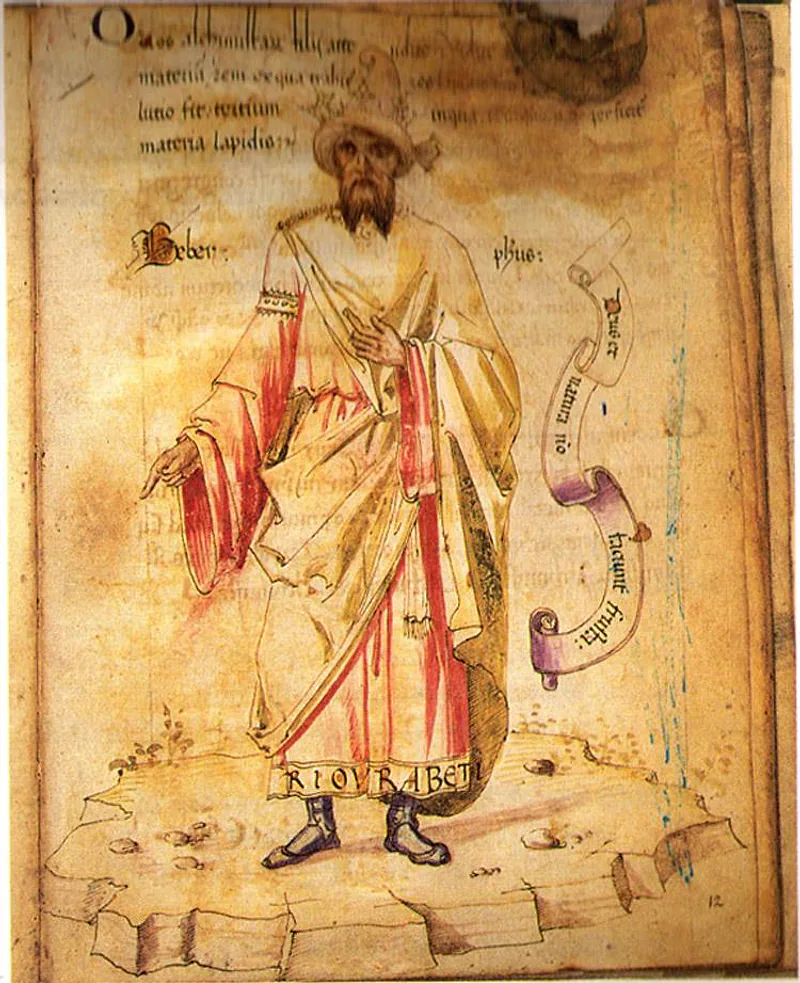
The Jabirian texts developed the influential sulphur–mercury theory: all metals are composed of two principles, a fiery, combustible "sulphur" and a fluid, volatile "mercury," and differ according to their proportions and purity. Gold represents perfect balance. The physician and philosopher Abu Bakr al-Razi (d. c. 925) wrote systematic, practically oriented works classifying substances and apparatus. The Arabic tradition also gave the West the word al-kīmiyāʾ itself, the term al-iksīr (elixir), and the short, enigmatic Emerald Tablet, first attested in Arabic and attributed to Hermes Trismegistus, which became a foundational text of European alchemy.
Latin translations and medieval European alchemy§
Alchemy entered Latin Europe through translation. The traditional starting point is Robert of Chester's translation of an Arabic work, Liber de compositione alchemiae, dated 1144. Over the next century many Arabic texts were translated in Spain and Italy, and Latin authors began writing their own. Around the late thirteenth century an anonymous author, writing under the name "Geber" (the Latin form of Jabir), produced the Summa perfectionis, a clear, practically grounded treatise that William Newman has shown to be a Latin original, probably by the Franciscan Paul of Taranto. It became one of the most authoritative alchemical texts in Europe.
Medieval scholastics debated whether art could truly transform species, and in 1317 Pope John XXII issued a decree against fraudulent alchemists who produced counterfeit coin. Many alchemical works were attributed pseudonymously to famous figures, including Albertus Magnus, Thomas Aquinas, Roger Bacon, Ramon Llull and Arnald of Villanova. Later legends grew up around Nicolas Flamel, the Parisian scribe (d. 1418) whose reputation as a successful adept stems from texts published long after his death.
The Philosopher's Stone and the stages of the Great Work§
The goal of the "Great Work" (magnum opus) was the Philosopher's Stone (lapis philosophorum), a substance able to transmute base metals into silver or gold when projected upon them, and often also a universal medicine able to cure disease and prolong life. Alchemists disagreed about its starting material, the "first matter," and described it in deliberately obscure language, with symbols such as the green lion, the red king and white queen, the pelican and the ouroboros, the serpent biting its tail.
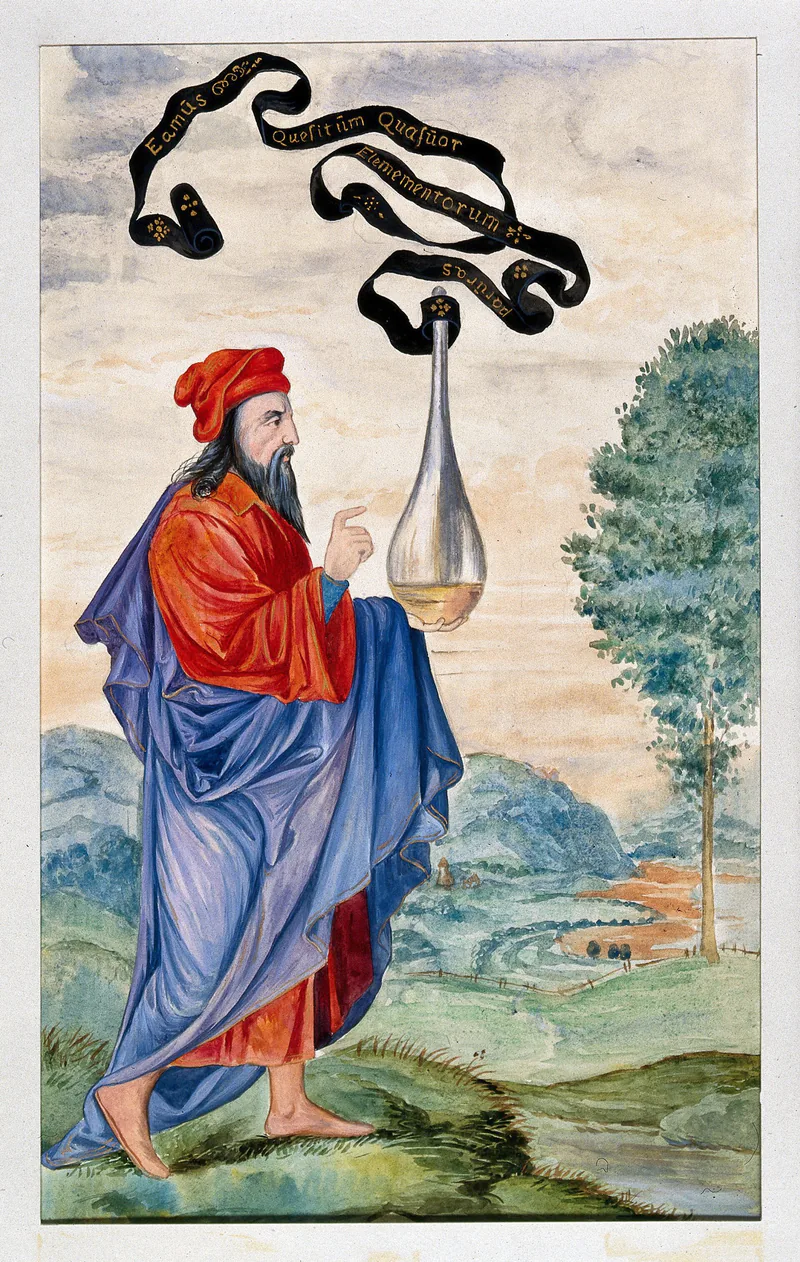
Many texts describe the work as a sequence of colour changes:
- Nigredo (blackening): putrefaction and dissolution of the matter, often associated with death and the crow.
- Albedo (whitening): purification and washing, yielding a white stone capable of making silver.
- Citrinitas (yellowing): a stage named in earlier sources but often omitted from later schemes.
- Rubedo (reddening): the final perfection, producing the red stone that makes gold.
Other schemes list seven or twelve operations, such as calcination, solution, separation, conjunction, putrefaction, coagulation and projection. These sequences correspond partly to observable changes in heated materials and partly to a symbolic narrative of death and resurrection.
Paracelsus and the tria prima§
Paracelsus (Theophrastus von Hohenheim, 1493/4–1541), a Swiss-German physician, redirected alchemy toward medicine. He attacked the authority of Galen and Avicenna, taught that diseases had specific external causes and called for chemically prepared remedies. His followers, the Paracelsians, developed "iatrochemistry," chemical medicine, which influenced pharmacy for two centuries.
Paracelsus added a third principle to the sulphur–mercury pair: salt. The resulting tria prima held that all bodies consist of sulphur (combustibility, the soul), mercury (volatility, the spirit) and salt (fixity, the body). Burning wood illustrated the theory: flame was sulphur, smoke was mercury and ash was salt. The tria prima became a mainstay of later alchemical and Rosicrucian thought, and it still appears as a symbolic triad in Hermetic and Golden Dawn teaching.
Newton, Boyle and early modern chymistry§
The seventeenth century was a golden age of alchemical publishing, with richly illustrated works such as Michael Maier's Atalanta fugiens (1617). It was also when alchemy's apparent decline began, though historians now tell this story differently. Robert Boyle (1627–1691), long celebrated as a founder of modern chemistry for The Sceptical Chymist (1661), believed in the possibility of transmutation and lobbied in 1689 for the repeal of an English statute against "multiplying" gold. Isaac Newton (1643–1727) left over a million words of alchemical manuscripts, studied the writings of the American alchemist George Starkey ("Eirenaeus Philalethes") and carried out extensive experiments.
Lawrence Principe and William Newman have argued that seventeenth-century practitioners did not draw a sharp line between "alchemy" and "chemistry." They use the period spelling "chymistry" for this unified field, in which transmutational goals coexisted with productive work on metals, salts, acids and medicines. The separation of alchemy as an occult pursuit was largely an eighteenth-century development, as chemists distanced themselves from transmutation.
Spiritual alchemy and Jung's psychological reading§
Alongside laboratory work, some alchemists understood the Great Work in spiritual or theological terms. Heinrich Khunrath's Amphitheatrum sapientiae aeternae (1595/1609) presented alchemy within a mystical Christian framework, and Jacob Boehme used alchemical language for the soul's regeneration. In the nineteenth century, Mary Anne Atwood's A Suggestive Inquiry into the Hermetic Mystery (1850) and the American writer Ethan Allen Hitchcock argued that alchemy had always been purely spiritual, a view that strongly shaped occultists.
C. G. Jung gave this approach its most influential modern form. In Psychology and Alchemy (1944) and Mysterium Coniunctionis (1955–56) he interpreted alchemical imagery as projections of unconscious processes, with the stages from nigredo to rubedo mirroring individuation. Principe and Newman have criticised the Jungian and Victorian spiritual readings as anachronistic when applied to texts that were often straightforward, if coded, laboratory instructions. Today, historians generally hold that alchemy was diverse: some authors were practical chymists, some spiritual allegorists, and many were both. Comparison with the Chinese neidan tradition, which made a similar move from laboratory to inner work, is instructive.
Frequently asked questions§
What was the Philosopher's Stone supposed to do?§
The Philosopher's Stone was believed to transmute base metals such as lead into gold or silver when projected onto them. Many alchemists also considered it a universal medicine that could cure illness and extend life.
What are nigredo, albedo, citrinitas and rubedo?§
They are the colour stages of the alchemical Great Work: blackening, whitening, yellowing and reddening. They describe the putrefaction, purification and final perfection of the matter, and were later read symbolically as stages of spiritual or psychological transformation.
Did Isaac Newton practise alchemy?§
Yes. Newton wrote extensively on alchemy, copying and annotating texts and conducting many experiments over several decades. His alchemical papers, largely unpublished in his lifetime, are now studied as a serious part of his scientific work.
What is the tria prima?§
The tria prima, introduced by Paracelsus, holds that all bodies are composed of three principles: sulphur, mercury and salt. It extended the older Arabic theory that metals were composed of sulphur and mercury.
Sources and further reading§
- The Secrets of Alchemy — Lawrence M. Principe, 2013
- Alchemy Tried in the Fire: Starkey, Boyle, and the Fate of Helmontian Chymistry — William R. Newman and Lawrence M. Principe, 2002
- Newton the Alchemist — William R. Newman, 2019
- Psychology and Alchemy — C. G. Jung, 1944
- The Summa Perfectionis of Pseudo-Geber — ed. and trans. William R. Newman, 1991
- The Janus Faces of Genius: The Role of Alchemy in Newton's Thought — Betty Jo Teeter Dobbs, 1991
- The Sceptical Chymist — Robert Boyle, 1661