Liber I · Alchemy · Chapter V: History of Alchemy
Isaac Newton's Alchemy: The Manuscripts, Sources and Meaning
Isaac Newton's alchemy: the papers sold in 1936, his laboratory, Philalethes and the green lion, Praxis, the 1693 crisis and what historians now conclude.

Isaac Newton (1642–1727) studied and practised alchemy intensively for nearly three decades, leaving manuscripts on the subject commonly estimated at around a million words. These papers, largely unknown until they were sold at auction in 1936, show the author of the Principia copying alchemical texts, compiling indexes of their symbols and carrying out long series of experiments in his own laboratory at Trinity College, Cambridge. Historians now regard his alchemy not as an embarrassing hobby but as a serious part of his natural philosophy, though they still debate how far it shaped his physics.
The discovery of Newton's alchemical papers§
For two centuries after his death, Newton's reputation rested on the Principia (1687) and the Opticks (1704), and his alchemical manuscripts remained in the hands of his heirs, the Earls of Portsmouth. When Cambridge University received the scientific papers in the 1880s, the alchemical and theological material was judged of little value and returned to the family. In July 1936 the remaining Portsmouth papers were auctioned at Sotheby's in London and dispersed among many buyers.
The economist John Maynard Keynes bought a large part of the alchemical manuscripts and later bequeathed them to King's College, Cambridge; the scholar Abraham Shalom Yahuda acquired much of the theological material, now in the National Library of Israel. Keynes's essay "Newton, the Man", read in 1946 shortly after his death, famously described Newton as "the last of the magicians" rather than the first figure of the age of reason. The phrase was memorable but oversimplified, and it set the terms of debate for decades.
When and how Newton studied alchemy§
Newton seems to have turned to chemistry and alchemy in the late 1660s. A notebook records purchases in 1669 of furnaces, glassware, chemicals and the multi-volume alchemical anthology Theatrum chemicum. His library at his death contained well over a hundred alchemical books, a significant share of the whole, as John Harrison's catalogue of the library showed in 1978.
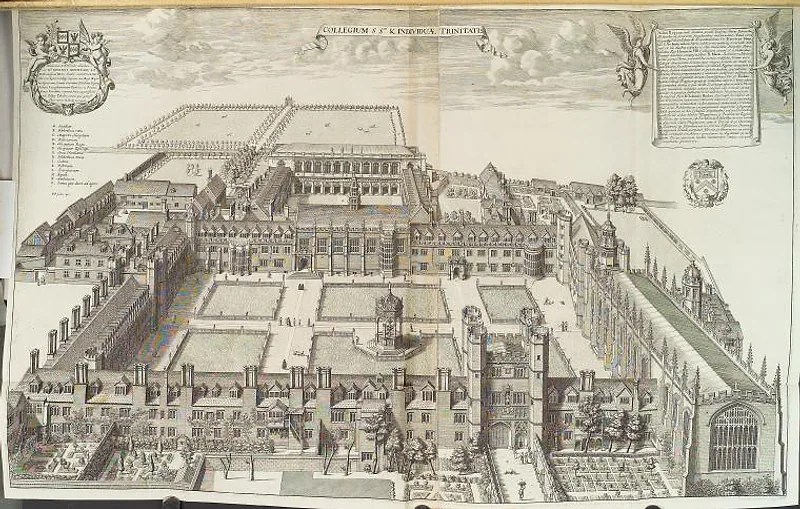
He read with extraordinary thoroughness, copying whole treatises by hand, collating different versions and building up an Index chemicus, a reference work of several hundred headings that drew together what different authors said about each term or substance. He also translated the Emerald Tablet and wrote a commentary on it. At the same time he worked in a laboratory set up in the garden of his rooms at Trinity. His assistant Humphrey Newton later recalled that during spring and autumn the furnace fires were kept going for weeks at a time and that Newton often worked late into the night. Newton's laboratory notebooks record experiments in detail, often using alchemical names for his materials. They are historical documents; the substances he handled, including mercury and lead, were toxic, and his experiments are studied today for what they reveal about his thought, not as procedures to repeat.
Newton's sources: Philalethes, Sendivogius and the green lion§
Newton was not inventing alchemy anew; he was trying to decode an existing literature. His favourite author was "Eirenaeus Philalethes", the pseudonym of the American-born chymist George Starkey (1628–1665), whose treatises on the preparation of a special "philosophical mercury" were among the most widely read alchemical works of the seventeenth century. Newton also studied Michael Sendivogius, the Polish alchemist whose Novum lumen chymicum (1604) taught that a hidden "salt" or "food of life" in the air sustained nature.
He read the English alchemical poems gathered by Elias Ashmole in the Theatrum Chemicum Britannicum (1652), which can be read in the reading room. One of these, "The Hunting of the Greene Lyon", gave Betty Jo Teeter Dobbs the subtitle of her pioneering study of 1975. The green lion, the "net", the "doves of Diana" and the "star" of antimony were all images that Newton tried to match with laboratory substances and procedures.
For a time scholars believed that one short text, the Clavis ("key"), recorded Newton's own discovery. William Newman later showed that it is a copy of a work by Starkey, a reminder of how much of the archive consists of Newton's careful transcriptions of other authors. Newton also exchanged alchemical information with Robert Boyle and, after Boyle's death in 1691, with John Locke. In 1676 he advised that a process Boyle had published should have been kept in "high silence", a sign of how seriously he took the tradition of secrecy.
Key manuscripts: Of Natures Obvious Laws and Praxis§
Among the most revealing of Newton's own compositions is a treatise usually known by its opening words, Of Natures obvious laws & processes in vegetation, probably written in the early 1670s and now in the Dibner Library of the Smithsonian Institution. In it Newton distinguished between ordinary or "vulgar" chemistry, which merely rearranged particles mechanically, and a subtler process of "vegetation" by which a hidden, life-giving spirit brought about growth and transformation in metals as in plants and animals. He imagined the earth as a great living body that breathes in and out an ethereal spirit.
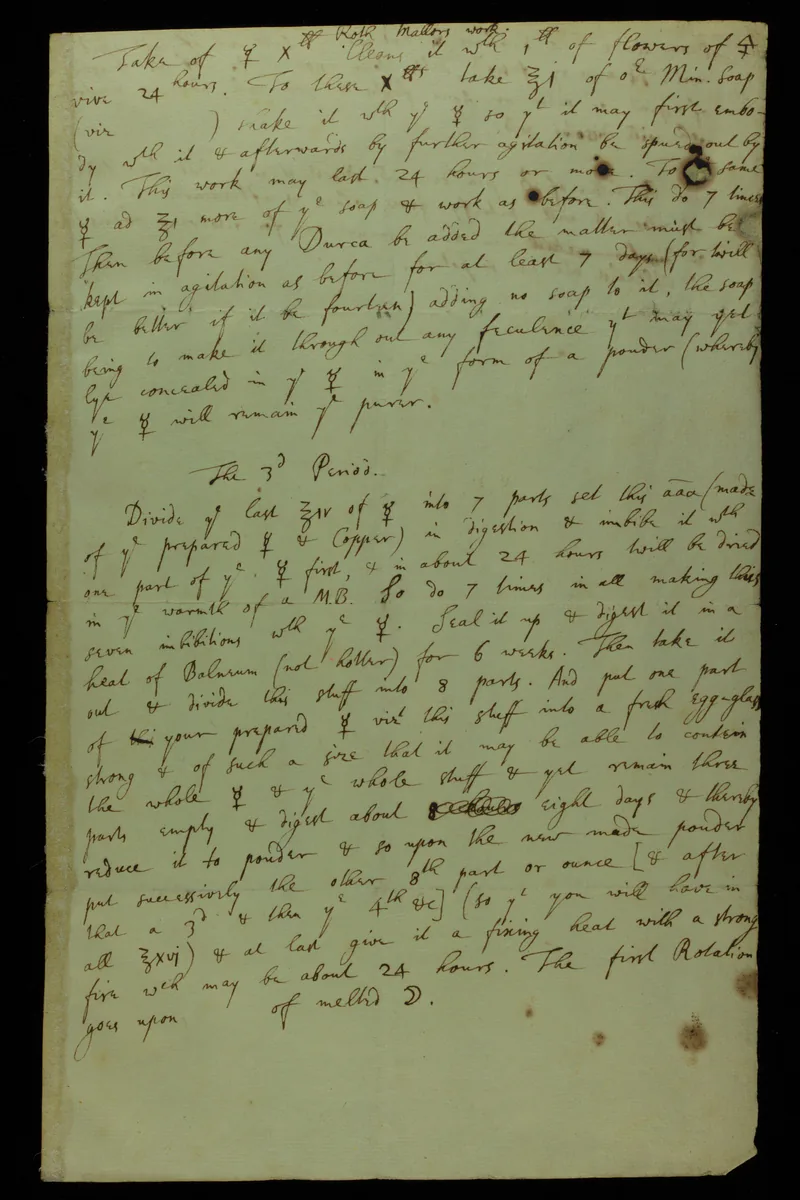
Praxis, written around 1693, is the most ambitious of his alchemical papers. Drawing on Philalethes and many other authors, it attempts to set out the stages of the Great Work in order, including the multiplication of the Philosopher's Stone. Historians disagree about whether it records experimental success, reflects a hopeful reading of texts, or belongs to the troubled period of 1693. Newton signed some of his alchemical papers with the pseudonym Jeova sanctus unus, "Jehovah the holy one", an anagram of the Latin form of his name that also expressed his anti-Trinitarian faith in one God.
Alchemy, religion and the active principles of nature§
Why did Newton pursue alchemy? Dobbs argued in The Janus Faces of Genius (1991) that alchemy offered him a way of understanding the active, non-mechanical principles in nature, such as fermentation, growth and attraction, which strict mechanical philosophy could not explain. She and Richard Westfall suggested that alchemical ideas of hidden forces may have helped make Newton willing to accept gravitational attraction acting at a distance, a concept his critics called occult.
His published work contains traces of these interests. His "Hypothesis of Light" of 1675 described nature as "a perpetual circulatory worker", and the queries added to later editions of the Opticks speculate on attractive forces, fermentation and the activity of matter in ways that echo his alchemical reading. Newton also believed in an ancient wisdom, the prisca sapientia, which he thought had been known to early sages and later corrupted, a view described in the article on ancient theology. Alchemy, for him, could be one route back to that lost understanding of God's action in the world.
The crisis of 1693 and the mercury hypothesis§
In 1693 Newton suffered a serious breakdown. His letters to Samuel Pepys and John Locke from that autumn show insomnia, suspicion and confusion, and he later apologised for them. Because his laboratory work involved prolonged heating of metals, some scholars have suggested that he suffered from heavy-metal poisoning. Analyses of hair samples attributed to him, published in 1979, reported elevated levels of mercury and other metals.
The hypothesis remains uncertain. The provenance of the hair is not beyond doubt, and the symptoms of 1693 can also be explained by overwork, sleeplessness, personal disappointments and depression. What is clear is that the episode coincided with the end of his most intense period of alchemical work. In 1696 he moved to London as Warden of the Mint, and although he kept reading and annotating alchemical texts, his laboratory years were largely over.
How historians interpret Newton's alchemy§
Interpretations of Newton's alchemy have changed considerably. Keynes's "magician" was followed by Dobbs's careful reconstruction of his sources, Westfall's biography Never at Rest (1980), which took the alchemy seriously as part of his intellectual life, and a long debate about its relation to his physics. More popular books, such as Michael White's Isaac Newton: The Last Sorcerer (1997), emphasised the contrast between the rational scientist and the secret alchemist.
The most recent major study, William Newman's Newton the Alchemist (2019), rejects that contrast. Working with a long-running digital edition of the manuscripts and with laboratory reconstructions of seventeenth-century recipes, Newman shows that Newton's alchemy was a disciplined attempt to decipher difficult texts and test them experimentally, continuous with the chymistry of Boyle and Starkey. On this reading Newton was neither a magician nor a modern chemist but a natural philosopher working in a tradition that, as the history of Western alchemy shows, had not yet separated chemistry from alchemy. His case is now a central example in discussions of occultism and science.
Frequently asked questions§
Was Isaac Newton an alchemist?§
Yes. From the late 1660s to the mid-1690s he read, copied and indexed alchemical texts and carried out extensive experiments in his own laboratory. His alchemical papers are commonly estimated at around a million words.
Did Newton believe in the Philosopher's Stone?§
His writings show that he took the possibility seriously and tried to understand how it was prepared, especially from the works of Philalethes. There is no evidence that he believed he had made it.
Where are Newton's alchemical manuscripts today?§
After the Sotheby's sale of 1936 they were dispersed. The largest group, bought by John Maynard Keynes, is at King's College, Cambridge; others are in libraries such as the Dibner Library of the Smithsonian and collections in Britain, the United States and Israel.
Sources and further reading§
- The Foundations of Newton's Alchemy, or "The Hunting of the Greene Lyon" — Betty Jo Teeter Dobbs, 1975
- The Janus Faces of Genius: The Role of Alchemy in Newton's Thought — Betty Jo Teeter Dobbs, 1991
- Newton the Alchemist: Science, Enigma, and the Quest for Nature's Secret Fire — William R. Newman, 2019
- Never at Rest: A Biography of Isaac Newton — Richard S. Westfall, 1980
- The Library of Isaac Newton — John Harrison, 1978
- Priest of Nature: The Religious Worlds of Isaac Newton — Rob Iliffe, 2017
- Isaac Newton: The Last Sorcerer — Michael White, 1997
- Theatrum Chemicum Britannicum — Elias Ashmole, 1652