The Philosopher's Stone: History, Meaning and Legends
The Philosopher's Stone explained: its origins in Greek and Arabic alchemy, transmutation and projection, the elixir of life, famous claims and its symbolism.

The Philosopher's Stone (Latin lapis philosophorum) was the central goal of Western alchemy: a substance believed to turn base metals such as lead or mercury into silver or gold, and often also to cure disease and prolong life. Alchemists described it as a heavy red or white powder, or a glassy, waxy mass, produced by a long sequence of operations called the Great Work. For roughly fifteen centuries, from Greco-Egyptian Alexandria to the age of Boyle and Newton, learned people debated whether it could be made, how it worked, and what it meant.
Origins of the Stone in Greek and Arabic alchemy§
The earliest alchemical writings, composed in Greek in Roman Egypt, speak less of a "stone" than of tinctures and dyes that could colour metals and make them "golden" in depth rather than on the surface. Zosimos of Panopolis, writing around 300 CE, and his successors described a powerful dry agent, the xērion, that would transform a prepared metal. The famous riddle of a "stone that is not a stone", common in later texts, probably reflects this tradition: the agent was mineral in origin yet unlike any ordinary stone.
Arabic-speaking alchemists of the ninth and tenth centuries turned the xērion into the iksīr, the elixir, and made it the organising concept of their art. The writings attributed to Jabir ibn Hayyan describe elixirs prepared from mineral, vegetable and even animal substances, each designed to correct a precise imbalance in a metal's qualities. Abu Bakr al-Razi (d. c. 925) classified the substances of the laboratory and treated the elixir as a practical preparation. When these works were translated into Latin from the twelfth century, al-iksīr became elixir, and the term lapis philosophorum spread through the new Latin literature. The background to this transmission is told in the history of Western alchemy.
What the Stone was supposed to do: transmutation and projection§
The Stone's best-known power was transmutation. A small amount, usually wrapped in paper or wax, was "projected" onto molten lead or heated mercury, which was then said to turn into gold. Texts disagree wildly about the ratio: modest accounts claim one part of Stone transmutes ten parts of metal, while later works attributed to Ramon Llull and others speak of a thousandfold or a millionfold multiplication. The Stone could also be "multiplied", that is, repeatedly dissolved and fixed again to increase its potency.

Most authors distinguished two grades. The white stone or white elixir perfected metals to silver; the red stone perfected them to gold. In the colour sequence of the Great Work, the white stage (albedo) produced the first and the red stage (rubedo) the second. Writers also stressed that the Stone did not create gold from nothing: it acted like a ferment or a seed, completing a natural ripening that metals underwent slowly in the earth.
Theories of how the Stone worked§
The Stone made sense within a specific theory of matter. Following Aristotle, alchemists held that all bodies were composed of the four elements and that their qualities (hot, cold, wet, dry) could change. From the Arabic period onward, a more specific doctrine dominated: all metals were formed underground from two principles, sulphur and mercury, combined in different degrees of purity and proportion. Gold was the perfect and balanced union; lead, tin, iron and copper were the same principles in impure or unbalanced form. The doctrine appears in the Arabic Book of the Secret of Creation attributed to Balinas, the same text that preserves the earliest version of the Emerald Tablet.
If metals differed only in purity and balance, a sufficiently concentrated "medicine" could correct them. The thirteenth-century Latin Summa perfectionis, attributed to "Geber", gave this idea a sophisticated form, speaking of medicines of the first, second and third order and explaining their action in terms of tiny particles that penetrated and fixed the metal. Paracelsus later added salt as a third principle (the tria prima), and seventeenth-century chymists such as George Starkey and Robert Boyle explained the Stone in increasingly corpuscular terms. The theory was coherent by the standards of its day, which is why serious natural philosophers took it seriously.
The Stone as universal medicine and elixir of life§
From the late Middle Ages, the Stone was also the supreme medicine. If it could remove the "disease" of base metals, it seemed reasonable that it might cure the human body. Roger Bacon wrote of alchemy's power to prolong life, and the fourteenth-century Franciscan John of Rupescissa described a "quintessence" distilled from wine (essentially strong alcohol) and infused with gold and other substances as a medicine against corruption. Potable gold (aurum potabile) became a celebrated, and expensive, remedy.
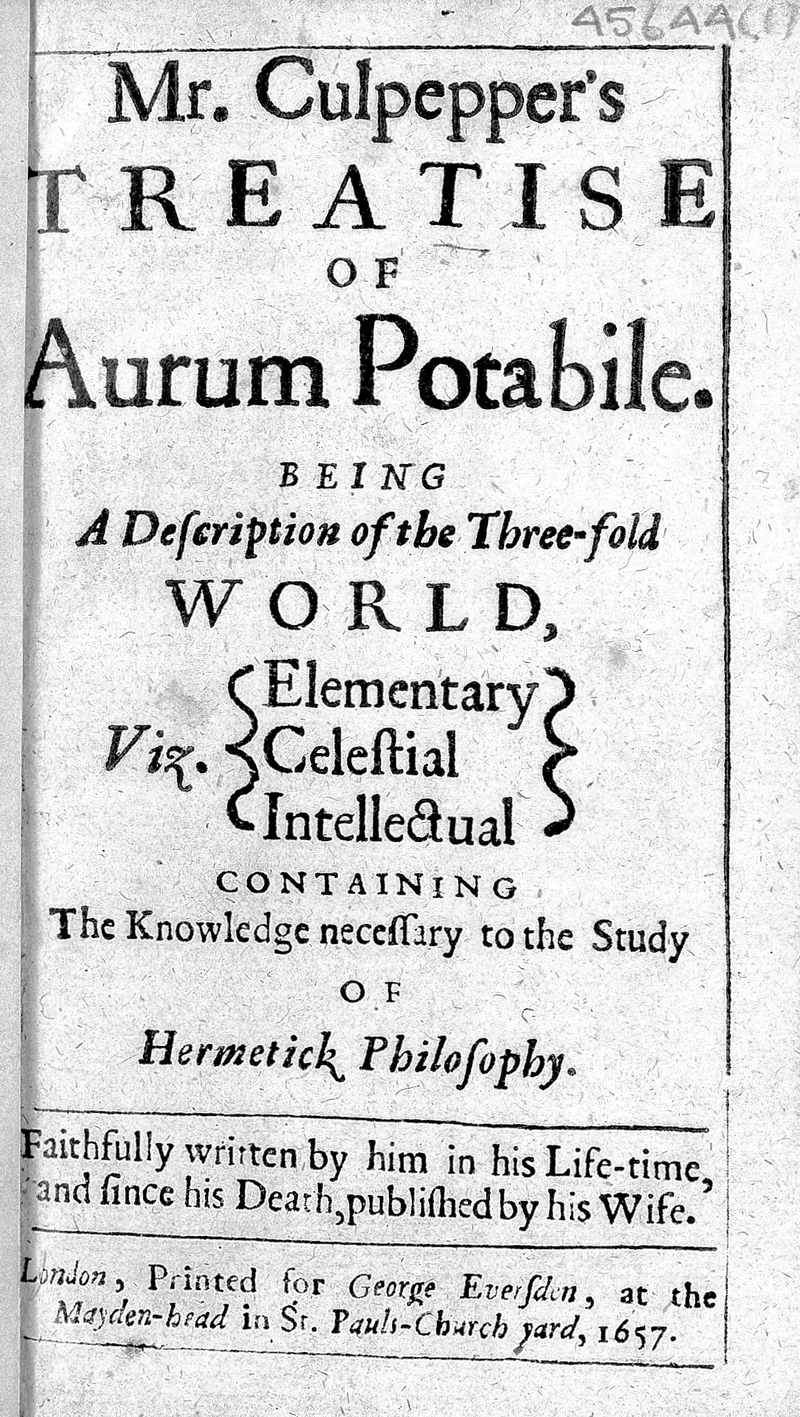
Paracelsus (1493/94–1541) redirected much of alchemy toward making medicines, and his followers sought chemical remedies more than gold. In this medical strand, the Stone and the elixir of life merged into a single hope: a substance that restored balance to both metals and bodies. The claims were never demonstrated, and some "elixirs" containing mercury or antimony were dangerous; the history is one of aspiration rather than of proven cures. The parallel Chinese search for an elixir of immortality is described in the guide to Chinese alchemy.
Famous claims, witnesses and legends§
Alchemical literature is full of stories of adepts who possessed the Stone. The most famous concerns Nicolas Flamel, a Parisian scribe who died in 1418; a century and more after his death he was credited with making gold and with a book of hieroglyphic figures, first printed in 1612, which historians regard as a later fabrication. Other stories come from apparently sober witnesses. The physician Joan Baptista van Helmont reported that he had transmuted mercury with a grain of powder given to him by a stranger, and Johann Friedrich Schweitzer, known as Helvetius, described in his Golden Calf (1667) how a visitor at The Hague showed him the Stone in December 1666 and how he later turned lead into gold with a crumb of it. The philosopher Spinoza made enquiries about this case in his correspondence.
Robert Boyle, often presented as a founder of modern chemistry, believed in the Stone and in 1678 published an account of an "anti-elixir" that degraded gold. He lobbied successfully for the repeal in 1689 of an English statute of 1404 forbidding the "multiplication" of gold and silver. Isaac Newton spent decades studying alchemical texts. Alongside such believers stood a long line of fraudsters who used hollow stirring rods and false-bottomed crucibles, discussed in the article on alchemical hoaxes and transmutation claims.
The Stone as a religious and spiritual symbol§
Medieval and early modern writers soon saw theological meaning in the Stone. Petrus Bonus of Ferrara, in his Precious New Pearl (c. 1330), compared its making to the incarnation and resurrection of Christ, and the vocabulary of death, burial and glorified bodies entered the language of the Work. The New Testament image of Christ as the stone rejected by the builders reinforced the parallel. In the seventeenth century, writers in the tradition of Jacob Boehme and the Rosicrucian literature spoke of a spiritual Stone formed in the soul.
This symbolic reading grew into the "spiritual alchemy" of the nineteenth century and, through C. G. Jung, into the idea of the Stone as an image of the psychological self. These interpretations are traced in the guide to spiritual alchemy. Historians emphasise that most pre-modern alchemists combined both levels, treating the Stone as a real material while also seeing in its making a sign of divine order.
The Philosopher's Stone in modern science and culture§
The decline of the Stone came not from a single refutation but from the gradual replacement of the sulphur–mercury theory by eighteenth-century chemistry, in which elements could not be converted into one another by chemical means. Ironically, the twentieth century showed that transmutation is possible. In 1901 Ernest Rutherford and Frederick Soddy recognised radioactive decay as the natural transmutation of one element into another, and in 1980 a team associated with Glenn Seaborg produced traces of gold from bismuth in a particle accelerator, at a cost vastly greater than the gold obtained.
In popular culture, the Stone survives as a symbol of impossible wealth, secret knowledge and immortality, most familiarly in J. K. Rowling's first Harry Potter novel (1997), which features Nicolas Flamel as its maker. For readers of the alchemical tradition, it remains the key to the whole literature: a concept at once chemical, medical, philosophical and religious. A general overview of the art is given in What Is Alchemy?.
Frequently asked questions§
What is the Philosopher's Stone made of?§
Alchemical texts never agree, and they deliberately concealed their starting material, the prima materia. Proposed ingredients include gold, mercury, antimony ores, vitriol, salts and organic matter. The finished Stone was described as a red or white powder or a heavy glassy mass.
Did anyone ever make the Philosopher's Stone?§
There is no reliable evidence that anyone made a substance that turned base metals into gold by chemical means. Many claims were sincere misinterpretations of colour changes or impure assays, and others were deliberate frauds. Nuclear physics can transmute elements, but by quite different means.
What is the difference between the Philosopher's Stone and the elixir of life?§
The terms overlap. "Elixir" originally meant the transmuting powder itself, and many writers believed the same substance would perfect both metals and human bodies. Later, "elixir of life" came to mean specifically a medicine for health and longevity.
Why is it called the Philosopher's Stone?§
Alchemists called themselves "philosophers" because their art was part of natural philosophy, the study of nature's causes. The "stone" describes a mineral, solid agent, although texts insist it is a stone unlike others.
Sources and further reading§
- The Secrets of Alchemy — Lawrence M. Principe, 2013
- Promethean Ambitions: Alchemy and the Quest to Perfect Nature — William R. Newman, 2004
- The Summa Perfectionis of Pseudo-Geber — William R. Newman, 1991
- The Aspiring Adept: Robert Boyle and His Alchemical Quest — Lawrence M. Principe, 1998
- Gehennical Fire: The Lives of George Starkey, an American Alchemist in the Scientific Revolution — William R. Newman, 1994
- A Dictionary of Alchemical Imagery — Lyndy Abraham, 1998