Liber I · Alchemy · Chapter II: Alchemists
Zosimos of Panopolis: Visions, Writings and Greek Alchemy
Zosimos of Panopolis, the first alchemist whose works survive: his life in Roman Egypt, his apparatus, dream visions, letters to Theosebeia and legacy.

Zosimos of Panopolis was a Greek-speaking alchemist from Upper Egypt, active around 300 CE, and he is the earliest alchemical author whose writings survive in any quantity under his own name. His treatises combine detailed descriptions of furnaces, stills and coloured "tinctures" with dream visions, Hermetic and Gnostic speculation and sharp attacks on rival practitioners. Because he quoted older authorities such as Maria the Jewess, he is also our main window onto the first generations of alchemy.
Panopolis and the world of Greco-Egyptian alchemy§
Panopolis, today Akhmim on the east bank of the Nile, was a prosperous city of Roman Egypt known for its textile industry, its temples of the god Min (identified by Greeks with Pan) and its lively Greek literary culture. This setting matters, because the craft from which alchemy grew was rooted in Egyptian workshops that dyed cloth, alloyed metals and imitated precious stones.
Recipe books such as the Leiden and Stockholm papyri, usually dated to the third century CE, show this craft at work: they give practical instructions for making metals look like gold or silver and for colouring textiles purple. What distinguishes the alchemy of Zosimos and his predecessors is the attempt to explain such operations philosophically, to treat the colouring of metal as a real change of nature, and to set the work within a religious picture of the cosmos. The wider story of this beginning is told in the history of Western alchemy.
Almost nothing is known of Zosimos's life beyond what his own writings suggest. The tenth-century Byzantine encyclopedia known as the Suda calls him a philosopher of Alexandria and says that he wrote a work on chemistry in twenty-eight books, arranged by the letters of the alphabet and addressed to his "sister" Theosebeia. His references to earlier authors and the absence of later ones point to a career around the turn of the fourth century, though no date in his work is secure.
The writings of Zosimos and how they survived§
No complete book by Zosimos has come down to us. What survives are excerpts and treatises preserved in the Byzantine collections of Greek alchemical writings, compiled probably in the seventh to ninth centuries and copied in manuscripts such as the Venice codex Marcianus graecus 299 (tenth or eleventh century) and later Paris manuscripts. Modern scholars group these pieces under titles such as the Authentic Memoirs (Hypomnēmata), On the Letter Omega and the Final Count (sometimes rendered "Final Quittance" or "Final Abstract").
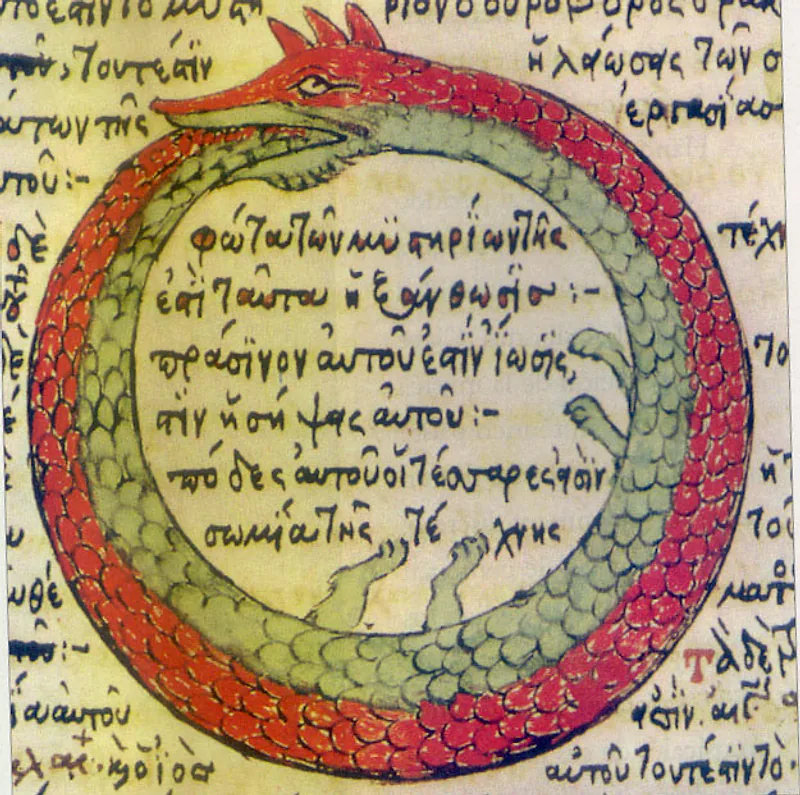
Further material exists outside Greek. A Syriac collection of alchemical texts preserved in Cambridge contains works attributed to Zosimos, and in Arabic he appears as an authority quoted by later writers, while an illustrated Arabic treatise known as the Book of Pictures (Muṣḥaf al-ṣuwar) circulated under his name. The relation of these versions to the Greek originals is still being studied. Since the late nineteenth century, when Marcellin Berthelot and Charles-Émile Ruelle published the Greek alchemical corpus, editors have worked to separate genuine Zosimian texts from later additions; Michèle Mertens's critical edition of the Authentic Memoirs (1995) is the standard modern work.
Apparatus, tinctures and the craft of the laboratory§
Much of what survives is technical. Zosimos describes furnaces, water baths, sublimation vessels and stills, and he names their inventors. Several pieces of apparatus are credited to Maria the Jewess, whom he quotes with great respect: the tribikos, a still with three outlet arms, and the kerotakis, a closed vessel in which metal sheets were exposed to rising vapours. Without Zosimos, Maria would be little more than a name; through his citations she became one of the founding figures of the art, as the survey of famous alchemists explains.
The central concern of these texts is the tincture (baphē), a colouring agent that could change the surface or, as Zosimos thought, the very nature of a metal. Metals were understood as composed of a body and a volatile "spirit" or pneuma. Distillation and sublimation separated the volatile spirits from the bodies, and the spirits could then be fixed on to new bodies, colouring them silver or gold. Sulphurous waters, which Greek writers called "divine water" (a pun on the Greek theion, meaning both "sulphur" and "divine"), played a key part in this thinking.
These passages are history, not instruction: many materials they name are toxic. What they show is that alchemy began as a demanding practical art whose readers were expected to know the furnace as well as the philosophy.
The visions of Zosimos: dream, sacrifice and transformation§
Zosimos is most famous today for a series of visionary narratives found in a treatise usually called On Excellence (Peri aretēs). He tells how, falling asleep, he saw a priest standing before a bowl-shaped altar approached by steps. The priest, who calls himself Ion, describes how he has been pierced with a sword, dismembered, his flesh and bones burned in the fire, until he was transformed and became spirit. In further dreams Zosimos meets a "man of copper" and other figures who undergo similar torments in a place of boiling waters.

On waking, Zosimos interprets the vision himself: it concerns, he says, the "composition of the waters", that is, the processes of the laboratory. The tormented figures are metals undergoing heating, dissolution and volatilisation, and their transformation into spirit is the separation of a tincture from its body. Yet the language of sacrifice, punishment and rebirth goes far beyond chemical shorthand. Scholars have compared it to mystery initiation and Egyptian temple ritual.
These dreams later attracted C. G. Jung, who lectured on them at the Eranos conference in 1937 and published an expanded study, "The Visions of Zosimos", reprinted in his Alchemical Studies. Jung read them as projections of unconscious processes of psychic transformation. Historians are more cautious, preferring to read the visions within their late antique literary and religious context, but agree that they show how closely technical and spiritual vocabulary were already intertwined at the start of the alchemical tradition.
Theosebeia, rival priests and the Final Count§
Many of Zosimos's writings are addressed to Theosebeia, whom he calls his sister. Whether she was a relative, a fellow initiate, a pupil or a wealthy patron is uncertain. The Final Count is the most personal of his texts. In it Zosimos warns her against certain priests and practitioners, among them a man named Neilos, who claim that their tinctures are gifts of local daimons and who use sacrifices to obtain "timely" or opportune results.
Zosimos sets against them a different ideal. True tinctures, he argues, are natural, and the adept should not chase quick success through daimonic help but cultivate inner calm, rid the soul of passions and turn towards the one God. Only then will the proper tinctures come. Olivier Dufault has read this as evidence of competition between rival experts for patrons; others stress its ascetic tone. Either way, alchemy appears as a contested field where reputation, religious authority and skill were bound together.
Zosimos also preserves one of the earliest myths of alchemy's origin. In a passage quoted by the Byzantine chronicler George Syncellus, he relates that fallen angels taught the arts of nature to the women they loved, a story clearly connected with the tradition preserved in the Book of Enoch. The art thus had a dangerous as well as a divine pedigree.
Zosimos, Hermetism and Gnostic ideas§
The treatise On the Letter Omega shows Zosimos at his most philosophical. He discusses fate and the soul, citing Hermes and Zoroaster, and distinguishes between people ruled by fate and the spiritual person who rises above it. He tells of the first man, called Adam by the Hebrews and Thoth by the Egyptians, whose inner, luminous self is imprisoned in a body, a teaching that recalls Gnostic anthropology as described in What Is Gnosticism?.
He also urges Theosebeia to hurry to Poimenandres and to be baptised in the mixing bowl, a clear reference to the Hermetic treatises now collected in the Corpus Hermeticum, in which a divine bowl filled with mind is sent down for the souls who wish to ascend. Zosimos is therefore an important early witness to the circulation of Hermetic texts, and Garth Fowden used him as a key example of the "technical" and "philosophical" Hermetica meeting in one person. For Zosimos, purification of metals and purification of the soul were parallel tasks under the guidance of Hermes Trismegistus.
Legacy: Byzantium, Arabic alchemy and Jung§
Byzantine commentators such as Stephanus of Alexandria and Olympiodorus treated Zosimos as an authority, and the anthologies that preserved his work shaped Greek alchemy for centuries. Through Syriac and Arabic translation his name and ideas passed into the Islamic alchemical tradition associated with Jabir ibn Hayyan and later writers.
In the twentieth century Zosimos acquired a second life. Jung's essay made his visions famous among readers interested in spiritual alchemy, while historians such as Mertens, Howard Jackson, Shannon Grimes and Dufault reconstructed him as a real practitioner embedded in the economic and religious life of late Roman Egypt. The two images need not exclude each other. Zosimos was a craftsman who thought deeply about the meaning of his craft, and the double character of alchemy as technique and spiritual discipline begins, as far as surviving texts allow us to see, with him.
Frequently asked questions§
Who was Zosimos of Panopolis?§
He was an alchemist from Panopolis (Akhmim) in Roman Egypt, active around 300 CE. He is the earliest alchemical writer whose own works survive in substantial fragments, and he wrote for a woman named Theosebeia.
What are the visions of Zosimos?§
They are dream narratives in which a priest and other figures are pierced, dismembered and burned until they are transformed into spirit. Zosimos interpreted them as allegories of laboratory processes, while Jung later read them as images of psychological transformation.
What did Zosimos write about Maria the Jewess?§
He quoted her as an authority and credited her with apparatus such as the three-armed still (tribikos) and the kerotakis. Most of what is known about Maria comes from his citations.
Sources and further reading§
- Collection des anciens alchimistes grecs — Marcellin Berthelot & Charles-Émile Ruelle, 1888
- Les Alchimistes grecs, Tome IV: Zosime de Panopolis, Mémoires authentiques — Michèle Mertens, 1995
- Zosimos of Panopolis on the Letter Omega — Howard M. Jackson, 1978
- Becoming Gold: Zosimos of Panopolis and the Alchemical Arts in Roman Egypt — Shannon Grimes, 2018
- Early Greek Alchemy, Patronage and Innovation in Late Antiquity — Olivier Dufault, 2019
- Alchemical Studies — C. G. Jung, 1967
- The Egyptian Hermes — Garth Fowden, 1986
- The Secrets of Alchemy — Lawrence M. Principe, 2013