Liber I · Alchemy · Chapter II: Alchemists
Maria the Jewess: First Alchemist, Her Apparatus and Legacy
Maria the Jewess, the earliest named Western alchemist: her kerotakis and tribikos, the bain-marie, the sayings quoted by Zosimos and her long afterlife.

Maria the Jewess (also called Maria Prophetissa or Maria Hebraea) is the earliest named practitioner of Western alchemy whose words survive. She probably worked in Roman Egypt sometime between the first and third centuries CE, and she is known only through quotations preserved by later Greek authors, above all Zosimos of Panopolis. Those quotations credit her with laboratory apparatus such as the kerotakis and the three-armed still, and with sayings about uniting opposites that later alchemists, and later still C. G. Jung, treated as foundational.
Who was Maria the Jewess? Sources and dating§
Everything known about Maria comes from other writers. The oldest and most important witness is Zosimos of Panopolis, the Egyptian alchemist who wrote in Greek around 300 CE and who cites her repeatedly, usually with great respect, as one of "the ancients". Because Zosimos already treats her as an authority from the past, historians place her before him, most often somewhere in the first to third centuries CE. A more precise date is not possible, and some scholars have wondered whether "Maria" was a real individual or a name attached to a body of practical teaching.
Her epithet "the Jewess" (Hebraia) comes from the sources, and nothing in the quoted fragments contradicts it. Jews formed a large and long-established community in Alexandria and elsewhere in Egypt, and craft knowledge of metals, dyes and glass passed freely between Jewish, Egyptian and Greek workshops. Zosimos also mentions her alongside other figures of the early art, including the legendary Democritus, Ostanes and the woman known as Cleopatra the alchemist, and he addressed his own works to a female student, Theosebeia. The picture that emerges is of an early alchemy in which women could be recognised as teachers. The wider setting is described in the history of Western alchemy.
The kerotakis, the tribikos and the bain-marie§
Maria's fame rests above all on equipment. In his treatise on apparatus and furnaces, Zosimos describes several devices and says that Maria taught them, sometimes quoting her specifications in detail.
The kerotakis§
The kerotakis was originally a painter's palette, a small plate kept warm so that coloured wax could be worked. In alchemy the name passed to a closed apparatus in which a thin sheet of metal sat on a plate above a heated vessel containing substances such as sulphur, arsenic compounds or mercury. As these gave off vapours, the vapours attacked or coloured the metal, condensed in the cool upper part of the vessel and ran back down, so that the process could continue for a long time. Historians of chemistry regard it as an early form of reflux apparatus. It also fitted the theory of the time: the vapours were thought of as "spirits" that could carry colour and quality into a "body", the metal.
The tribikos§
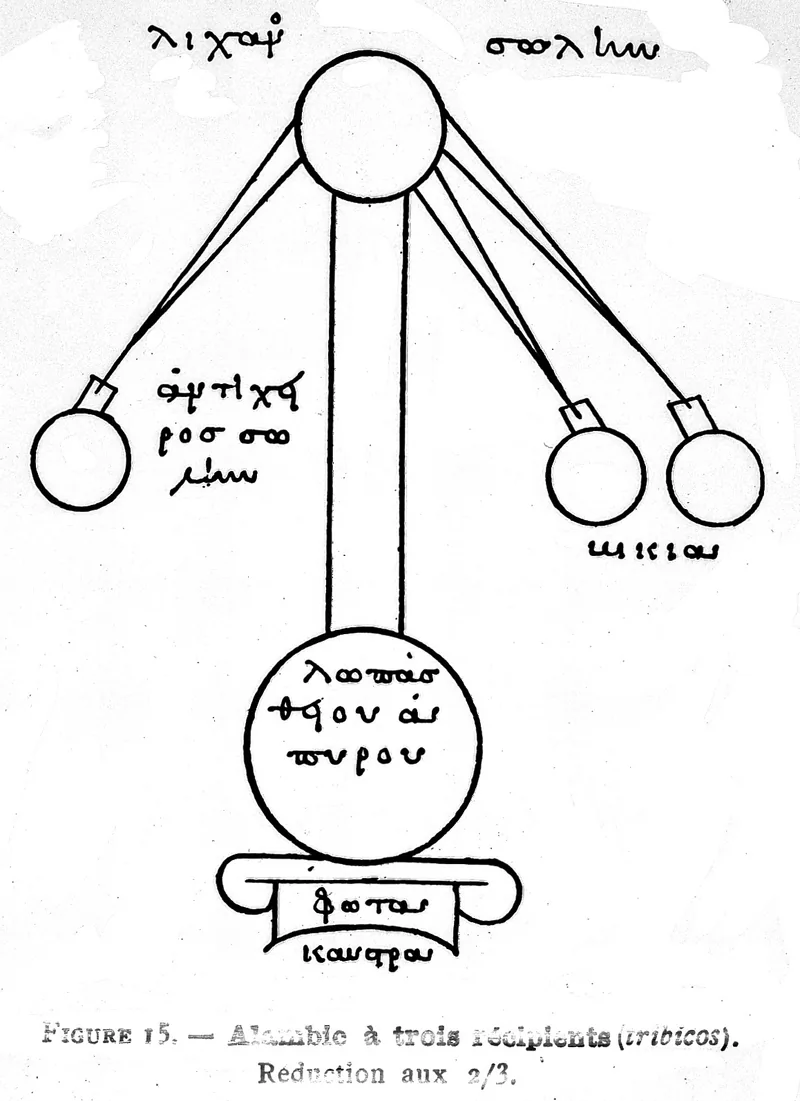
The tribikos was a still with three outlet tubes. A vessel of heated liquid sent its vapour into a still head, from which three copper spouts led to separate receivers. Zosimos reports Maria's directions on the thickness of the copper and on sealing the joints with a paste, details that suggest real workshop experience rather than pure allegory. Distillation was already known in Hellenistic Egypt, and Maria is not necessarily its inventor, but her name was firmly attached to the early still.
The bain-marie§
The water bath, used to heat a vessel gently and evenly by standing it in hot water, is known in French as the bain-marie and in medieval Latin as the balneum Mariae. From the later Middle Ages, alchemical writers commonly connected the name with Maria the alchemist. The device itself is simple and probably much older, and the link with her rests on tradition rather than on any early text; some have even suggested that the name originally referred to the Virgin Mary. It remains the most familiar everyday trace of the ancient alchemist, still in use in kitchens and laboratories.
Maria in the writings of Zosimos§
Zosimos cites Maria not only for apparatus but for doctrine. In the surviving fragments she distinguishes between the "bodies" of metals and the volatile, incorporeal agents that act upon them, and she speaks of the need to give body to what is incorporeal and to free the spirit from what is bodily. This language of body and spirit was central to Greek alchemy, and it allowed metallic change to be described in the same terms as death, purification and resurrection, themes that run through Zosimos's own visions.
Several passages concern the "divine water" or "sulphur water", theion hydor. The Greek word theion can mean both "divine" and "sulphur", and the ambiguity was almost certainly exploited deliberately: a sulphurous liquid used to whiten or yellow metals was at the same time a sacred water. Maria is also quoted on the colouring stages of the work, the whitening and yellowing that later developed into the classic sequence of the Great Work. Her advice is practical, impatient with excessive theory and attentive to proportions and fire, which is one reason modern historians treat her as a genuine craft authority rather than a mythical name.
Zosimos's respect for Maria also had a polemical side. He contrasted the patient methods of the ancients, Maria among them, with practitioners of his own day whom he accused of seeking shortcuts or relying on favourable demons. In his hands she became a model of correct practice.
Sayings attributed to Maria: opposites and the Axiom§
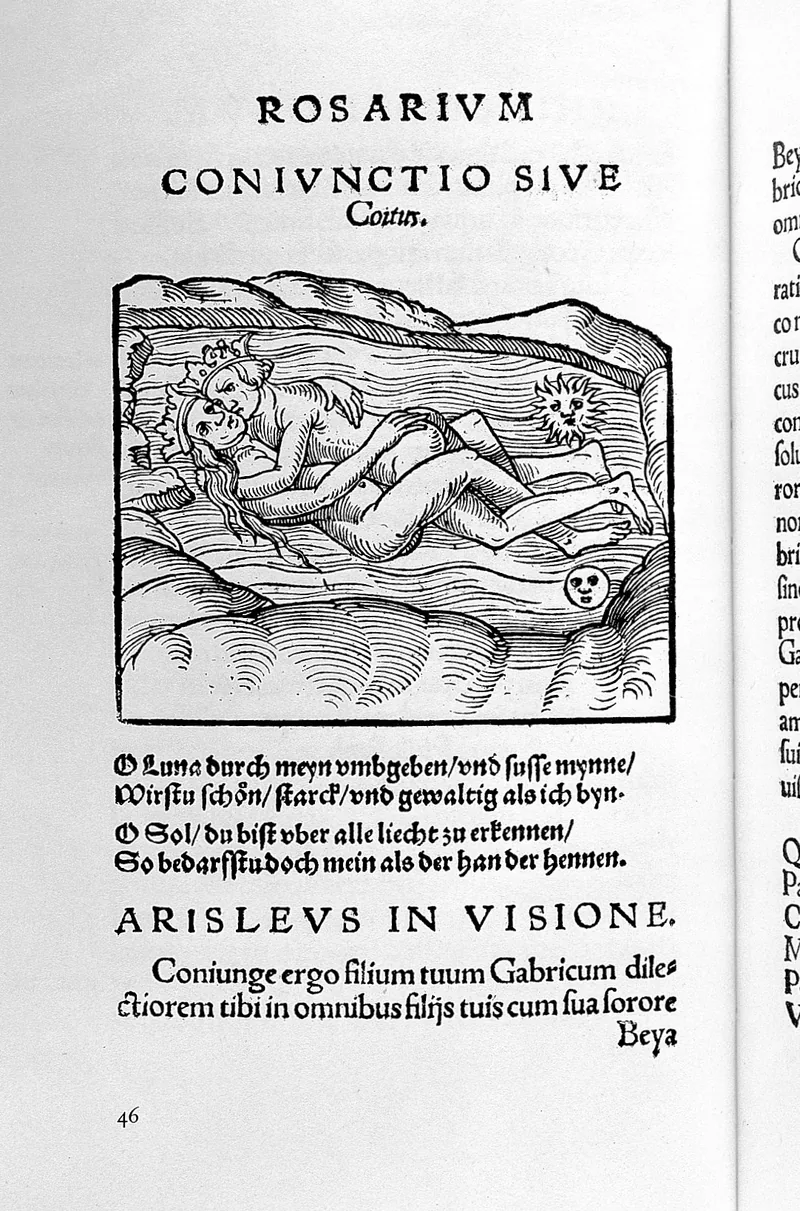
Alongside the technical fragments, a number of short, oracular sayings circulated under Maria's name. The best known urges the practitioner to join the male and the female, for in that union lies what is sought. The idea that the work consists in reconciling opposites, male and female, fixed and volatile, sun and moon, became one of the governing images of later alchemy, culminating in the royal wedding of king and queen and in the two-sexed figure of the rebis.
The other famous saying is a numerical riddle: one becomes two, two becomes three, and out of the third comes the one as the fourth. C. G. Jung called this the "Axiom of Maria" and discussed it at length in Psychology and Alchemy (1944), where he read it as an image of the movement from undifferentiated unity, through conflict and its resolution, to a new, conscious wholeness. Historians note that its connection with the historical Maria is uncertain: it belongs to the later tradition that gathered around her name rather than to the fragments quoted by Zosimos. Like much alchemical wisdom literature, the sayings were valued precisely because they could be read on several levels at once.
Later legends: Miriam, Maria the Copt and the Practica§
As alchemy passed from Greek into Arabic and then into Latin, Maria's identity grew more legendary. Arabic sources knew her under several names, including Māriya al-Qibṭiyya, "Maria the Copt", and associated her with Egyptian learning. A dialogue in which Maria instructs a philosopher named Aros (a form of Horus) circulated in Arabic and later in Latin as the Practica Mariae Prophetissae, and it was printed in the alchemical anthology Artis auriferae at Basel in 1593. The Practica contains recipes and enigmatic sayings and is generally regarded as a much later composition attributed to her.
European writers also identified her with Miriam, the prophetess and sister of Moses and Aaron in the Book of Exodus (Exodus 15:20). The identification gave alchemy a biblical pedigree, matching claims that Moses himself had known the art, and it explains the title "Prophetissa". In 1617 Michael Maier included her in his Symbola aureae mensae duodecim nationum, a book presenting twelve great adepts from twelve nations; his engraving shows Maria as the representative of the Hebrews, pointing to vessels and a plant growing on a small hill, an image often reproduced since. For the place of such figures in the wider gallery of practitioners, see the guide to famous alchemists.
Maria in modern scholarship and memory§
Nineteenth-century scholars such as Marcellin Berthelot, who edited the Greek alchemical corpus, recognised Maria as a key figure of early chemistry and discussed her apparatus. In the twentieth century the historian of chemistry F. Sherwood Taylor described the kerotakis and the stills in his studies of Greek alchemy, and the anthropologist and historian Raphael Patai devoted an article and a chapter of The Jewish Alchemists (1994) to her, calling her a founding figure of the art and assembling the scattered testimony about her in Greek, Arabic and Latin.
Recent scholarship on Graeco-Egyptian alchemy, including work on Zosimos and the pseudo-Democritean writings, places Maria within a world of temple craftsmen, metalworkers and philosophers who mixed practical recipes with religious and cosmological reflection. She has also become a figure of interest in the history of women in science, often cited as one of the first women known by name in a technical discipline. Popular accounts sometimes credit her with more than the sources support, and careful writers distinguish between what Zosimos reports, what later tradition added, and what modern admirers have imagined.
Whatever her exact history, Maria's double legacy is clear. Through the still and the water bath she stands at the start of laboratory practice that leads, by a long road, to modern chemistry; through her sayings about the union of opposites she stands at the start of the symbolic and spiritual reading of the work. Few figures express so neatly the two sides of alchemy.
Frequently asked questions§
Was Maria the Jewess a real person?§
Most historians accept that a woman teacher of alchemy known as Maria lived in Roman Egypt before about 300 CE, because Zosimos quotes her as a real authority with specific technical instructions. Nothing is known of her life, however, and many sayings later attributed to her are probably not hers.
Did Maria the Jewess invent the bain-marie?§
The water bath was named balneum Mariae after her in medieval tradition, but there is no early evidence that she invented it, and the device is probably older. She is better attested as a teacher of the kerotakis and of a three-armed still.
What is the Axiom of Maria?§
It is the saying that one becomes two, two becomes three, and from the third comes the one as the fourth. C. G. Jung gave it this name and used it as an image of psychological wholeness; its link to the historical Maria is uncertain.
Why is she called Maria Prophetissa?§
Later tradition identified her with Miriam, the prophetess and sister of Moses, which gave alchemy a biblical ancestry. The title "Prophetissa" reflects this legend rather than anything in the earliest sources.
Sources and further reading§
- The Jewish Alchemists: A History and Source Book — Raphael Patai, 1994
- Becoming Gold: Zosimos of Panopolis and the Alchemical Arts in Roman Egypt — Shannon Grimes, 2018
- The Origins of Alchemy in Graeco-Roman Egypt — Jack Lindsay, 1970
- The Alchemists: Founders of Modern Chemistry — F. Sherwood Taylor, 1949
- Collection des anciens alchimistes grecs — Marcellin Berthelot & Charles-Émile Ruelle, 1888
- Psychology and Alchemy — C. G. Jung, 1944
- The Secrets of Alchemy — Lawrence M. Principe, 2013