Liber I · Alchemy · Chapter II: Alchemists
Famous Alchemists: From Maria the Jewess to Isaac Newton
A guide to famous alchemists, from Maria the Jewess and Zosimos to Jabir, al-Razi, Paracelsus, Boyle and Newton, with notes on legends and pseudonyms.

The history of alchemy is carried by a long line of practitioners, from the women and men of Roman Egypt through the scholars of the Islamic world to the physicians, courtiers and natural philosophers of early modern Europe. Some, like Zosimos, al-Razi, Paracelsus, Boyle and Newton, are well documented; others, such as Jabir ibn Hayyan, Nicolas Flamel or Basil Valentine, are known mainly through legend or through writings composed under their names by later authors.
How to read the lives of the alchemists§
Alchemical biography poses special problems. Alchemists often wrote under pseudonyms, and later writers liked to credit famous philosophers, saints and kings with secret mastery of the art. Legends of successful transmutation grew up around names that had little or no connection with alchemy in their lifetimes. Historians therefore distinguish carefully between the historical person, the body of writings circulated under their name, and the legend that later readers built. The general background to these figures is set out in What Is Alchemy? and the history of Western alchemy.
Alchemists of Greco-Roman Egypt§
Maria the Jewess (also called Maria Prophetissa) is one of the earliest named alchemists, though she is known only through quotations in later authors, especially Zosimos. She is credited with designing apparatus, including the kerotakis, a device for exposing metals to vapours, and a still with several arms; the water bath still called the bain-marie ("Mary's bath") traditionally bears her name. Sayings attributed to her about the uniting of opposites were repeated for centuries.
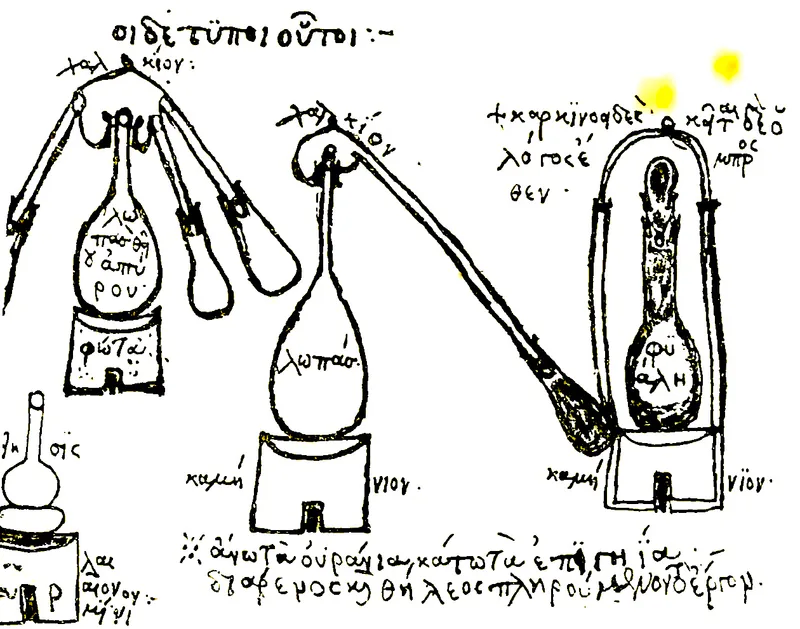
Zosimos of Panopolis (fl. c. 300 CE) is the first alchemist whose writings survive in quantity. Writing to a woman named Theosebeia, he described furnaces and distillation apparatus, criticised rival practitioners, and recorded dream-visions of figures dismembered and transformed upon an altar, which later readers took as allegories of chemical processes. His work blends Egyptian craft, Greek philosophy and religious ideas related to Gnostic and Hermetic thought.
Other names in the Greek corpus include pseudo-Democritus, whose Physika kai mystika is among the earliest alchemical treatises; Cleopatra, to whom the diagram sheet known as the Chrysopoeia is attributed (she is not the Egyptian queen); and later Byzantine commentators such as Stephanus of Alexandria (seventh century), who gave alchemy a more philosophical and devotional tone.
Alchemists of the Islamic world§
Jabir ibn Hayyan, traditionally placed in the eighth century and associated with the circle of the Shi'i imam Ja'far al-Sadiq, is credited with hundreds of treatises. The scholar Paul Kraus argued in the 1940s that most of the corpus was the work of a later school active in the ninth and tenth centuries, and whether a historical Jabir wrote any of it is still debated. The Jabirian writings developed the sulphur–mercury theory of metals and a "science of the balance" that sought to express the composition of substances numerically.
Abu Bakr Muhammad ibn Zakariya al-Razi (d. c. 925), the Persian physician known in Latin as Rhazes, wrote alchemical works notable for their practical, systematic character, classifying substances and describing laboratory equipment in detail. Ibn Umayl (tenth century), known in Latin as "Senior", wrote allegorical alchemical poetry and commentary that influenced European symbolic alchemy. Not every scholar accepted the art: Avicenna (Ibn Sina, d. 1037) argued that true transmutation of metallic species was impossible, and a Latin version of his critique circulated widely in Europe.
Medieval European alchemists and pseudonymous authors§
Latin alchemy grew from translation in the twelfth and thirteenth centuries. Its most influential treatise, the Summa perfectionis, was written under the name "Geber", the Latin form of Jabir; William Newman has argued convincingly that it is a Latin original, probably by the Franciscan Paul of Taranto in the late thirteenth century.
Many famous names became attached to alchemy only after their deaths. Works were attributed to Albertus Magnus, who did discuss minerals and metals and examined alchemical claims, to Thomas Aquinas, and to the Catalan philosopher Ramon Llull, whose genuine writings show no interest in alchemy but under whose name a large "pseudo-Lullian" corpus appeared from the fourteenth century. Roger Bacon wrote positively about alchemy as part of experimental science. The Franciscan John of Rupescissa (fourteenth century) promoted the distillation of a medicinal "quintessence" from wine. Nicolas Flamel (d. 1418) was a real Parisian scribe and property owner, but the story of his success with the Stone rests on texts published two centuries after his death. In England, George Ripley wrote The Compound of Alchymy (1471), with its twelve "gates" of the Work.
Renaissance and early modern alchemists§
Paracelsus (Theophrastus von Hohenheim, 1493/4–1541) transformed alchemy into a tool of medicine, attacking ancient medical authorities and adding salt to sulphur and mercury as a third principle. His followers spread chemical medicine across Europe.
The late sixteenth and early seventeenth centuries were a golden age of alchemical patronage. The court of Emperor Rudolf II in Prague attracted practitioners including the Englishman Edward Kelley, John Dee's colleague, and the Polish alchemist Michael Sendivogius, author of the Novum lumen chymicum (1604). Heinrich Khunrath combined laboratory and prayer in his Amphitheatrum sapientiae aeternae (1595, expanded 1609). Michael Maier, a physician to Rudolf, created the emblem book Atalanta fugiens (1617) and defended the Rosicrucian manifestos. The writings of Basil Valentine, presented as the work of a fifteenth-century monk, appeared from 1599 and were probably composed around that time.
In the seventeenth century the Flemish physician Jan Baptist van Helmont developed new chemical theories and coined the word "gas". The American-born George Starkey, writing as Eirenaeus Philalethes, produced some of the most widely read alchemical texts of the century. Robert Boyle, often cast as a founder of modern chemistry, sought the Philosopher's Stone and lobbied for the repeal of an English statute against multiplying gold. Isaac Newton left alchemical manuscripts running, by common estimate, to around a million words, showing that alchemy occupied him for decades.
Women in alchemy§
Women appear in the alchemical record more often than older histories suggested. Beyond Maria the Jewess, Cleopatra and Theosebeia in antiquity, early modern Europe produced books of "secrets" addressed to or written by women, such as the Secreti published under the name of Isabella Cortese (1561), whose authorship is uncertain. Marie Meurdrac published La chymie charitable et facile, en faveur des dames (1666), a practical chemistry for women. Noblewomen and princesses, including several in German courts, sponsored or practised laboratory work, and many anonymous women prepared distilled medicines at home.
Modern alchemists and the alchemical revival§
After 1700 alchemy declined among natural philosophers but persisted in Rosicrucian and Masonic circles, in Germany's Gold- und Rosenkreuz order, and in private practice. In the nineteenth century Mary Anne Atwood and the American general Ethan Allen Hitchcock reinterpreted alchemy as a spiritual discipline, a reading developed by the Golden Dawn and later by C. G. Jung. In twentieth-century France the pseudonymous Fulcanelli published Le mystère des cathédrales (1926), reading Gothic sculpture as alchemical code; his identity remains unknown. These later figures belong to the story of spiritual alchemy.
Frequently asked questions§
Who was the first alchemist?§
No single "first" alchemist can be named. The earliest alchemical writings come from Greco-Roman Egypt, and Maria the Jewess and pseudo-Democritus are among the earliest named authorities, but the first author whose own writings survive in quantity is Zosimos of Panopolis, around 300 CE.
Was Isaac Newton really an alchemist?§
Yes. Newton studied alchemical texts and performed laboratory experiments for decades, leaving a large body of alchemical notes. Historians such as Betty Jo Teeter Dobbs and William Newman have shown that this work was serious and connected with his wider natural philosophy.
Was Nicolas Flamel a real person?§
He was a real fourteenth- and fifteenth-century Parisian scribe and benefactor who died in 1418. The legend of his alchemical success, however, comes from writings published around two centuries later and is not supported by contemporary evidence.
Were there women alchemists?§
Yes. Maria the Jewess is among the earliest named alchemists, and women continued to practise and write about alchemy and chemistry, from the authors of books of secrets to Marie Meurdrac in the seventeenth century.
Sources and further reading§
- The Secrets of Alchemy — Lawrence M. Principe, 2013
- The Summa Perfectionis of Pseudo-Geber — William R. Newman, 1991
- Paracelsus: Medicine, Magic and Mission at the End of Time — Charles Webster, 2008
- Newton the Alchemist: Science, Enigma, and the Quest for Nature's Secret Fire — William R. Newman, 2019
- The Janus Faces of Genius: The Role of Alchemy in Newton's Thought — Betty Jo Teeter Dobbs, 1991
- Alchemy Tried in the Fire: Starkey, Boyle, and the Fate of Helmontian Chymistry — William R. Newman & Lawrence M. Principe, 2002