Liber I · Alchemy · Chapter IV: The Great Work
The Great Work in Alchemy: Stages of the Magnum Opus Explained
The alchemical Great Work explained: the prima materia, nigredo, albedo, citrinitas and rubedo, Ripley's twelve gates, the vessel and the Philosopher's Stone.

The Great Work (magnum opus) is the alchemists' name for the whole process of making the Philosopher's Stone, the substance believed to perfect base metals into gold and to serve as a universal medicine. Alchemical texts describe it as a sequence of operations and colour changes, most famously the blackening (nigredo), whitening (albedo), yellowing (citrinitas) and reddening (rubedo), through which a prepared "first matter" was dissolved, purified, reunited and fixed.
The goal: the Philosopher's Stone§
The Great Work aimed at the Philosopher's Stone (lapis philosophorum), often described as a heavy, red, glassy or powdery substance. A small quantity "projected" onto molten lead or mercury was supposed to transmute many times its weight into gold. Most texts distinguish a white stone, which turned metals to silver, from a red stone, which turned them to gold, and many add that the Stone, taken in tiny amounts, could heal disease and restore youth. The general background is given in What Is Alchemy?.
Because the Stone was thought to work by perfecting what was imperfect, the Work was understood not as manufacturing gold from nothing but as completing a process nature itself carried out slowly in the earth. The alchemist imitated and accelerated nature: "art perfects nature" was a common principle.
The first matter (prima materia)§
Every account of the Work begins with the prima materia, the raw material from which the Stone is made. Alchemists insisted that it was common, cheap and found everywhere, yet despised and unrecognised by the ignorant, and they described it with riddles: it was a stone and not a stone, water that does not wet the hands, a dragon, a virgin's milk or the "matter of all things".
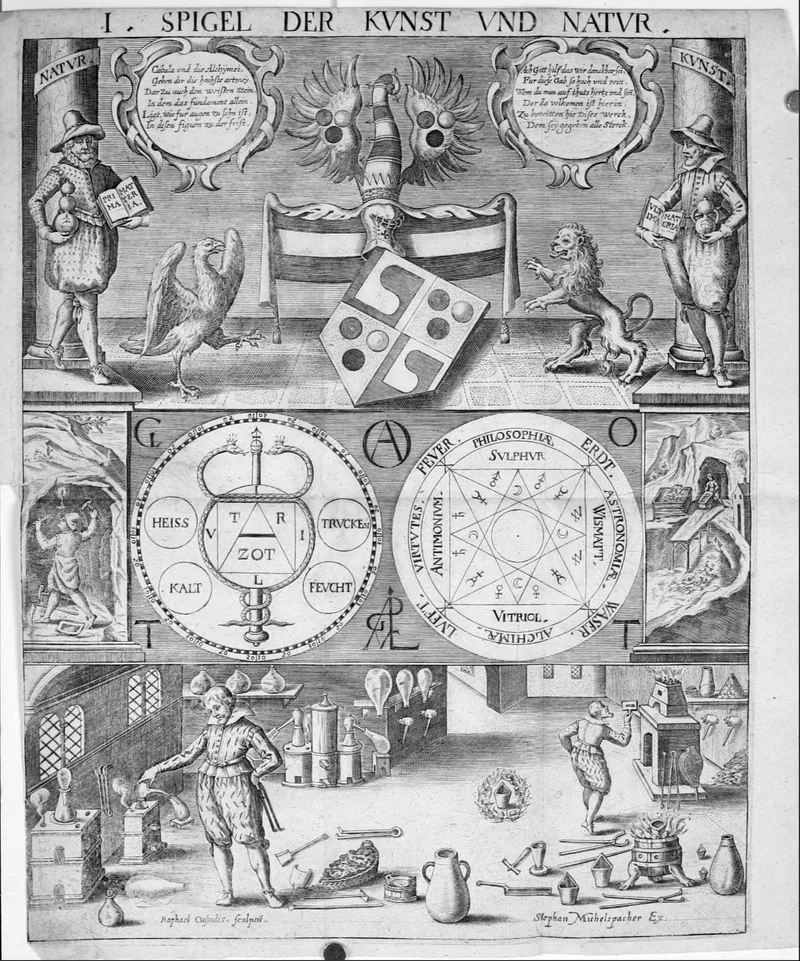
In practice, writers proposed very different starting points. Some worked with gold and a specially prepared "philosophical mercury"; others with antimony ores, vitriol, salts, dew or rainwater; still others with organic materials. The German alchemist Hennig Brand discovered phosphorus in 1669 while working with urine in search of the Stone. Philosophically, the first matter was often linked with Aristotle's formless matter underlying all things, which explains why texts describe it in paradoxes.
The four colours: nigredo, albedo, citrinitas, rubedo§
The best-known framework for the Work is the sequence of colours, already present in Greek alchemical writings as blackening, whitening, yellowing and a final purple or red. Medieval and early modern alchemists used the Latin names:
Nigredo: the blackening§
The nigredo is the stage of dissolution and putrefaction, when the matter in the sealed vessel turns black. It was described as death, burial and decay, and symbolised by the crow or raven, the "crow's head", skeletons and the black sun. Texts treat the blackness as a welcome sign that the matter has truly been broken down to its root.
Albedo: the whitening§
In the albedo the black matter is washed and purified until it turns white. Some authors describe a stage of many colours, the "peacock's tail", in between. Whiteness was associated with the moon, silver, the swan and the dove, and many texts say that the white stone obtained here could already transmute metals into silver.
Citrinitas: the yellowing§
The citrinitas or yellowing was part of the Greek fourfold scheme and appears in some medieval texts, but many later authors omitted it, merging it into the final stage and reducing the colours to three.
Rubedo: the reddening§
The rubedo is the culmination of the Work, when sustained heat brings the white matter to a deep red. It was associated with the sun, gold, the king, the phoenix and the resurrection. The red stone was the completed Philosopher's Stone. The animals and figures that mark these stages are discussed in the guide to alchemical symbols.
The operations: Ripley's twelve gates and other schemes§
Alongside the colours, alchemists described the Work as a sequence of operations. One of the most influential lists comes from the English canon George Ripley, whose verse treatise The Compound of Alchymy (1471) describes twelve "gates" leading into the castle of the Stone: calcination, solution (dissolution), separation, conjunction, putrefaction, congelation, cibation (feeding), sublimation, fermentation, exaltation, multiplication and projection.

Other writers proposed seven operations, linked to the planets, or different numbers again, and the order varied. Some terms describe recognisable chemical procedures: calcination (heating a substance to a powder), dissolution, distillation and sublimation. Others, such as conjunction, cibation and exaltation, are more allegorical. A well-known Latin formula, solve et coagula ("dissolve and coagulate"), summed up the rhythm of the whole: what is fixed must be made volatile, and what is volatile must be fixed.
The vessel, the furnace and the fire§
The Work was usually carried out in a sealed glass flask, often egg-shaped and called the "philosophical egg" or "vessel of Hermes", from which the expression "hermetically sealed" derives. The vessel sat in a slow, steady furnace called the athanor, designed to maintain a gentle heat for weeks or months; texts compare it to the warmth of a brooding hen or of the womb.
Control of the fire was considered crucial. Alchemists described "degrees" of heat and warned that too strong a fire would ruin the matter. Some distinguished a long "wet way" (via humida), lasting many months, from a quicker and more dangerous "dry way" (via sicca) that used intense heat in a crucible. Texts by George Starkey and others, studied by William Newman and Lawrence Principe, show alchemists keeping careful notes of quantities and timings, much like later chemists.
Multiplication and projection§
Once made, the Stone could be "multiplied": by repeating parts of the process with the finished Stone, its power was said to increase tenfold or more each time. The final operation, projection, was the use of the Stone on base metal. Early modern Europe circulated many reports of eyewitnessed projections, sometimes in the presence of princes, and some of these accounts were used to defend the reality of transmutation, though historians generally attribute them to fraud, alloys or misunderstanding.
Laboratory process or spiritual allegory?§
From early on, the Work was described in religious terms. The death and resurrection of the matter invited comparison with the passion and resurrection of Christ, and some medieval and early modern texts drew the parallel explicitly. Heinrich Khunrath portrayed the alchemist praying in an oratory beside the laboratory. In the nineteenth and twentieth centuries, writers such as Mary Anne Atwood and C. G. Jung read the stages as phases of inner transformation, with the nigredo as a confrontation with darkness in the psyche and the rubedo as integration.
Historians now emphasise that most premodern alchemists understood the Work as a real chemical process, even when they surrounded it with religious meaning. Both dimensions can be present in the same text. The modern symbolic reading is examined in our guide to spiritual alchemy, and the historical setting in the history of Western alchemy.
Frequently asked questions§
What are the stages of the Great Work?§
The most common scheme names four colour stages: nigredo (blackening), albedo (whitening), citrinitas (yellowing) and rubedo (reddening), with many later writers dropping the yellow stage. Other schemes describe the Work as seven or twelve operations, such as calcination, dissolution, conjunction and projection.
What is the prima materia?§
It is the "first matter" from which the Philosopher's Stone was to be made. Alchemists described it in riddles and disagreed about its identity, proposing substances from gold and mercury to antimony, salts or dew.
What does "magnum opus" mean?§
It is Latin for "great work". In alchemy it refers to the entire process of making the Philosopher's Stone; the phrase later passed into general use for an author's or artist's masterpiece.
How long did the Great Work take?§
Accounts vary widely. Some texts describe a process lasting many months or even years with gentle heat, while others describe a faster "dry way" taking days. The long durations reflect the belief that the Work imitated nature's slow maturation of metals.
Sources and further reading§
- The Secrets of Alchemy — Lawrence M. Principe, 2013
- A Dictionary of Alchemical Imagery — Lyndy Abraham, 1998
- Alchemy Tried in the Fire: Starkey, Boyle, and the Fate of Helmontian Chymistry — William R. Newman & Lawrence M. Principe, 2002
- The Compound of Alchymy — George Ripley, 1471
- Alchemy: The Medieval Alchemists and Their Royal Art — Johannes Fabricius, 1976
- Psychology and Alchemy — C. G. Jung, 1944