Liber I · Alchemy · Chapter IV: The Great Work
Albedo: The Whitening Stage of the Alchemical Great Work
Albedo, the alchemical whitening: washing after the nigredo, the white stone and lesser work, moon, swan and queen, the Rosarium images and Jung's reading.

The albedo ("whitening") is the second great colour stage of the alchemical Great Work, in which the blackened, putrefied matter of the nigredo was washed and purified until it turned white. Its goal was the "white stone", an agent believed to perfect base metals into silver, and its imagery is dominated by the moon, the queen, the swan, the dove and the white rose. In religious and later psychological readings, the albedo came to stand for purification, the return of light after darkness and the first, partial completion of an inner transformation.
The whitening in the colour sequence of the Great Work§
From the earliest Greek alchemy, the transformation of matter was described as a sequence of colours. Greek authors spoke of blackening, whitening, yellowing and a final violet or red, and Latin alchemists translated these as nigredo, albedo, citrinitas and rubedo. Many later writers reduced the sequence to three, black, white and red, so that the albedo became the central hinge of the work. The overall plan is described in the guide to the Great Work.
The albedo had meaning only in relation to what came before it. The nigredo was the death and decay of the matter, the stage of the raven and the black sun. Whitening was its reversal: the dark, dissolved substance was cleaned of impurities until a pure white appeared. Many authors described an intermediate display of many colours, the cauda pavonis or "peacock's tail", as the sign that the black was giving way. Alchemists treated the appearance of white as a decisive and joyful moment, proof that the matter had survived its death and was beginning to be reborn.
Ablution and the washing of the matter§
The operation most associated with the albedo was ablutio, washing, sometimes called mundificatio, cleansing. In the laboratory this meant repeated cycles in which the matter in the sealed vessel gave off vapours that condensed and fell back on to it, gradually changing its colour and texture. Alchemical writers described this as the matter being bathed in its own water, and they compared the falling condensate to rain or to dew.
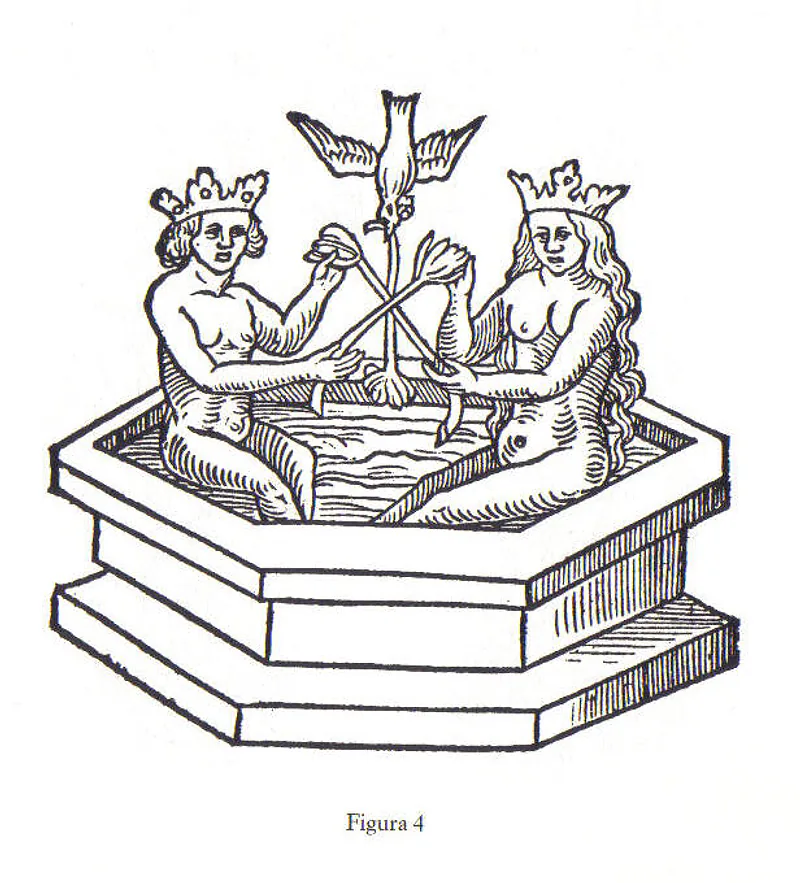
A saying repeated in many treatises urged the practitioner to "whiten the laton" (the base, brass-like matter) "and rend the books", meaning that patient work in the vessel mattered more than endless reading. Writers spoke of the "white foliated earth" (terra alba foliata), a pure white substance in which the "seed" of gold could be sown for the next stage. Such phrases were deliberately obscure, and modern historians stress that their technical content varied greatly from author to author. They are discussed here as history; no attempt to reproduce the procedures is implied or advisable, since many alchemical materials were toxic.
The white stone and the lesser work§
Most alchemical authors divided the Work into two great parts. The "lesser work" (opus minor or the work "to the white") ended in the albedo and produced the white stone, also called the white elixir or white tincture. This was believed to transmute base metals into silver and was sometimes credited with medicinal powers. The "greater work" (opus maior, the work "to the red") continued the process through the rubedo to the red stone, which made gold. The two grades of the Philosopher's Stone thus correspond directly to the two decisive colours.
Silver was the metal of the moon, as gold was the metal of the sun, and the planetary correspondences of the metals gave the albedo its lunar character. In some texts the white stone is called the "white queen" or "Luna", waiting to be united with the "red king" or "Sol". The albedo could therefore be seen both as an end in itself, for those content with silver, and as a necessary preparation for the final perfection.
Images of the albedo: moon, queen, swan and dove§
Because alchemy was written in images, the albedo produced a rich symbolic vocabulary, set out more broadly in the guide to alchemical symbols. The moon, often shown as a crescent or a crowned woman, is its principal emblem. The white queen or bride represents the purified feminine principle, ready for the royal marriage of the rubedo. The swan, white and associated with song at death, signified the passage from black to white, while the dove stood for the descending spirit and for purity, as it does in Christian art.
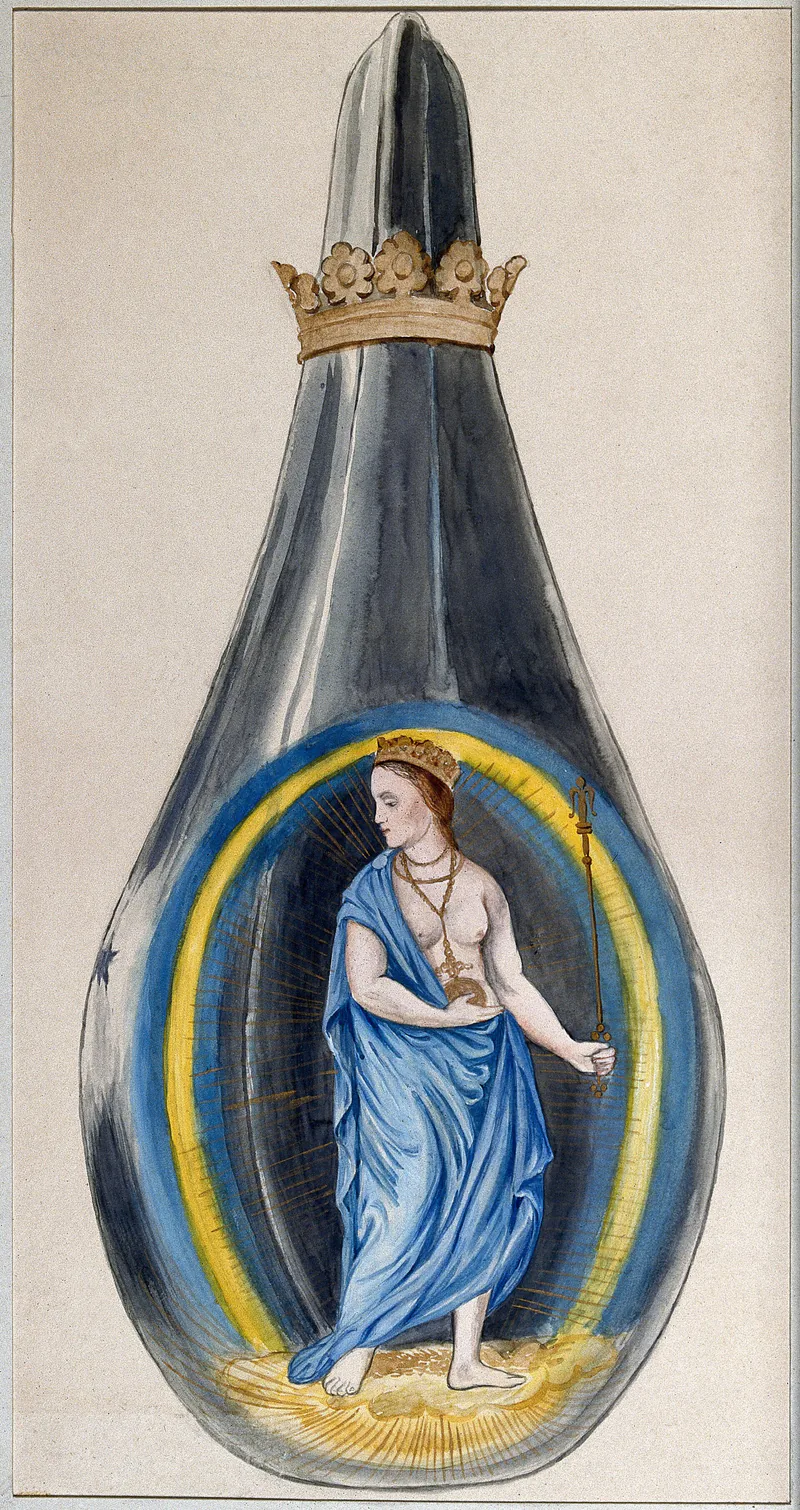
Flowers played their part: the white rose and the lily, both Marian symbols in late medieval devotion, could stand for the white stone. The illuminated Splendor Solis (c. 1532–35) includes a series of glass flasks containing animals and figures, among them a peacock with spread tail and a crowned white queen, which have often been read as stages of the colour sequence. In alchemical diagrams the albedo is frequently placed in the west or associated with water, silver and the night, balancing the solar and fiery imagery of the red stage.
The Rosarium philosophorum and the white rebis§
The clearest visual account of the whitening comes from the woodcuts of the Rosarium philosophorum, printed at Frankfurt in 1550. After the union of king and queen and their death in the tomb, the series shows dew falling on the lifeless body, labelled as an ablution or cleansing; then the soul descending from the clouds to reanimate it; and finally a crowned two-headed figure standing on a crescent moon. This hermaphrodite, the rebis, represents the white stone, the united opposites reborn in purified form.
The Rosarium then repeats much of the sequence for the red stage, ending with an image of the risen Christ. The arrangement shows how alchemists thought of the albedo: a resurrection that was real but not yet complete, a first perfection that awaited a second. C. G. Jung made these woodcuts the backbone of his essay "The Psychology of the Transference" (1946), reading the white stage as a crucial but provisional integration.
Religious readings: purity, resurrection and the dew§
For Christian alchemists the whitening naturally recalled the cleansing of the soul. Psalm 51 prays, "wash me, and I shall be whiter than snow" (Psalm 51:7), and the Book of Revelation describes the redeemed in robes "made white in the blood of the Lamb" (Revelation 7:14). Texts in the tradition of the Aurora consurgens wove such verses into alchemical description, so that the whitening of the matter became a figure of repentance, baptism and grace.
Dew had special prestige. Falling silently from heaven, it was a scriptural sign of divine blessing and in alchemical imagery the agent that washed the dead body in the vessel. The same theme of a sacrificial, nourishing liquid appears in the emblem of the pelican. Through such associations the albedo became, for many readers, the moment at which grace enters the work. These ideas belong to the broader history of spiritual alchemy, in which laboratory practice and devotion were often pursued together.
Jung, Hillman and the psychological albedo§
In Psychology and Alchemy (1944) and later works, Jung interpreted the colour stages as phases of psychological development. He compared the albedo to daybreak: after the darkness of the nigredo, light returns, but the full sunrise comes only with the rubedo. In his scheme the whitening was linked to the moon and to the anima, the feminine image in a man's psyche, and to a state of reflection and detachment that could become cold or abstract if it did not move on to the warmth of the red.
The archetypal psychologist James Hillman developed this theme in essays later gathered in Alchemical Psychology (2010), describing the "silver" of the albedo as a reflective, imaginative consciousness, cooler than the solar certainty of gold. Historians of alchemy have criticised such readings for imposing modern psychology on texts concerned with matter, but they have shaped how the albedo is understood today in therapy, literature and art. Whether read chemically, devotionally or psychologically, the whitening keeps the same structure: purification after loss, a light that follows darkness, and a stage that is precious precisely because it is not yet the end.
Frequently asked questions§
What is the albedo in alchemy?§
It is the whitening stage of the Great Work, following the blackening of the nigredo. The darkened matter was washed and purified until it turned white, producing the white stone that was believed to transmute metals into silver.
What comes after the albedo?§
In the four-stage scheme, the citrinitas or yellowing follows, then the rubedo or reddening. Many authors omitted the yellow stage and passed directly from white to red, the stage of the red stone and of gold.
What does the albedo mean in Jungian psychology?§
Jung saw it as a dawn of consciousness after the darkness of the nigredo, associated with the moon and the anima. It represents a real but incomplete integration, which reaches fulfilment only in the rubedo.
Sources and further reading§
- A Dictionary of Alchemical Imagery — Lyndy Abraham, 1998
- The Rosary of the Philosophers — Adam McLean, 1980
- Psychology and Alchemy — C. G. Jung, 1944
- Mysterium Coniunctionis — C. G. Jung, 1956
- Alchemical Psychology — James Hillman, 2010
- Splendor Solis: The World's Most Famous Alchemical Manuscript — Stephen Skinner, Rafal T. Prinke, Georgiana D. Hedesan & Joscelyn Godwin, 2019
- The Secrets of Alchemy — Lawrence M. Principe, 2013