Liber I · Alchemy · Chapter III: Chinese Alchemy
Wuzhen pian: Zhang Boduan's Awakening to Reality Explained
The Wuzhen pian (Awakening to Reality), Zhang Boduan's 1075 poems on Taoist inner alchemy: structure, lead and mercury, Chan, the Southern Lineage.

The Wuzhen pian (悟真篇), usually translated Awakening to Reality or Understanding Reality, is a collection of poems on Taoist inner alchemy (neidan) written by Zhang Boduan and prefaced in 1075. Together with the older Cantong qi, it is the most influential text of the Chinese alchemical tradition, and it became the founding scripture of the so-called Southern Lineage of inner alchemy. Its verses describe the making of an inner "golden elixir" in the language of lead, mercury, dragon and tiger, while insisting that these are images of the practitioner's own body and mind.
Zhang Boduan and the composition of the Wuzhen pian§
Zhang Boduan, also known by his style name Pingshu and the sobriquet Ziyang ("Purple Yang"), came from the region of Tiantai in present-day Zhejiang. The dates usually given, 987 to 1082, come from later hagiography and are not certain. According to his own preface, he studied widely in Confucian, Buddhist and Taoist learning, including medicine, divination and the military arts, but failed to find the essential teaching of the elixir until he met a master in Chengdu in 1069. Later legend identified this teacher with the immortal Liu Haichan, a figure also claimed by other lineages.
The preface explains that Zhang composed the poems so that the teaching he had received would not be lost and so that others would not waste their lives on false methods. A postface, dated a few years later, voices regret at having transmitted the secret too freely and warns that only worthy persons should receive it. Such statements of reluctance are a common feature of alchemical literature, East and West, and the work was in fact copied, printed and commented on widely; it is included in the Taoist Canon described in the article on the Daozang.
Structure of the text: eighty-one poems and their numbers§
The poems are arranged according to cosmological numbers. The core of the Wuzhen pian consists of sixteen "regulated verses" (lüshi) of eight lines each, sixty-four quatrains (jueju) and one further poem, eighty-one pieces in all. Commentators explained the sixteen verses by the sixteen ounces in a Chinese pound, a measure of completeness for the elixir; the sixty-four quatrains correspond to the sixty-four hexagrams of the Yijing; and eighty-one is the square of nine, the number of pure yang.

To this core were added twelve lyrics to the tune "West River Moon" (Xijiang yue), matching the twelve months, and a supplement of verses and short prose pieces in a Chan Buddhist style. The exact form of the original text and the date of some additions have been debated, and editions differ in order and wording. Fabrizio Pregadio, who translated the regulated verses in 2009, notes that the work's poetic form allowed it to be memorised, recited and read at several levels at once.
Lead, mercury and the language of inner alchemy§
The Wuzhen pian borrows its vocabulary from external alchemy (waidan), the laboratory search for elixirs described in the guide to Chinese alchemy. Its key terms are lead and mercury, the furnace and cauldron, the dragon and the tiger, and the "fire times" by which heat was regulated. But Zhang insists that these words do not refer to physical substances. Lead and mercury in his poems are what the tradition calls "true lead" and "true mercury": the hidden yang within yin and the hidden yin within yang.
This doctrine is expressed through the trigrams of the Yijing. Kan (water) has a yang line enclosed between two yin lines; Li (fire) has a yin line between two yang lines. In the practice described by the poems, the practitioner "takes from Kan to fill Li", restoring the pure yang of the trigram Qian, the state of the human being before the division of the original unity. In terms of the body, this is the refinement of essence (jing) into breath (qi), of breath into spirit (shen), and of spirit into emptiness, the sequence described in the article on Taoist internal alchemy.
The poems are sharply critical of practices Zhang considered misguided: swallowing mineral elixirs, fasting, breathing exercises pursued for their own sake, visualising deities, and sexual techniques. None of these, he says, can produce the elixir, because the true ingredients are already present within the self and need only to be recognised and joined. The cosmology behind this language, including the cycle of the moon and the hexagrams used to time the inner "fire", comes largely from the Cantong qi, which the Wuzhen pian treats as its great predecessor. Inner alchemy involves sustained meditation, and anyone drawn to such practice is usually advised to learn it under an experienced teacher.
The Three Teachings and the Chan supplement§
One of the most distinctive features of the Wuzhen pian is its openness to Buddhism and Confucianism. Zhang's preface argues that the three teachings share a single truth: Confucianism speaks of fully realising one's nature, Buddhism of awakening to emptiness and Taoism of cultivating life. The alchemical poems concern what the tradition calls ming, "life" or bodily vitality, while the Chan supplement addresses xing, "nature" or the mind's original awareness.
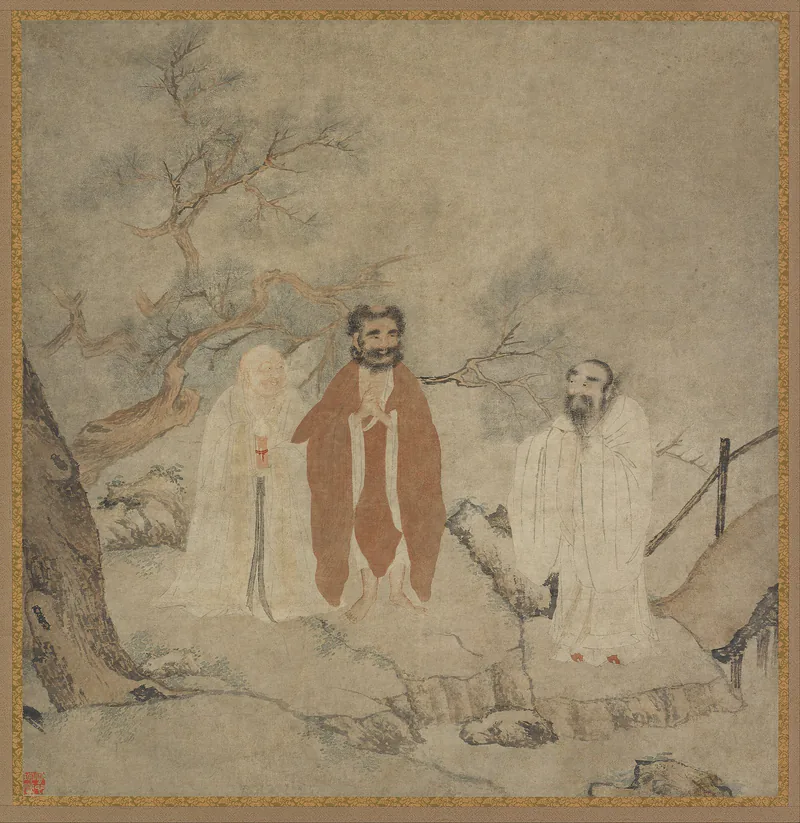
This pairing became the basis of the doctrine of the "joint cultivation of nature and life" (xingming shuangxiu), central to later neidan. The Southern Lineage was often said to begin with life and proceed to nature, while the Northern Quanzhen school, founded by Wang Zhe in the twelfth century, began with nature. The Chan elements of the supplement, with their emphasis on seeing one's original mind, link the text to the tradition described in the guide to Zen and Chan Buddhism. Whether all of this material comes from Zhang himself has been questioned, but by the Southern Song it was transmitted as part of the work.
The Southern Lineage and the commentarial tradition§
In the thirteenth century, followers of the Taoist master Bai Yuchan (traditionally 1194–1229) constructed a line of patriarchs running from Zhang Boduan through Shi Tai, Xue Daoguang and Chen Nan to Bai himself. Historians regard this "Southern Lineage" as largely retrospective, but it gave the Wuzhen pian the status of a founding scripture. Under the Yuan dynasty the Southern and Northern traditions were merged into a single genealogy of the golden elixir, and the text became common property of neidan as a whole.
The Wuzhen pian attracted more commentaries than almost any other alchemical work. Weng Baoguang wrote an influential commentary in the twelfth century, and Chen Zhixu interpreted it under the Yuan. In the Ming period, Lu Xixing and others read some passages as referring to a joint practice between partners, a reading rejected by many other commentators. The most widely read modern interpretation goes back to the Qing master Liu Yiming (1734–1821), whose Direct Pointers to the Wuzhen pian treats the entire work as a description of inner virtue and the return to original nature.
Translations and modern study§
Western readers first met the Wuzhen pian through partial translations in the early twentieth century, including one by Tenney L. Davis and Chao Yün-ts'ung in 1939. Thomas Cleary's Understanding Reality (1987) gave the whole work in English with Liu Yiming's commentary, and Fabrizio Pregadio's Awakening to Reality (2009) offered an annotated translation of the regulated verses. Joseph Needham and Lu Gwei-Djen discussed it at length in the volume of Science and Civilisation in China devoted to "physiological alchemy", and Isabelle Robinet placed it within the long history of Taoist thought.
Modern scholarship stresses that the Wuzhen pian marks a turning point. After it, Chinese alchemy was understood above all as an inner discipline, and the laboratory search for elixirs, already discredited by the elixir poisonings of the Tang dynasty, faded into the background. The text thus stands at the centre of a transformation comparable to, though historically independent of, the inner reading of the Great Work in Western spiritual alchemy. Its promise of a "golden elixir" that brings immortality is understood within the tradition as the realisation of the Taoist immortal, not as the prolongation of ordinary bodily life.
Frequently asked questions§
What does Wuzhen pian mean?§
The title means roughly "Folios on Awakening to Reality" or "Chapters on Understanding Reality". Wu means awakening or realising, zhen means the real or true, and pian refers to a written composition.
Who wrote the Wuzhen pian?§
It is attributed to Zhang Boduan, a Song-dynasty scholar from Tiantai whose preface is dated 1075. Later tradition made him the first patriarch of the Southern Lineage of inner alchemy, though the lineage itself was constructed after his death.
Is the Wuzhen pian about making real elixirs?§
No. It uses the vocabulary of laboratory alchemy, such as lead, mercury and the furnace, but explicitly says these are images of inner principles. It criticises those who swallow mineral elixirs or rely on physical techniques alone.
Sources and further reading§
- Understanding Reality (Wuzhen pian) — Zhang Boduan, 1987
- Awakening to Reality: The "Regulated Verses" of the Wuzhen pian, a Taoist Classic of Internal Alchemy — Fabrizio Pregadio, 2009
- The Seal of the Unity of the Three: A Study and Translation of the Cantong qi — Fabrizio Pregadio, 2011
- The Encyclopedia of Taoism — Fabrizio Pregadio (ed.), 2008
- Taoism: Growth of a Religion — Isabelle Robinet, 1997
- Science and Civilisation in China, vol. 5, part 5: Spagyrical Discovery and Invention: Physiological Alchemy — Joseph Needham & Lu Gwei-Djen, 1983
- Daoism Handbook — Livia Kohn (ed.), 2000