Liber I · Alchemy · Chapter IV: The Great Work
Nigredo: The Blackening Stage of the Alchemical Great Work
Nigredo, the alchemical blackening: putrefaction in the vessel, the raven and black sun, Saturn and melancholy, death and rebirth, and Jung's reading.

The nigredo ("blackening") is the first of the colour stages of the alchemical Great Work, in which the prepared matter in the sealed vessel was dissolved, putrefied and turned black. Alchemists welcomed the blackness as proof that the old form of the substance had been destroyed and that a new, purer one could be born from it. Described in images of death, decay, ravens and a black sun, the nigredo later became, through C. G. Jung, a metaphor for psychological crisis and the encounter with one's own darkness.
Nigredo in the colour sequence of the Great Work§
From its beginnings in Greco-Roman Egypt, alchemy described the transformation of matter as a series of colours. Greek texts speak of blackening (melanōsis), whitening (leukōsis), yellowing (xanthōsis) and a final violet or red (iōsis). Medieval Latin alchemy translated these as nigredo, albedo, citrinitas and rubedo, and many later authors dropped the yellow stage to leave a simpler sequence of black, white and red. The overall structure of the Work is explained in the guide to the Great Work.
Within this sequence the nigredo occupies a paradoxical place. It is the first sign of success and at the same time the lowest point of the process. The matter has lost its original appearance and seems ruined, yet alchemical authors insisted that without this blackness nothing further could happen. Many texts state that if the black does not appear, the alchemist has made a mistake and must begin again.
Putrefaction: what happened in the vessel§
In the laboratory, the nigredo was associated with the operations of dissolution and putrefaction. The materials, often metals combined with a prepared "philosophical mercury" or with sulphurous substances, were sealed in a glass vessel and kept for long periods at a gentle, steady heat, sometimes compared to the warmth of a brooding hen or of fermenting horse dung. Over time the mixture darkened, swelled, gave off vapours that condensed and fell back, and might form a black, pitch-like mass.
Such changes are chemically plausible. Many metals turn black when finely divided or when combined with sulphur, and mixtures of metals and mercury can change colour and texture dramatically under prolonged heat. Historians who have reconstructed early modern recipes, notably Lawrence Principe working from the texts of George Starkey, have shown that some of the effects described in alchemical literature can actually be observed. To the alchemist, however, the blackness was not merely a product but a stage of life: the matter was understood to be dying, as seeds die in the earth before they sprout.
Images of the blackening: raven, black sun and coffin§
Because alchemists described processes through symbols, the nigredo produced some of the most striking images in the tradition. The commonest is the raven or crow, and the dark matter was called the "raven's head" (caput corvi). Other images are the black sun (sol niger), the sun eclipsed or sinking into darkness, which appears in the illuminated Splendor Solis (c. 1532–35); the skeleton and the grave; the king who dies or is devoured; and the toad or the dragon rotting in the earth.
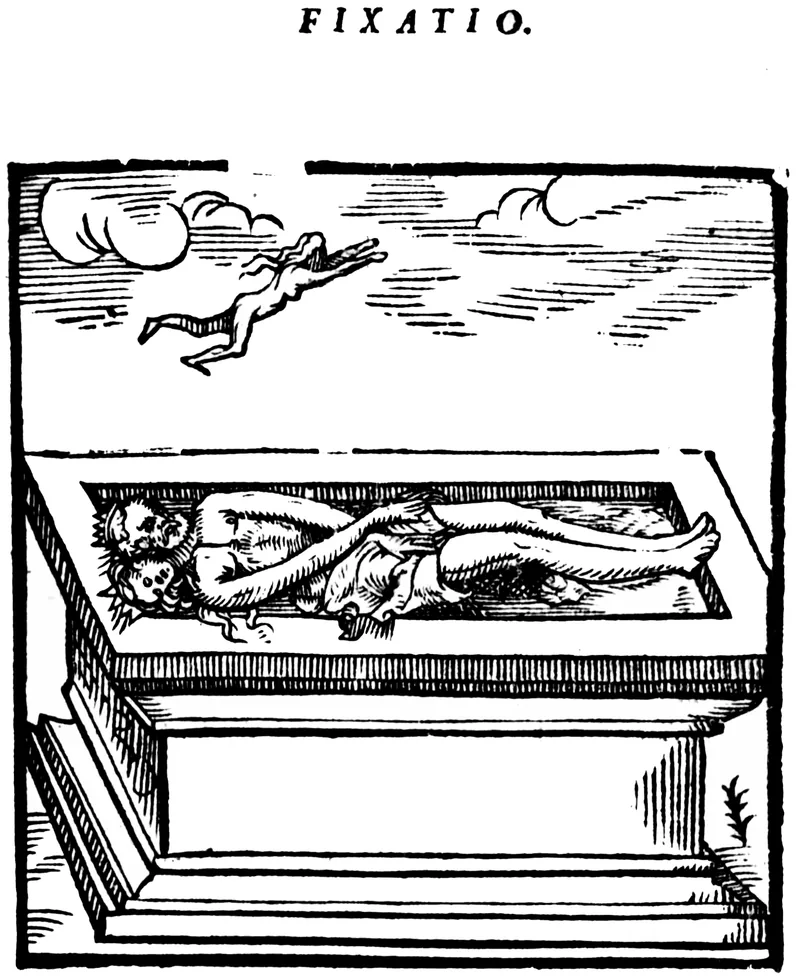
The woodcuts of the Rosarium philosophorum (printed 1550) show the united king and queen lying lifeless in a tomb under the heading "conception or putrefaction", followed by an image of the soul departing from the body. Here death follows marriage: the union of opposites must pass through dissolution before it can be revived. These images are part of the wider language described in the guide to alchemical symbols and in the article on the green lion, another emblem of devouring and dissolution.
Saturn, lead and melancholy§
The nigredo belonged to Saturn. In the planetary scheme of metals, Saturn ruled lead, the heaviest, darkest and most "imperfect" of the seven metals, and lead or its symbols often appear at the start of the Work. Saturn was also the planet of old age, death, time and the melancholic temperament, which ancient and medieval medicine attributed to an excess of black bile.
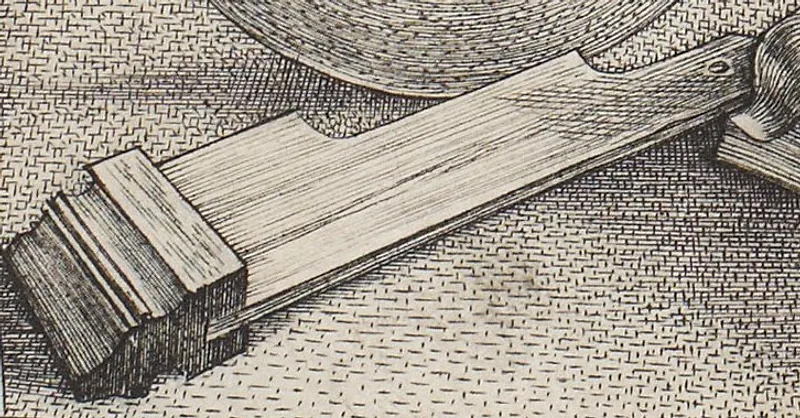
Renaissance thought gave melancholy a double meaning. Marsilio Ficino, in his Three Books on Life (1489), described scholars and contemplatives as children of Saturn, prone to depression but also capable of profound insight. Albrecht Dürer's engraving Melencolia I (1514), with its brooding winged figure surrounded by tools, a polyhedron and a magic square, has often been read in this light, and some interpreters have connected it with alchemy. Through Saturn, the nigredo thus joined a long European meditation on darkness as the condition of wisdom. The planetary background is set out in the guide to the zodiac and planets.
Death and resurrection: the religious meaning of the nigredo§
For Christian alchemists, the death and revival of the matter naturally evoked the death and resurrection of Christ and the hope of the resurrection of the body. Alchemical authors could invoke the Gospel image of the seed: "Except a corn of wheat fall into the ground and die, it abideth alone: but if it die, it bringeth forth much fruit" (John 12:24). The blackness was the grave, the albedo the resurrection, the rubedo the glorified body.
Texts such as the Aurora consurgens, attributed in its manuscripts to Thomas Aquinas but certainly not by him, and works in the tradition of Petrus Bonus developed these parallels in detail, mixing alchemical description with the language of the Psalms and the Song of Songs. Such readings did not usually replace the laboratory; rather, they gave the practitioner's patient work a sacred meaning. This theme runs through the history of spiritual alchemy.
Jung and the psychological nigredo§
In the twentieth century, C. G. Jung made the nigredo a central concept of his psychology of alchemy. In Psychology and Alchemy (1944) and Mysterium Coniunctionis (1955–56), he argued that alchemists projected unconscious processes onto their materials, and that the blackening corresponded to the disorientation, depression and confrontation with the "shadow" that open the way to psychological integration. The dissolution of the old form of the matter mirrored the breakdown of an old attitude in the personality.
Later Jungian writers developed this idea further. Stanton Marlan's The Black Sun (2005) treats the alchemical image as a symbol of experiences of darkness that cannot simply be converted into light. Historians of alchemy have criticised such readings for projecting modern psychology onto texts that were often concerned with real chemistry, but the psychological nigredo has become one of the most widely known alchemical ideas in modern culture.
The nigredo in modern literature and thought§
The term has passed far beyond alchemy. Marguerite Yourcenar's novel L'Œuvre au noir (1968), published in English as The Abyss, takes its title from the French name for the nigredo and follows a sixteenth-century physician and alchemist through a life of inquiry, persecution and inner dissolution. Poets, painters and musicians have used the word for periods of crisis, mourning or creative darkness, and in therapeutic and spiritual writing it often names the "dark night" that precedes renewal.
These modern uses are a long way from the sealed glass vessels of the early modern laboratory, yet they preserve the core alchemical intuition: that transformation requires a breaking down, and that blackness is a beginning rather than an end. For the ultimate goal of the process, see The Philosopher's Stone.
Frequently asked questions§
What is the nigredo in alchemy?§
It is the blackening stage at the beginning of the Great Work, when the matter in the sealed vessel was dissolved and putrefied until it turned black. Alchemists saw it as the death of the old form, necessary before purification and rebirth.
What symbols represent the nigredo?§
The most common are the raven or raven's head, the black sun, the skeleton, the coffin or grave, and the dying king. Saturn and lead were also associated with it.
What did Jung mean by the nigredo?§
Jung interpreted it as a psychological stage of darkness, depression and confrontation with the shadow side of the personality. In his view this crisis was the necessary beginning of individuation, the process of becoming whole.
Sources and further reading§
- A Dictionary of Alchemical Imagery — Lyndy Abraham, 1998
- Psychology and Alchemy — C. G. Jung, 1944
- Mysterium Coniunctionis — C. G. Jung, 1956
- The Black Sun: The Alchemy and Art of Darkness — Stanton Marlan, 2005
- Saturn and Melancholy — Raymond Klibansky, Erwin Panofsky & Fritz Saxl, 1964
- The Secrets of Alchemy — Lawrence M. Principe, 2013
- Splendor Solis: The World's Most Famous Alchemical Manuscript — Stephen Skinner, Rafal T. Prinke, Georgiana D. Hedesan & Joscelyn Godwin, 2019