Liber XXX · Symbols · Chapter V: Sacred Geometry
The Golden Ratio: History, Sacred Geometry and Modern Myths
The golden ratio (phi, 1.618) explained: Euclid's extreme and mean ratio, Fibonacci, Pacioli's divine proportion, Zeising and Le Corbusier, and the myths.

The golden ratio is the proportion in which a line is divided so that the whole is to the longer part as the longer part is to the shorter, a number of about 1.618 written with the Greek letter φ (phi). Defined by Euclid around 300 BCE as "extreme and mean ratio", it governs the pentagon, the pentagram and two of the Platonic solids, and it is closely tied to the Fibonacci sequence. Called the "divine proportion" in the Renaissance and the "golden section" only from the nineteenth century, it became a central idea of modern sacred geometry, surrounded by claims about pyramids, temples and paintings that historians and mathematicians have largely found to be exaggerated.
What Is the Golden Ratio?§
Take a line and cut it at a point so that the ratio of the whole line to the longer piece equals the ratio of the longer piece to the shorter. That ratio is the golden ratio. Expressed as a number, it is φ = (1 + √5) ÷ 2, about 1.6180339887, an irrational number whose decimal expansion never ends or repeats.
The number has unusual algebraic properties that help explain its fascination:
- Its square is itself plus one (φ² ≈ 2.618), and its reciprocal is itself minus one (1/φ ≈ 0.618).
- Written as a continued fraction it consists entirely of ones, which makes it, in a technical sense, the irrational number hardest to approximate by fractions.
- A golden rectangle, whose sides are in the ratio φ, can be divided into a square and a smaller golden rectangle, and the process can be repeated without end. Joining quarter-circles across the squares produces the "golden spiral".
Its most important geometric home is the regular pentagon. The ratio of a pentagon's diagonal to its side is φ, and the diagonals of a pentagon, which together form a pentagram, cut each other in exactly this proportion. For this reason the golden ratio runs through the pentagram, the dodecahedron with its pentagonal faces, and the icosahedron.
Euclid's "Extreme and Mean Ratio" and the Pentagon§
The first surviving definition is in Euclid's Elements (c. 300 BCE). Book VI defines a line as cut in "extreme and mean ratio" when the whole is to the greater segment as the greater is to the less, and an equivalent construction appears earlier, in Book II, as a problem about areas. Euclid uses the division in Book IV to construct the regular pentagon, and in Book XIII to construct the dodecahedron and icosahedron, the last two of the five Platonic solids.
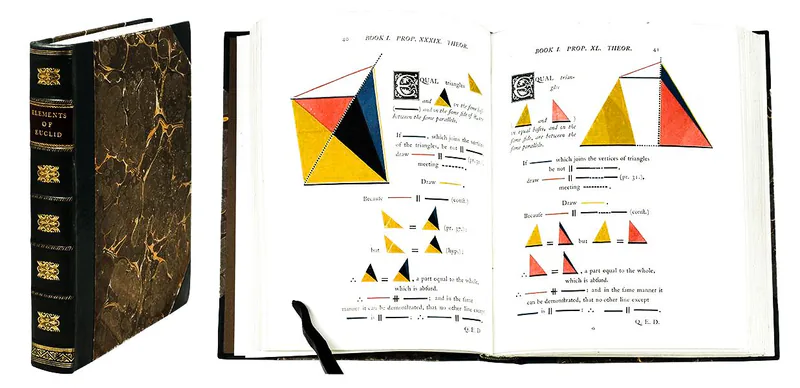
Euclid did not invent the idea. Historians have argued that the ratio was studied in Plato's Academy and earlier, and the mathematician Kurt von Fritz suggested in 1945 that the Pythagoreans' study of the pentagram may have led to the discovery of incommensurable magnitudes, quantities with no common measure, a discovery associated in legend with Hippasus of Metapontum (see Pythagoras and Pythagorean number mysticism). This hypothesis is plausible but cannot be proved from the surviving evidence.
It is important to note that Greek mathematicians treated the ratio as a geometrical construction, not as a number, and gave it no special aesthetic or mystical status. No ancient text recommends it as the ideal proportion for buildings or bodies.
Fibonacci and the Rabbits: The Sequence Behind the Ratio§
In 1202 the Pisan mathematician Leonardo, later called Fibonacci, published Liber Abaci, the book that did most to introduce Hindu-Arabic numerals to Europe. Among its exercises is a problem about rabbits breeding month by month, whose solution is the sequence 1, 1, 2, 3, 5, 8, 13, 21, 34, 55…, in which each number is the sum of the two before it. The same sequence had been known centuries earlier to Indian scholars of Sanskrit prosody, who used it to count possible metrical patterns.
Fibonacci himself did not connect the sequence with Euclid's ratio. The link was noticed later: the ratio of successive Fibonacci numbers (8/5, 13/8, 21/13…) approaches φ ever more closely. Johannes Kepler remarked on this in the early seventeenth century, and in the nineteenth century the French mathematician Jacques Binet published a formula expressing every Fibonacci number in terms of φ. Kepler was also an admirer of the ratio itself, famously ranking the division in extreme and mean ratio alongside Pythagoras' theorem as one of the two great treasures of geometry.
The Divine Proportion: Pacioli and the Renaissance§
The ratio acquired theological meaning in the Renaissance. The Franciscan friar and mathematician Luca Pacioli wrote De divina proportione ("On the Divine Proportion") in the late 1490s in Milan and published it at Venice in 1509, with illustrations of the solids by his friend Leonardo da Vinci. Pacioli explained why the proportion deserved to be called divine: like God, it is unique; it unites three terms in one proportion, as the Trinity unites three persons; it cannot be expressed by any rational number, as God cannot be defined in words; it is always the same, whatever the size of the line, as God is unchanging and present everywhere; and it gives form to the dodecahedron, which Plato had associated with the heavens.
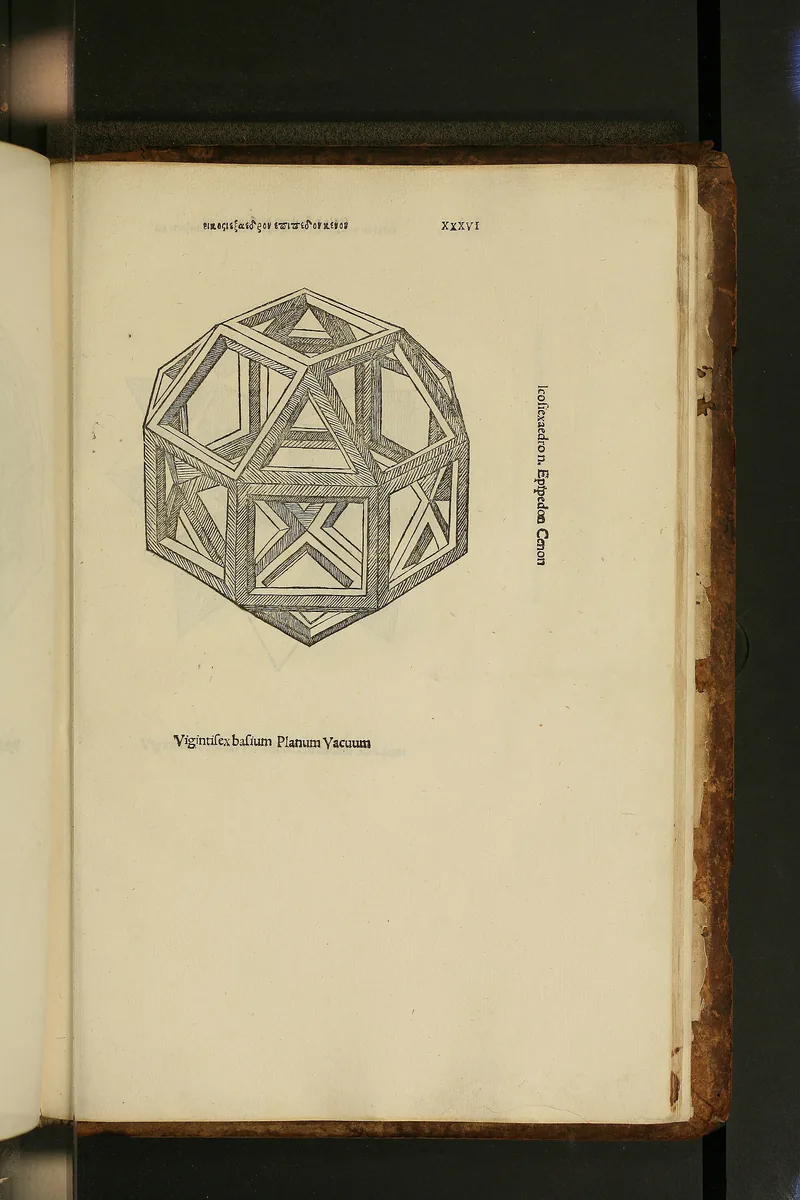
Pacioli's book did not, however, argue that artists should design their works on the golden ratio. In the section on architecture and proportion he followed Vitruvius, who recommended simple whole-number ratios derived from the human body. Leonardo's famous drawing of the Vitruvian Man (c. 1490) illustrates Vitruvius' proportions, not the golden ratio, despite frequent claims to the contrary. Renaissance artists and architects generally preferred rational ratios that could be measured and built, such as those of musical harmony.
How the "Golden Section" Got Its Name: Zeising, Ghyka and Le Corbusier§
The ratio's modern reputation was created in the nineteenth and twentieth centuries. The term "golden section" (goldener Schnitt) first appears in print in 1835, in a mathematics textbook by Martin Ohm, who seems to have recorded an expression already in use. In 1854 the German writer Adolf Zeising published a book proposing the golden section as a universal law of proportion governing the human body, plants, animals, architecture and music. Zeising's claims were enormously influential and launched a search for the ratio everywhere. The psychologist Gustav Fechner, in experiments of the 1860s and 1870s, reported that people preferred rectangles close to the golden proportion, but later studies have produced inconsistent results.
The symbol φ was introduced in the early twentieth century by the American engineer Mark Barr, in honour, it is often said, of the Greek sculptor Phidias, and was publicised in Theodore Andrea Cook's The Curves of Life (1914). The Romanian diplomat and writer Matila Ghyka, in Le Nombre d'or (1931) and The Geometry of Art and Life (1946), presented the golden number as a key to art, nature and an esoteric Pythagorean tradition. The architect Le Corbusier based his Modulor, a scale of architectural proportions developed in the 1940s and published in 1950, on a human figure and the golden ratio, and Salvador Dalí painted The Sacrament of the Last Supper (1955) on a canvas of roughly golden proportions, with a vast dodecahedron hovering over the scene. By the late twentieth century the ratio had become a central doctrine of popular sacred geometry.
Myths and Realities: Pyramids, Parthenon, Nautilus and Sunflowers§
Many of the most repeated claims about the golden ratio do not survive careful examination, a point made by the mathematician George Markowsky in "Misconceptions about the Golden Ratio" (1992) and by the astrophysicist Mario Livio in The Golden Ratio (2002).
- The Great Pyramid: some of its proportions come close to φ, but Egyptian builders specified slopes by a simple ratio of horizontal run to vertical rise, the seked, and other theories fit the measurements as well. No Egyptian text mentions the golden ratio.
- The Parthenon: claims depend on where measurements are taken; the building's proportions are generally better explained by other ratios, and it predates Euclid's definition.
- Paintings: golden rectangles can be drawn over almost any picture if one is free to choose the starting points. There is no documentary evidence that Leonardo designed the Mona Lisa on the ratio.
- The nautilus shell: its spiral is logarithmic, but its growth factor is not the golden ratio.
- The human body: ratios such as total height to navel height vary widely between people and only roughly approach 1.6.
The real natural occurrence is in phyllotaxis, the arrangement of leaves and seeds. Many plants place successive leaves or florets about 137.5 degrees apart, the "golden angle" derived from φ, which packs them efficiently; as a result the seed spirals of sunflowers and the scales of pine cones often come in consecutive Fibonacci numbers, such as 34 and 55. In modern mathematics and physics the ratio appears in Roger Penrose's non-repeating tilings of the 1970s and in quasicrystals, discovered by Dan Shechtman in 1982. For other misunderstandings of esoteric history, see myths and misconceptions.
Frequently asked questions§
What is the golden ratio in simple terms?§
It is the proportion you get when you divide a line so that the whole is to the longer piece as the longer piece is to the shorter. Numerically it is about 1.618, and it is closely related to the Fibonacci sequence.
Why is it called the divine proportion?§
Luca Pacioli gave it that name in 1509, arguing that its uniqueness, its three terms and its irrational nature mirrored the attributes of God. The name "golden section" appeared only in the nineteenth century.
Is the golden ratio really in the Great Pyramid and the Parthenon?§
Not demonstrably. Some measurements come close, but they can be explained by other design methods, and no ancient source says the builders used the ratio. Historians treat these claims as modern interpretations.
Sources and further reading§
- The Elements — Euclid, c. 300 BCE
- The Golden Ratio: The Story of Phi, the World's Most Astonishing Number — Mario Livio, 2002
- A Mathematical History of the Golden Number — Roger Herz-Fischler, 1998
- De divina proportione — Luca Pacioli, 1509
- Fibonacci's Liber Abaci — Laurence Sigler (trans.), 2002
- The Geometry of Art and Life — Matila Ghyka, 1946
- The Modulor — Le Corbusier, 1950
- Sacred Geometry: Philosophy and Practice — Robert Lawlor, 1982