Liber XXX · Symbols · Chapter IV: Religious Symbols
Chi-Rho Symbol: Meaning, Origins and Constantine's Sign
The Chi-Rho symbol explained: the Greek monogram of Christ, the staurogram, Constantine's vision and labarum, early Christian art and related Christograms.

The Chi-Rho is one of the oldest symbols of Christianity: a monogram formed by superimposing the first two Greek letters of Christos, chi (Χ) and rho (Ρ), so that the loop of the rho rises through the centre of the cross-shaped chi. It became famous as the sign the emperor Constantine placed on his soldiers' shields and on his battle standard, the labarum, around the time of his victory at the Milvian Bridge in 312, and it spread through Roman coinage, sarcophagi, mosaics and church silver before the plain cross became the dominant Christian emblem.
What the Chi-Rho Is: Letters, Forms and Names§
The Greek title Christos, a translation of the Hebrew mashiach ("anointed one", Messiah), begins with the letters chi and rho. Writing the two letters as a single interlocked sign produces the Chi-Rho, also called the chrismon in Latin sources and the "monogram of Christ" in older English writing. It belongs to a larger family of Christograms, abbreviations of the name or title of Jesus used as sacred signs, which also includes IHS, IC XC and the acrostic fish (ichthys) discussed below.
Several forms are found. The commonest has the vertical stroke of the rho running through the crossing of an X. A variant turns the chi upright into a plus-shaped cross with a rho loop at the top, which scholars call the monogrammatic cross. The Chi-Rho is often enclosed in a wreath, a sign of victory taken over from Roman military and athletic imagery, and flanked by the Greek letters alpha (Α) and omega (Ω), echoing the words of Christ in Revelation 1: "I am Alpha and Omega, the beginning and the ending."
Its meaning is simple: it names Christ, compressing the title into one mark that could stand on a ring, a lamp, a tomb or a shield. For the wider family of Christian signs see religious symbols and what is sacred symbolism.
Before Constantine: Scribal Ligatures and the Staurogram§
The chi-rho ligature was not invented by Christians. Greek scribes sometimes wrote a combined chi and rho in the margins of manuscripts, apparently as an abbreviation for words such as chrēston ("useful" or "good"), to mark a passage worth noting. Ligatures of the two letters also appear on some Hellenistic coins, including bronze issues of Ptolemy III of Egypt in the third century BCE, where they probably abbreviate a name or an official title.
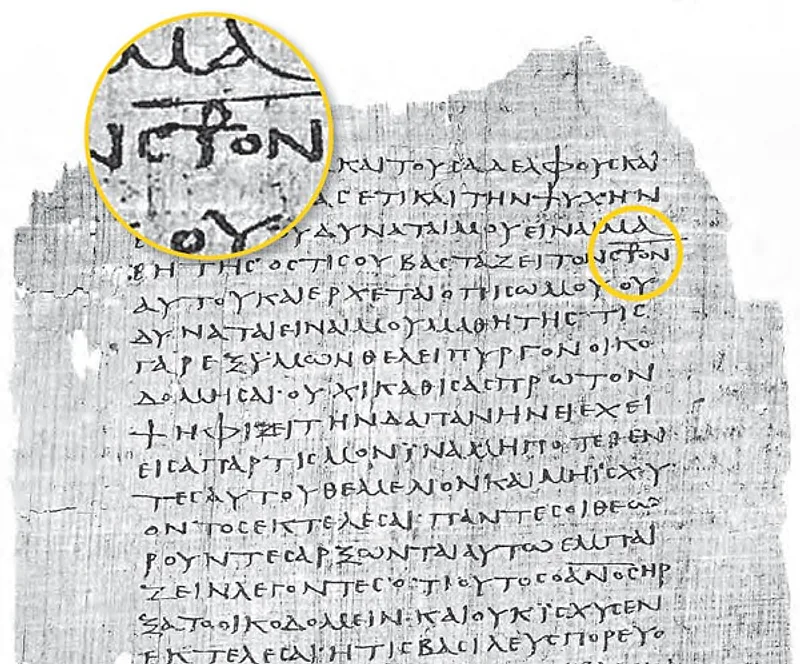
The more important Christian precursor is the staurogram (⳨), formed from the letters tau (Τ) and rho. In several early New Testament papyri, notably the Bodmer papyri of the Gospels of John and Luke usually dated around 200 CE, scribes wrote the Greek words for "cross" (stauros) and "crucify" (stauroō) in abbreviated form with the tau and rho combined. Because the tau looks like a cross and the loop of the rho can be read as a head, the historian Larry Hurtado argued that the staurogram is one of the earliest visual references to the crucified Jesus, older than surviving crucifixion images. It belongs to the scribal practice of the nomina sacra, the abbreviated "sacred names" of Christian manuscripts.
Before the fourth century, Christians appear to have preferred other discreet emblems. Clement of Alexandria, writing around 200, advised believers to choose signet rings engraved with a dove, a fish, a ship, a lyre or an anchor rather than with pagan gods. Roman catacomb art shows the same preference, and the Chi-Rho becomes common only after 312.
Constantine's Vision and the Battle of the Milvian Bridge§
On 28 October 312 Constantine defeated his rival Maxentius at the Milvian Bridge north of Rome and became master of the western Roman Empire. Two Christian writers connect the victory with a sign of Christ.
Lactantius, a Christian rhetorician who later tutored Constantine's son, wrote On the Deaths of the Persecutors within a few years of the battle. He says that Constantine was told in a dream to mark the heavenly sign of God on his soldiers' shields, and did so with a letter X turned and with its top bent round, a compressed description read as either the staurogram or the Chi-Rho.
Eusebius of Caesarea gives a far more dramatic version in his Life of Constantine, completed after the emperor's death in 337. Constantine, he says, told him under oath that while marching with his army he saw at midday a cross-shaped trophy of light above the sun with the words "By this conquer" (Greek toutō nika, later rendered in Latin as in hoc signo vinces). That night Christ appeared to him in a dream and told him to make a likeness of the sign as a protection in battle. Eusebius does not place the vision at the battle itself, and his earlier Church History omits it.
Historians still debate these accounts. Some regard the vision as pious elaboration; others take it as Constantine's own interpretation of an experience. One suggestion, made by Peter Weiss, is that Constantine saw a solar halo display, a natural phenomenon of ice crystals that can produce cross-like arcs around the sun and later understood it in Christian terms. What is secure is that from about 312 Constantine publicly associated his rule with the God of the Christians, and that the Chi-Rho became the emblem of that association. The doctrinal side of his reign, including the Council of Nicaea in 325, is covered in Christian creeds and ecumenical councils.
The Labarum and the Chi-Rho in Imperial Rome§
Eusebius also describes the standard Constantine had made, which he says he saw himself. It was a tall spear with a crossbar, forming a cross; at its top was a wreath of gold and precious stones enclosing the Chi-Rho, and from the crossbar hung a square banner with portraits of the emperor and his sons. This standard, the labarum (a word of uncertain origin), was carried before the army as a sign of divine protection.
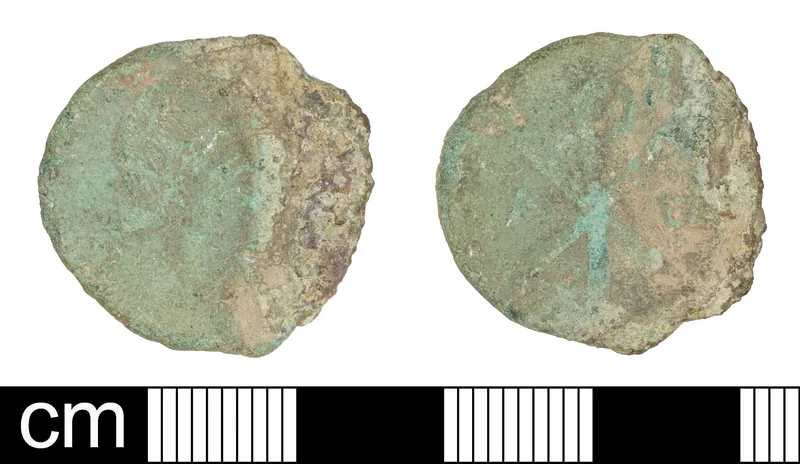
The Chi-Rho then entered the official imagery of the empire, though gradually. A silver medallion struck at Ticinum (Pavia) around 315 shows Constantine wearing a helmet with a small Chi-Rho badge. Coins of the 320s and later show the labarum piercing a serpent or carried by the emperor, and the sign appears on the shields of soldiers. The usurper Magnentius (350–353) issued bronze coins whose entire reverse is a large Chi-Rho between alpha and omega. The emperor Julian (361–363), who tried to restore the worship of the traditional gods, set Christian emblems aside, but his successors restored them, and in Byzantium the labarum and Chi-Rho remained imperial signs. The older cults they displaced are described in Roman religion.
The Chi-Rho in Early Christian Art from Rome to Britain§
In the fourth century the Chi-Rho appears wherever Christians made objects. On Roman sarcophagi it often stands at the centre of a composition. The so-called Passion sarcophagus in the Vatican Museums, from about 350, shows a cross topped by a Chi-Rho in a victor's wreath held by an eagle, with two Roman soldiers below, one sleeping and one watching: an image of the Resurrection.
Roman Britain has some of the most striking examples. The Hinton St Mary mosaic from Dorset, discovered in 1963 and now in the British Museum, shows a male bust in front of a Chi-Rho, flanked by pomegranates; it is widely interpreted as one of the earliest images of Christ in a floor mosaic anywhere. At the Lullingstone villa in Kent, wall paintings of a Chi-Rho in a wreath and of figures praying with raised hands suggest that a room was used for Christian worship in the later fourth century. The Water Newton treasure, found in Cambridgeshire in 1975, includes bowls, cups and votive plaques marked with the Chi-Rho and is often described as the earliest known group of Christian liturgical silver from the Roman Empire.
The monogram survived the end of Roman rule. In early medieval Gospel books the opening of Matthew 1:18, Christi autem generatio ("Now the birth of Christ"), was treated as a second beginning of the Gospel and written with an enormous decorated Chi-Rho. The Chi-Rho page of the Book of Kells (folio 34r, usually dated around 800) fills the page with interlace, spirals, angels and even cats and mice, and is among the most celebrated pages of Insular art. The life of the figure the monogram names is told in Jesus and the apostles.
IHS, IC XC and the Ichthys: Related Christograms§
The Chi-Rho was never the only abbreviation of Christ's name. The ichthys, Greek for "fish", was read as an acrostic of Iēsous Christos Theou Huios Sōtēr, "Jesus Christ, Son of God, Saviour". Tertullian, around 200, plays on the image when he calls Christians "little fishes" born in the water of baptism after their Ichthys, Jesus Christ.
IHS (sometimes IHC) comes from the first three letters of the Greek name ΙΗΣΟΥΣ, iota, eta and sigma, transcribed into Latin script. Medieval readers, no longer recognising the Greek, reinterpreted it as an abbreviation of Latin phrases such as Iesus Hominum Salvator ("Jesus, Saviour of mankind"). The Franciscan preacher Bernardino of Siena (1380–1444) popularised a devotion to the Holy Name in which IHS was painted in gold within a radiant sun, and the Society of Jesus later adopted the monogram, with a cross above the H, as its emblem.
In the Greek East, icons label Christ with IC XC, the first and last letters of Iēsous and Christos, sometimes accompanied by NIKA ("conquers"), an echo of the Constantinian promise of victory. All of these signs remain in use: the Chi-Rho is embroidered on vestments and altar cloths in many churches (see Christian sacraments and liturgy), and the background of alpha and omega is discussed in the Book of Revelation.
Frequently asked questions§
What does the Chi-Rho symbol mean?§
It is a monogram of Christ formed from the Greek letters chi and rho, the first two letters of Christos. It names Christ and, after Constantine, also came to signify Christ's victory over death and the protection of the Christian empire.
Did Constantine invent the Chi-Rho?§
No. Chi-rho ligatures already existed as abbreviations in Greek writing, and Christian scribes used the related staurogram around 200 CE. Constantine made the Chi-Rho famous by placing it on shields and on his labarum standard from about 312.
What is the difference between the Chi-Rho and the staurogram?§
The Chi-Rho combines chi and rho, the opening letters of Christos. The staurogram combines tau and rho and was first used by scribes to abbreviate the Greek words for "cross" and "crucify"; because its shape resembles a figure on a cross, it is considered one of the earliest Christian images of the crucifixion.
Sources and further reading§
- Life of Constantine — Eusebius of Caesarea, c. 339
- On the Deaths of the Persecutors (De mortibus persecutorum) — Lactantius, c. 315
- Constantine and Eusebius — Timothy D. Barnes, 1981
- The Earliest Christian Artifacts: Manuscripts and Christian Origins — Larry W. Hurtado, 2006
- Ante Pacem: Archaeological Evidence of Church Life Before Constantine — Graydon F. Snyder, 1985
- Early Christian Art and Architecture — Robert Milburn, 1988
- The Book of Kells — Bernard Meehan, 2012
- Signs and Symbols in Christian Art — George Ferguson, 1954