Liber XXX · Symbols · Chapter IV: Religious Symbols
Swastika Symbol: Religious History from India to the Nazis
The swastika's religious history: its Sanskrit meaning, prehistoric origins, sacred use in Hinduism, Jainism and Buddhism, and its appropriation by the Nazis.

The swastika is an equal-armed cross whose arms are bent at right angles, and it is one of the oldest and most widespread symbols in the world. Its name comes from the Sanskrit svastika, "conducive to well-being", and for more than two thousand years it has been a sign of good fortune and sacred order in Hinduism, Jainism and Buddhism, while related designs appear in prehistoric, Greek, Roman, Christian and Native American art. In the twentieth century the Nazi movement adopted a tilted form as its emblem, and for many people in Europe and the Americas that use now overshadows every other meaning.
The Name and Meaning of the Swastika§
The word svastika is built from su, "good" or "well", and asti, "it is", with a suffix that makes a noun or adjective; it means something like "a thing of well-being". The related greeting svasti, "may it be well", opens many Sanskrit inscriptions. The sign has two mirror-image forms: arms bent to the right (clockwise, 卐) and arms bent to the left (counter-clockwise, 卍). Some later Hindu writers called the left-facing form sauvastika and associated it with night or with fierce goddesses, but in practice both forms are used across the Indian traditions and in East Asia, and no single rule governs them.
Many cultures gave the sign their own names. Greeks called similar designs gammadion, because each arm resembles the capital letter gamma (Γ), or tetraskelion, "four-legged". In Old and Middle English heraldry the form is the fylfot. Japanese call it manji, Tibetans yungdrung in the Bon tradition, and Germans Hakenkreuz, "hooked cross", the word used for the Nazi emblem. Interpretations usually see movement around a centre (the sun's course, the turning heavens, the four directions), but these are often later explanations of a design whose earliest meanings are unrecoverable.
Prehistoric and Ancient Swastikas§
Swastika-like meanders appear on some of the earliest decorated objects in Europe. A carved ivory bird from Mezine in Ukraine, usually dated to the Upper Palaeolithic, is covered with interlocking meander patterns that some writers describe as swastikas, though the identification is loose. More clearly, painted bowls of the Samarra culture in northern Mesopotamia (around 6000–5000 BCE) arrange birds, fish or women's flowing hair around a central swastika, creating a whirling composition; one well-known bowl is in the Pergamon Museum in Berlin.
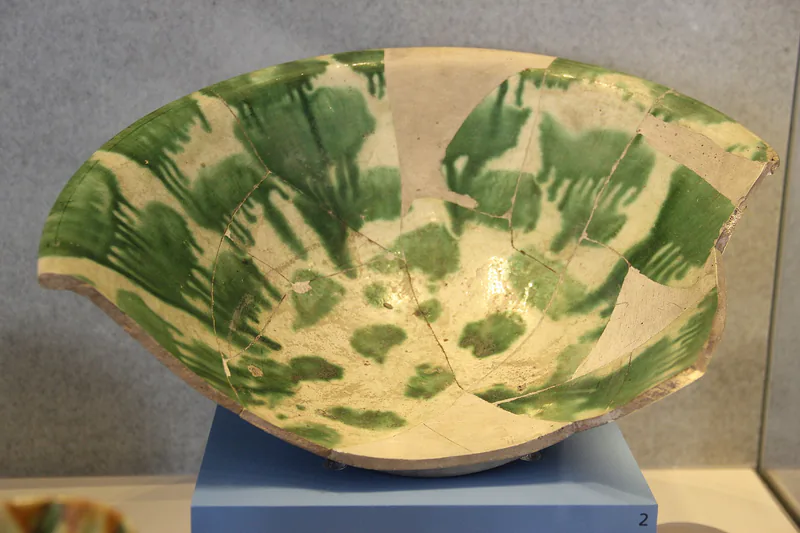
The Indus Valley civilisation (about 2600–1900 BCE) carved swastikas on square steatite seals, alongside animal motifs and the undeciphered Indus script. Because the script cannot be read, their meaning is unknown, but they place the sign in South Asia long before Sanskrit texts. In Bronze and Iron Age Europe the swastika appears on pottery, metalwork and textiles from the Balkans to Scandinavia. Greek Geometric vases use it as a filling ornament, and Roman mosaics build meander borders from interlocking swastikas.
The discovery that most shaped modern ideas came from Troy. Excavating at Hisarlik in the 1870s, Heinrich Schliemann found hundreds of clay spindle whorls marked with swastikas. He compared them with Indian examples and, encouraged by scholars such as Émile Burnouf, concluded that the sign was an ancestral emblem of the "Aryan" peoples who, in the philology of the day, had spread the Indo-European languages. In 1896 Thomas Wilson of the Smithsonian Institution published a large survey, The Swastika, documenting the sign worldwide.
The Swastika in Hinduism and Jainism§
In Hinduism the swastika is a sign of auspiciousness (mangala). It is drawn in red powder or turmeric paste on doorways, thresholds and floors, painted on vehicles and new houses, and marked on the first page of merchants' account books during the Diwali festival, when Lakshmi, goddess of prosperity, is worshipped. It is closely associated with Ganesha, the remover of obstacles invoked at the start of every undertaking, and appears in wedding decorations and on ritual vessels. Its four arms are variously linked to the four Vedas, the four goals of life or the sun's course, reflections rather than fixed doctrine. Temple and festival practice is described in Hindu temples, rituals and festivals.
For Jains the swastika is among the most important symbols of all. It is one of the eight auspicious objects (ashtamangala) in the Shvetambara tradition and the emblem of the seventh tirthankara, Suparshvanatha. Jains explain its four arms as the four possible states of rebirth: as a god, a human, an animal or plant, or a hell being. In temple worship devotees arrange rice into a swastika, add three dots above it for the "three jewels" of right faith, knowledge and conduct, and above them a crescent and dot representing the siddhashila, the abode of liberated souls at the summit of the universe. In 1975, for the 2,500th anniversary of Mahavira's liberation, Jain communities adopted a common emblem in which a swastika sits within the outline of the universe. See what is Jainism and Jain temples and pilgrimage.
Buddhism, Bon and East Asia§
Buddhist art took over the sign as a mark of auspiciousness and of the Buddha's virtue. It is listed among the auspicious marks on the soles of the Buddha's feet in some traditions and is often carved on the chest of Buddha images, especially in East Asia, where it is said to represent the Buddha's mind or the seal of his heart. In Chinese it became the character 卍 (wan), read with the same sound as the word for "ten thousand" and associated with boundless good fortune; Chinese tradition credits the Tang empress Wu Zetian with fixing this reading in the late seventh century, an attribution that is uncertain.
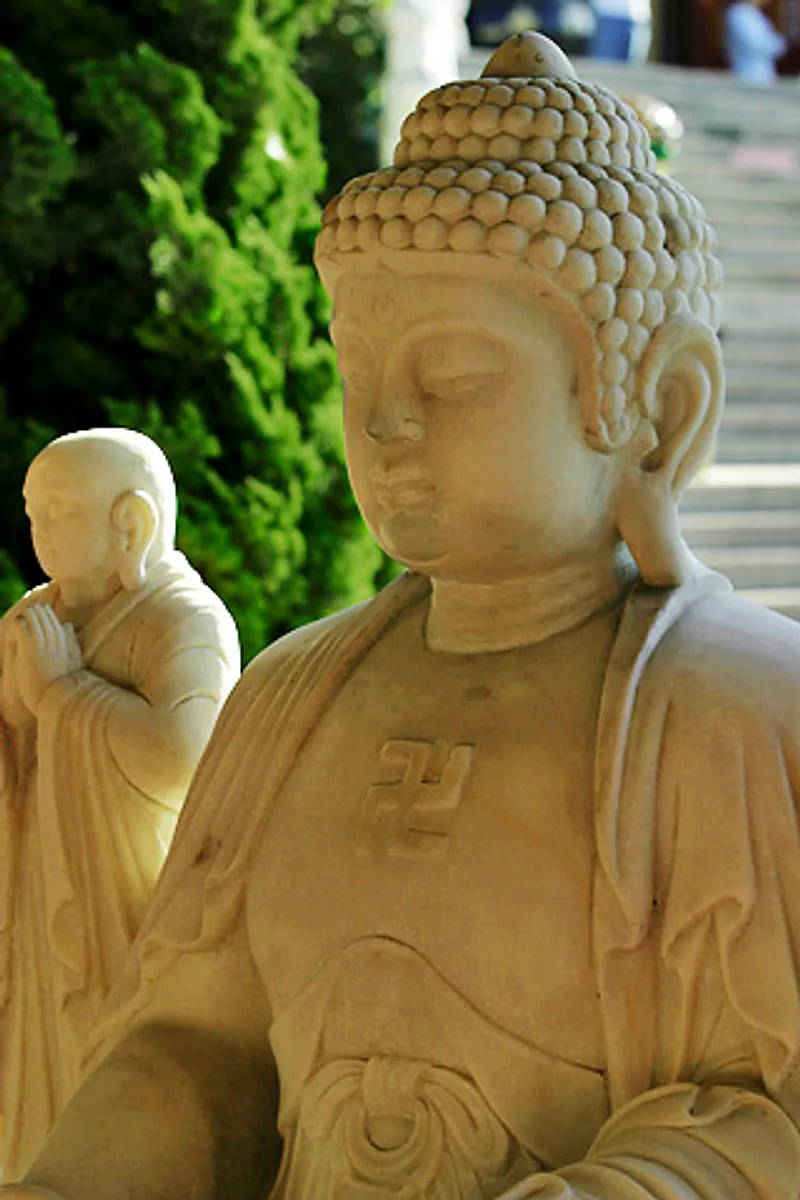
In Japan the left-facing manji marks Buddhist temples on maps and appears on family crests. In 2016 the national mapping agency considered replacing it on maps for foreign visitors before the Tokyo Olympics, to avoid confusion with the Nazi emblem; after criticism from Buddhist organisations the symbol was kept on standard Japanese maps. In Tibet the indigenous Bon religion uses the left-turning yungdrung as its central emblem of the eternal and indestructible teaching, and the name Yungdrung Bon means "everlasting Bon"; Tibetan Buddhists generally use the right-turning form. See Tibetan Buddhism.
Christian, European and Native American Uses§
Early Christians sometimes used the gammadion as a disguised or decorative cross, the crux gammata, and it appears in catacomb inscriptions, on Byzantine textiles and in the vestments of figures in medieval church art. In northern Europe the sign occurs on Anglo-Saxon cremation urns and metalwork, Viking-age objects and Baltic textiles; some modern writers link it with the hammer of the god Thor, but the evidence is thin. Its folk use as a lucky or protective mark resembles that of other apotropaic marks.
In North America the Navajo whirling-log motif, associated with a healing narrative, and similar designs among the Hopi, Apache and Tohono O'odham peoples, entered trade jewellery and blankets in the late nineteenth century. In 1940, after the Nazi use had become notorious, representatives of several south-western peoples publicly pledged to stop using it on their goods. Around 1900 the swastika was also a fashionable Western good-luck charm, found on postcards, advertising, the badges of youth organisations and the insignia of the Finnish air force. Western esotericists, too, adopted it as a sign of ancient wisdom: the seal of the Theosophical Society, founded in 1875, places a swastika at its top above interlaced triangles inside a serpent biting its tail.
From Aryan Theory to the Nazi Hakenkreuz§
The idea that the swastika was the emblem of an ancient Aryan race passed from philology into German nationalist and occult circles. The Austrian writer Guido von List wove it into his visionary system of runes and Germanic priesthood, and Jörg Lanz von Liebenfels raised a swastika flag over his castle of Werfenstein around 1907. In the years after the First World War the sign was used by the Thule Society in Munich and by paramilitary Freikorps units. These currents, described in German occultism from the Romantics to Ariosophy, are the subject of Nicholas Goodrick-Clarke's study The Occult Roots of Nazism, which also shows how limited their direct influence on Nazi policy was.
The National Socialist party adopted the swastika in 1920 as a black right-facing Hakenkreuz, usually tilted at 45 degrees, in a white disc on a red field. After 1935 that flag became the national flag of Germany. Under it the regime waged a war of aggression and carried out the Holocaust, the murder of six million Jews, together with the persecution and killing of Roma, disabled people and many others. For survivors and their descendants the tilted black swastika is a symbol of genocide, and it remains the most widespread emblem of neo-Nazi and white supremacist groups.
The Swastika Today: Law, Memory and Reclamation§
Germany prohibits the public display of Nazi symbols, including the swastika, under section 86a of its criminal code, with exceptions for education, art, scholarship and reporting; Austria and several other countries have similar laws. When a ban across the European Union was proposed in 2005, Hindu organisations in Britain and elsewhere objected that their sacred sign would be criminalised, and the proposal was dropped. Some recent laws, such as the 2022 ban on Nazi symbols in the Australian state of Victoria, explicitly exempt religious and cultural use of the swastika.
Hindu, Jain and Buddhist communities in the West have campaigned to explain the difference between their auspicious sign and the Nazi emblem, sometimes asking that the latter be called by its German name, Hakenkreuz, rather than "swastika". The case shows how one shape can carry a sacred meaning for some communities and a meaning of atrocity for others. For the wider family of sacred signs see religious symbols.
Frequently asked questions§
What does the swastika mean in Hinduism?§
It is a sign of auspiciousness and well-being, which is what the Sanskrit name means. Hindus draw it on thresholds, account books, vehicles and ritual objects, especially at festivals such as Diwali and at the start of new undertakings.
Is the Buddhist manji the same as the Nazi swastika?§
They share a basic shape, but they differ in meaning and usually in form: the Buddhist manji is generally left-facing and upright, while the Nazi emblem is right-facing, black and tilted at 45 degrees. Above all, the Buddhist sign expresses auspiciousness and the Buddha's virtue and has no connection with Nazism.
Why did the Nazis use the swastika?§
Nineteenth-century scholars wrongly treated it as the emblem of an ancient Aryan race, and German nationalist and occult groups took it up as a racial symbol. The Nazi Party adopted it in 1920 to present itself as heir to that imagined Aryan past.
Sources and further reading§
- The Swastika: The Earliest Known Symbol, and Its Migrations — Thomas Wilson, 1896
- Ilios: The City and Country of the Trojans — Heinrich Schliemann, 1880
- The Swastika: Constructing the Symbol — Malcolm Quinn, 1994
- The Swastika: Symbol Beyond Redemption? — Steven Heller, 2000
- The Occult Roots of Nazism — Nicholas Goodrick-Clarke, 1985
- The Jains — Paul Dundas, 1992
- The Encyclopedia of Tibetan Symbols and Motifs — Robert Beer, 1999