What Is Jainism? Beliefs, History and Practice of the Jains
What is Jainism? An introduction to the Jain religion: Mahavira and the Tirthankaras, soul and karma, ahimsa, the two sects, temples and festivals.

Jainism is an ancient religion of India that teaches that every living being has an eternal soul, and that the soul can free itself from the cycle of rebirth through non-violence (ahimsa), self-discipline and right knowledge. Jains follow the teachings of twenty-four Tirthankaras, "ford-makers" who crossed the ocean of rebirth and showed others the way, the last of whom, Mahavira, lived in north-eastern India in about the sixth or fifth century BCE. There are roughly four to five million Jains in India and several hundred thousand more abroad.
The Origins and History of Jainism§
Jains regard their religion as eternal, taught anew in each cosmic age by a series of Tirthankaras. In the present age the first was Rishabha (Adinatha), whom tradition places in an immensely distant past, and the twenty-third, Parshva, is widely thought by historians to have been a real teacher of perhaps the ninth or eighth century BCE. The twenty-fourth, Vardhamana, known by the title Mahavira ("great hero"), was born into a ruling family near Vaishali in what is now Bihar. Jain tradition dates his liberation to 527 BCE; many scholars prefer a date several decades later, making him a slightly older contemporary of the Buddha. His life and that of his predecessors are the subject of Mahavira and the 24 Tirthankaras.
Jainism belongs to the shramana ("striver") movements of ancient India — ascetic traditions that, like Buddhism, stood outside the Vedic sacrificial religion of the Brahmins and rejected the authority of the Vedas. It spread with the support of rulers and merchants; tradition associates the Mauryan emperor Chandragupta with the Jain teacher Bhadrabahu, and King Kharavela of Kalinga left a famous inscription in the Udayagiri caves of Odisha around the first century BCE. In the following centuries the community gradually divided into the Digambara ("sky-clad") and Shvetambara ("white-clad") traditions, explained in Digambara and Shvetambara Jainism.
Jainism flourished under royal patronage in Karnataka in the first millennium CE, and in Gujarat and Rajasthan in the medieval period, where the Shvetambara monk Hemachandra (1089–1172) advised the Chaulukya kings. Jains have long been prominent in trade and banking, in part because their ethics restrict occupations that harm living beings. Their libraries preserved vast collections of manuscripts, and their temples are among the finest in India.
Core Jain Teachings: Soul, Karma and Liberation§
Jain philosophy divides reality into jiva, the living soul, and ajiva, the non-living: matter, space, time and the media of motion and rest. Every soul is by nature infinitely knowing, perceiving, blissful and powerful, but since beginningless time it has been bound by karma, which Jains understand not as an abstract law but as subtle particles of matter attracted to the soul by passions such as anger, pride, deceit and greed. This karmic matter obscures the soul's qualities and determines its rebirths.
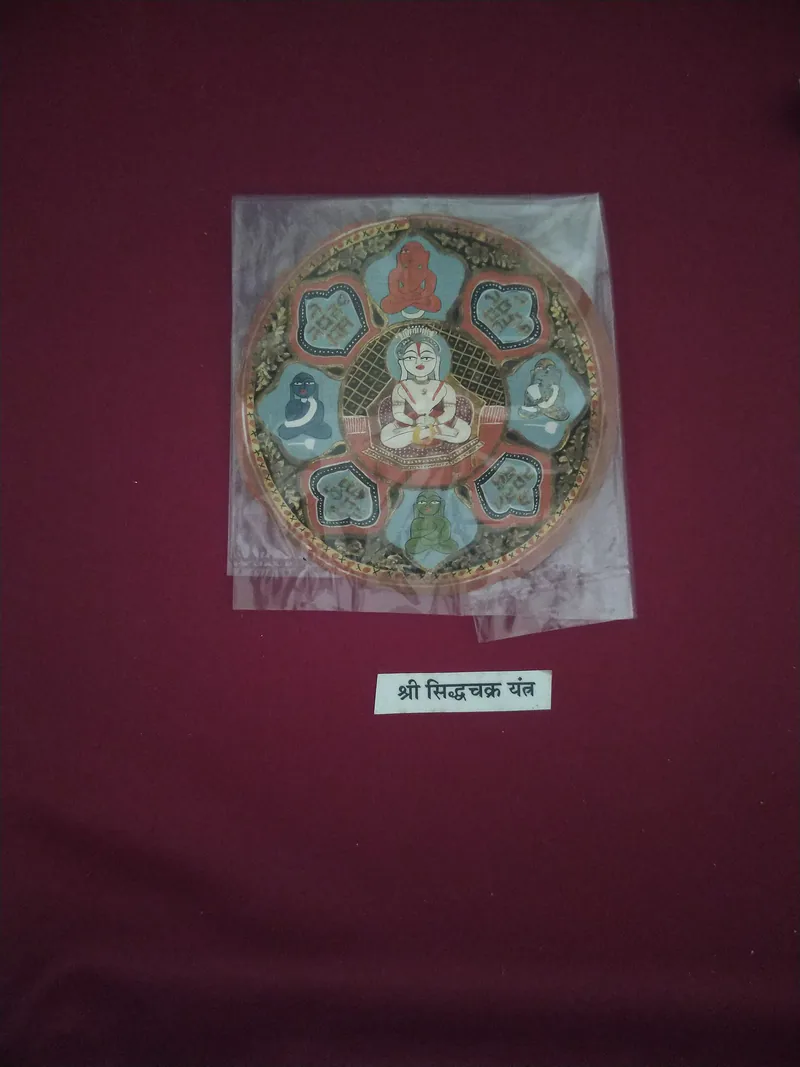
Liberation (moksha) comes from stopping the influx of new karma through restraint and burning away existing karma through austerity. The path is summed up in the "three jewels" (ratnatraya) at the start of the classic Jain treatise, the Tattvartha Sutra: right faith or insight, right knowledge and right conduct. A soul that has destroyed all karma rises to the top of the universe and dwells forever as a siddha, a perfected being. Jain thinkers also developed anekantavada, the doctrine of the many-sidedness of reality, which holds that any single statement captures only part of the truth. These ideas are explored in Jain Teachings.
Ahimsa and the Jain Way of Life§
For Jains, all souls are equal in nature, and living beings are classified by the number of their senses, from one-sensed beings such as earth, water, fire, air and plants up to five-sensed animals, humans, hell-beings and gods. Harming any of them binds karma. Ahimsa is therefore the first and greatest of the five vows that structure Jain ethics: non-violence, truthfulness, not stealing, chastity and non-possession.
Ascetics take these vows in their strictest form as the "great vows" (mahavratas); lay Jains take the "lesser vows" (anuvratas) adapted to life in the world. In practice this means a strictly vegetarian diet, usually avoiding root vegetables, honey and eating after dark; filtering water; and choosing occupations that minimise harm. Jain monks and nuns walk barefoot, carry a small whisk to sweep insects from their path and, in some traditions, wear a cloth over the mouth. The details are set out in Ahimsa and the Jain Vows.
The Jain Universe§
Jains do not believe in a creator god. The universe (loka) is eternal and uncreated, often depicted as a giant standing human figure with the hells below, the middle world of humans and animals at the waist, and the heavens above, crowned by the abode of the liberated souls. Time turns in an endless wheel of ascending and descending half-cycles, each divided into six eras; we live in the fifth era of a descending half-cycle, an age of decline in which no one in our region can attain liberation directly. Gods (devas) exist but are souls enjoying the fruits of good karma in the heavens, mortal and still bound to rebirth. This vision is described in Jain Cosmology. It invites comparison with the cyclical cosmologies of Hinduism and Buddhism, and with ideas of reincarnation found across many religions.
Worship, Festivals and Pilgrimage§
Although Jains do not pray to the Tirthankaras for favours — the liberated souls are beyond worldly involvement — many Jains worship their images in temples as a way of reflecting on and cultivating their qualities. Daily rites include darshan (viewing the image), offerings in the eightfold puja and recitation of the Namokar (Navkar) mantra, which honours the five supreme beings: the arhats, or omniscient teachers such as the Tirthankaras, the liberated souls, the leaders of the ascetic orders, the teachers and all ascetics. Some Shvetambara groups, the Sthanakavasis and Terapanthis, reject image worship altogether.
The most important festival is Paryushana among Shvetambaras, and the closely related Das Lakshana among Digambaras, a period of fasting, scripture reading and repentance in late summer that ends with mutual requests for forgiveness. Mahavira's liberation is commemorated at Diwali, and his birth at Mahavir Jayanti in spring. Pilgrimage to holy mountains such as Shatrunjaya, Girnar and Sammed Shikhar, and to temple complexes such as Mount Abu and Ranakpur, is discussed in Jain Temples and Pilgrimage.
Jainism Today and Its Influence§
The 2011 census of India counted about 4.45 million Jains, concentrated in Maharashtra, Rajasthan, Gujarat, Madhya Pradesh and Karnataka. Significant diaspora communities live in East Africa, Britain, North America and Belgium. Despite their small numbers, Jains have had an influence out of proportion to their size in commerce, philanthropy, education and the care of animals; Jain animal hospitals and bird hospitals are well known in Indian cities.
Jain ideas also travelled beyond India. Mahatma Gandhi, who grew up in Gujarat among Jains, acknowledged the influence of the Jain thinker Shrimad Rajchandra on his commitment to non-violence. In recent decades Jain ethics have attracted interest in debates on vegetarianism and veganism, environmental ethics and religious pluralism. Western scholarship on Jainism, pioneered in the nineteenth century by Hermann Jacobi, who demonstrated that Jainism was an independent religion rather than an offshoot of Buddhism, has grown into a lively field.
Frequently asked questions§
Do Jains believe in God?§
Jains do not believe in a creator or ruler of the universe. They revere the Tirthankaras and liberated souls as perfected beings worthy of worship, and they accept that gods live in the heavens, but these gods are mortal souls, not creators.
What is the main goal of Jainism?§
The goal is moksha, liberation of the soul from karma and from the cycle of birth and death. A liberated soul possesses infinite knowledge, perception, bliss and energy and dwells eternally at the summit of the universe.
Who founded Jainism?§
Jains hold that their religion is eternal and was not founded by any one person. Historically, Mahavira, the twenty-fourth Tirthankara, organised the community in its present form, building on the earlier tradition of Parshva.
How is Jainism different from Buddhism?§
Both arose among the ascetic movements of ancient India and reject a creator god and the authority of the Vedas. Jainism, however, teaches an eternal individual soul and a material theory of karma, and it stresses rigorous austerity, whereas Buddhism teaches non-self and the "middle way" between indulgence and severe asceticism.
Sources and further reading§
- The Jaina Path of Purification — Padmanabh S. Jaini, 1979
- The Jains — Paul Dundas, 1992
- Jainism: An Introduction — Jeffery D. Long, 2009
- That Which Is: Tattvartha Sutra — Umasvati, 1994
- Jaina Sutras — Hermann Jacobi (trans.), 1884