Jainism and Buddhism Compared: Shared Roots, Different Paths
Jainism and Buddhism compared: two shramana religions of ancient India, their founders, views of soul and karma, ascetic discipline, ethics and history.

Jainism and Buddhism are sister religions that grew up side by side in the Ganges valley in the middle of the first millennium BCE. Both were founded or renewed by wandering ascetics of the warrior class, both rejected the authority of the Vedas and animal sacrifice, and both teach liberation from an endless cycle of rebirth driven by karma. They differ sharply, however, on the existence of a permanent soul, on the nature of karma and on how severe the path of renunciation must be.
Two Shramana Religions of the Ganges Valley§
In the sixth and fifth centuries BCE the kingdoms of Magadha and its neighbours were home to many shramanas, "strivers" who left household life to seek release from rebirth by renunciation, meditation and austerity. Alongside the priests of the Vedic sacrifice, these ascetics formed a rival religious culture with its own teachers, debates and patrons. Jainism and Buddhism are the two shramana movements that survived; others, such as the Ajivikas of Makkhali Gosala, disappeared after some centuries.
The two founders' biographies run in strikingly parallel lines. Vardhamana Mahavira, as Jains tell it, was born a prince near Vaishali, renounced the world at about thirty, practised twelve years of severe austerity and attained omniscience, then taught for some thirty years before his liberation at Pavapuri (see Mahavira and the 24 Tirthankaras). Siddhartha Gautama, born among the Shakyas at Lumbini, renounced at twenty-nine, tried and abandoned extreme fasting, awakened under the bodhi tree at Bodh Gaya and taught for some forty-five years (see The Life of the Buddha). Both preached in the vernacular rather than Sanskrit, and both drew followers from kings, merchants and ordinary householders.
The dates of both men are debated. Jain tradition puts Mahavira's liberation in 527 BCE, and older scholarship placed the Buddha's death around 483 BCE; many historians now prefer a later date for the Buddha, around 400 BCE, and some move Mahavira correspondingly later. What is clear is that they belonged to the same generation and the same landscape.
A crucial difference lies in how each tradition sees its founder. For Buddhists, Gautama rediscovered a forgotten path and is the Buddha of this age. For Jains, Mahavira was not a founder at all but the twenty-fourth and last Tirthankara of the present cycle, renewing a teaching already given by Parshvanatha and, before him, by Rishabha in the remote past.
Mahavira and the Buddha in Each Other's Texts§
The Pali Canon mentions the Jains more often than the Jain canon mentions Buddhists. In the Samannaphala Sutta (Digha Nikaya 2), the king Ajatashatru reports the doctrines of six rival teachers, among them "Nigantha Nataputta", the "unbound one of the Nata clan", whose teaching is summarised as a "fourfold restraint" (catuyama-samvara). This phrase seems to reflect the fourfold vow associated in Jain sources with Parshva rather than Mahavira's five vows, which suggests that Buddhist authors knew the Jain community at an early stage. Other suttas, such as the Upali Sutta (Majjhima Nikaya 56), stage debates in which a Jain lay disciple is won over by the Buddha, and one text records disputes among the Niganthas after their master's death.

These passages are polemical, written to show the Buddha's superiority, but historians value them as independent evidence that Mahavira and his order existed in the Buddha's lifetime. In the nineteenth century some European scholars assumed that Jainism was merely an offshoot of Buddhism. Hermann Jacobi, introducing his translation of the Jaina Sutras in 1884, used exactly this Buddhist evidence to show that the Jain community was older than or at least as old as the Buddhist one, and his conclusion has been accepted ever since.
Soul, Karma and the Nature of Liberation§
The deepest doctrinal difference concerns the self. Jainism holds that the universe contains infinitely many eternal souls (jiva), each by nature possessing infinite knowledge, perception, bliss and energy. These qualities are obscured by karma, which Jains understand as a fine physical substance that flows into the soul through actions driven by passion and sticks to it. Liberation means shedding every particle of karmic matter so that the pure soul rises to the summit of the universe, where it abides for ever. This scheme is explained in Jain Teachings: Soul, Karma and Anekantavada and The Six Dravyas.
Buddhism teaches the opposite on the central point. In its analysis a person is a changing stream of five aggregates (skandhas), with no permanent self to be found among them; clinging to the idea of a self is itself a root of suffering. Karma in Buddhism is not a substance but intention (cetana) and the volitional actions it produces. Nirvana is the extinguishing of craving, hatred and delusion, and Buddhist schools have generally refused to describe what, if anything, "remains" after the final nirvana of an awakened being. The four noble truths and dependent origination, outlined in Core Teachings of Buddhism, have no direct Jain counterpart.
Many-sidedness and the middle way§
Both traditions developed sophisticated philosophies of knowledge. Jains formulated anekantavada, the doctrine that reality is many-sided, with its method of standpoints (naya) and conditional assertion (syadvada), allowing apparently opposed views to be partly true from different angles. Buddhist philosophers, especially Nagarjuna, developed the Madhyamaka "middle way" between eternalism and annihilationism, arguing that all things are empty of intrinsic nature (see Nagarjuna and Madhyamaka). Medieval Jain and Buddhist logicians debated each other at length, and each borrowed technical tools from the other.
Ascetic Discipline: Austerity and the Middle Way§
Because Jains see karma as matter attracted by every action, the Jain path emphasises restraint and the burning away of accumulated karma through tapas, austerity. Fasting, standing motionless in meditation, enduring heat and cold and, for Digambara monks, complete nudity are all signs of detachment. At the end of life, an ascetic or layperson may take the vow of sallekhana, gradually giving up food in a calm and deliberate death.
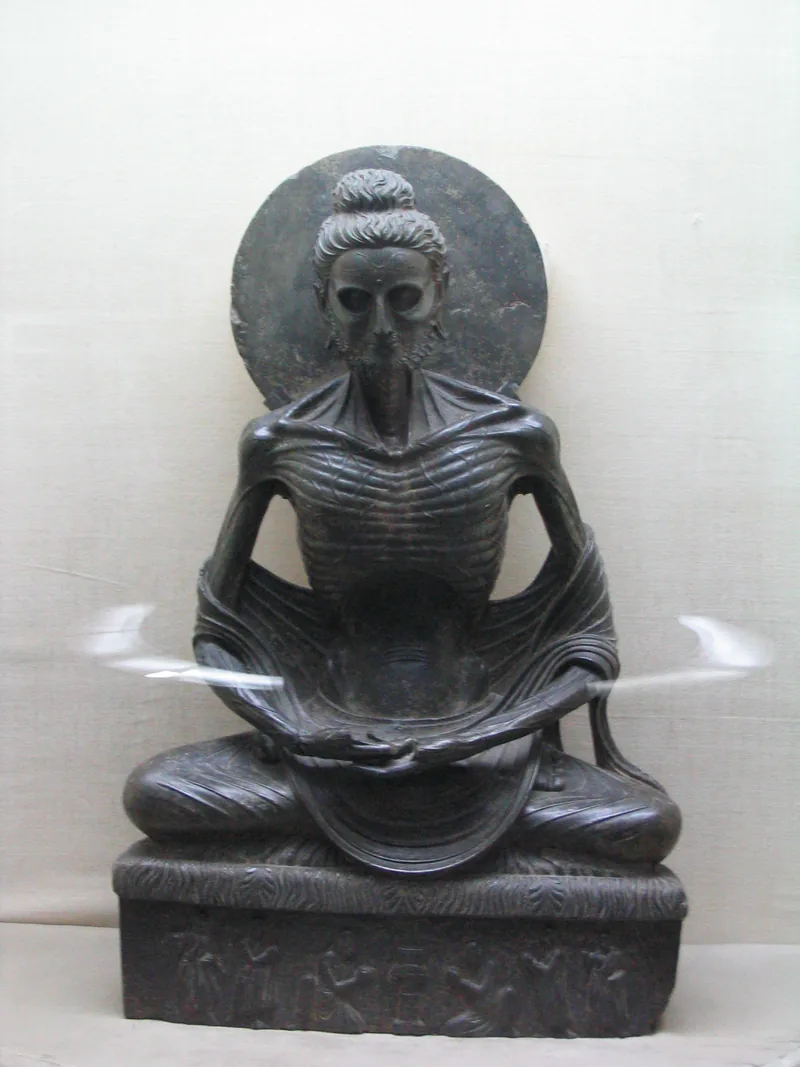
The Buddha's biography tells a different story about austerity. Having fasted almost to death, Siddhartha concluded that self-mortification, like sensual indulgence, does not lead to awakening, and he took food before sitting under the bodhi tree. Buddhist monks therefore eat a daily meal, wear robes, may own a small set of requisites and follow the detailed rules of the Vinaya (see Buddhist Monastic Life). Jain monks and nuns also live by elaborate rules, but their five great vows are applied with exceptional rigour, as described in Jain Monks and Nuns.
Both orders share many practices: wandering for most of the year, staying in one place during the rainy-season retreat, begging food from householders and admitting women as nuns. The Jain nuns' order has been, and remains, larger than the monks' order, while in much of the Buddhist world the full ordination lineage for women lapsed and is only now being revived in some countries.
Ethics, Diet and Non-Violence§
Non-violence (ahimsa) is central to both religions, but its scope differs. Jains extend moral concern to every living being, including the one-sensed lives in earth, water, fire, air and plants, and their discipline is designed to minimise harm even to these. Strict vegetarianism is a defining mark of Jain identity; many Jains also avoid root vegetables, honey and eating after dark, as explained in Ahimsa and the Jain Vows.
Buddhism's first precept likewise forbids killing, and the Buddha condemned animal sacrifice. Yet the early Vinaya allowed monks to accept meat offered to them unless they knew the animal had been killed for them, and dietary practice varies widely: Chinese and Vietnamese monastic Buddhism became strictly vegetarian, while Tibetan and Theravada communities often are not. Buddhist ethics concentrates on intention; Jain ethics, while also valuing intention, pays close attention to the physical consequences of action, since every act draws in karmic matter.
Divergent Histories in India and Asia§
Both religions won royal patronage. Jain tradition remembers Chandragupta Maurya as a disciple of the monk Bhadrabahu, while his grandson Ashoka became the most celebrated patron of Buddhism (see Ashoka and the Spread of Buddhism). Ashoka's edicts mention the Niganthas among the ascetic groups his officials were to look after.
Their later fortunes diverged dramatically. Buddhist missionaries carried the dharma to Sri Lanka, Central Asia, China, Korea, Japan, Southeast Asia and Tibet, where it became a civilisational force. In India, however, Buddhism depended heavily on large monasteries; when patronage dwindled and great centres such as Nalanda were sacked around 1200, it largely disappeared from the land of its birth. Jainism hardly spread beyond India before the modern diaspora, but it never vanished. Historians often explain its survival by the close integration of ascetics and laity: Jain monks and nuns depend on lay families for every meal, lay merchants funded temples and libraries, and the community kept a distinct identity within a Hindu environment. The History of Jainism traces this story in detail.
Art, temples and sacred images§
Early Jain and Buddhist art grew from the same workshops. Both built stupas, and the Kankali Tila site at Mathura has yielded Jain stupa remains and inscribed images from the early centuries CE. A Jina and a Buddha can look alike in seated meditation, but Jina images usually have the shrivatsa mark on the chest, no monastic robe and none of the Buddha's cranial bump or hand gestures of teaching; standing Jinas hold the rigid kayotsarga posture with arms hanging straight. Over time the Jain temple, with its rows of Tirthankara images and elaborate marble halls, became the community's centre, as described in Jain Temples and Pilgrimage.
Frequently asked questions§
What is the main difference between Jainism and Buddhism?§
The main doctrinal difference is the self. Jainism teaches that each living being has an eternal soul bound by karmic matter, while Buddhism teaches non-self and understands karma as intention. Jainism also places far greater weight on austerity than the Buddha's middle way.
Did Mahavira and the Buddha ever meet?§
No surviving source records a meeting between them. The Pali Canon mentions Mahavira as Nigantha Nataputta and describes debates between their followers, which shows that they taught in the same region at about the same time.
Which is older, Jainism or Buddhism?§
Jains regard their religion as eternal and Mahavira as the last of twenty-four Tirthankaras. Historically, Mahavira and the Buddha were near contemporaries, and many scholars accept that Parshvanatha, Mahavira's predecessor, was a real teacher, so the Jain community probably predates the Buddhist one.
Do Jains and Buddhists both believe in reincarnation?§
Both teach rebirth according to karma and aim at liberation from it. The difference is that Jains speak of a soul passing from body to body, while Buddhists describe a causal continuity of consciousness without a permanent self.
Sources and further reading§
- The Jains — Paul Dundas, 1992
- The Jaina Path of Purification — Padmanabh S. Jaini, 1979
- Jaina Sutras — Hermann Jacobi (trans.), 1884
- The Two Traditions of Meditation in Ancient India — Johannes Bronkhorst, 1986
- Greater Magadha: Studies in the Culture of Early India — Johannes Bronkhorst, 2007
- Collected Papers on Buddhist Studies — Padmanabh S. Jaini, 2001
- Jainism: An Introduction — Jeffery D. Long, 2009