Liber XXVI · Shinto · Chapter II: Festivals & Rites
Niinamesai and Daijōsai: Shinto Harvest and Enthronement Rites
Niinamesai and Daijōsai explained: the emperor's offering of new rice, the Daijōsai of a new reign, its history, meaning and modern controversies.

The Niinamesai is the Shinto harvest rite in which the emperor of Japan offers the year's new rice to Amaterasu and the other kami and then partakes of it himself; it is held every year on 23 November. The Daijōsai, or Great Thanksgiving, is the special, far grander Niinamesai performed once at the beginning of each reign, and it is regarded as the most important and most secret of the rites by which a new emperor assumes his role.
Rice, Kingship and the Harvest in Shinto§
Rice has been the central crop and symbol of Japanese civilisation since its cultivation spread through the islands in the first millennium BCE. In the myths, the sun goddess Amaterasu cultivates rice fields in heaven and celebrates the first-fruits festival there; her brother Susanoo's crimes include breaking the dikes of her fields and defiling the hall where she tastes the new grain. When her grandson descends to rule the land, the Nihon shoki says he receives ears of rice from her sacred fields. The story of Amaterasu Ōmikami thus links the imperial line to the growing and offering of rice.
The ritual year of shrines, described in Shinto festivals, is structured around the agricultural cycle: the Toshigoi or Kinensai in early spring prays for a good harvest, and the autumn rites give thanks for it. The anthropologist Emiko Ohnuki-Tierney has argued that rice came to stand for the Japanese self and community, so that its offering to the kami expresses the bond between the land, its people and its ruler.
The Niinamesai: The Emperor's Harvest Offering§
The term niiname means roughly "tasting the new [grain]". The Nihon shoki mentions harvest rites of this kind in the reigns of legendary and early historical rulers, and similar rites were held in many households and villages. At court the Niinamesai was held in the eleventh month of the lunar calendar, on the second day of the hare; after Japan adopted the Gregorian calendar in 1873 the date was fixed at 23 November.
The rite takes place at night in a sanctuary within the palace grounds, the Shinkaden. The emperor, having purified himself, enters the hall twice: once in the evening (yūbe no gi) and again before dawn (akatsuki no gi). On each occasion he personally offers dishes of rice, millet, sake brewed from the new rice, fish, fruit and other foods to Amaterasu and the gods of heaven and earth, recites a prayer of thanks and eats and drinks with them. The rite is closed to the public and its details are known mainly from historical ceremonial texts.
Shrines throughout Japan hold their own Niinamesai, led by their priests, on or around the same day, and before it, in October, the Kannamesai is celebrated at Ise, where the new rice from the shrine's own fields is offered to Amaterasu and an imperial envoy brings offerings from the palace. In 1948 the postwar government converted the date of the palace rite into a secular holiday, Labour Thanksgiving Day (Kinrō kansha no hi), whose origin many Japanese no longer associate with the harvest offering.
The Daijōsai: The Great Thanksgiving of a New Reign§
When a new emperor comes to the throne, the first Niinamesai of his reign is performed as the Daijōsai (also read Ōnie no matsuri). If the accession falls late in the year, the rite is held in the following autumn. The distinction between the annual and the accession rites is usually dated to the late seventh century, the age of Tenmu and Jitō, when the institutions of the imperial state took shape, and the procedures were set out in detail in the Engishiki.
The preparations begin months in advance. By divination using a heated turtle shell (kiboku), two regions are chosen to supply the rice: the Yuki region to the east and the Suki region to the west of the capital. In each a field is designated, its rice planted and harvested under ritual supervision, and the grain carried to the capital. Since the modern era the choice has been made among prefectures; for the Daijōsai of 2019 the Yuki field was in Tochigi Prefecture and the Suki field in Kyoto Prefecture.
Meanwhile a temporary complex, the Daijōkyū, is erected within the palace grounds. Its two main halls, the Yukiden and the Sukiden, are built in an archaic style with rough-hewn timbers, thatched roofs and earthen floors covered in matting, recalling the simplest early Japanese architecture. After the rite the buildings are dismantled, in keeping with the Shinto ideal of renewal also seen in the periodic rebuilding of the shrines at Ise.
Inside the Daijōkyū: Ritual and Interpretation§
The Daijōsai repeats the structure of the Niinamesai on a grander scale. During the night the emperor, dressed in pure white silk robes, proceeds first to the Yukiden and then to the Sukiden, and in each he presents the new rice and other offerings, prays, and partakes of rice and sake with the deities. Ladies of the court and ritualists assist; music and ancient songs and dances from the provinces, including the Kume-mai and the Gosechi dance, form part of the surrounding ceremonies, followed by banquets.
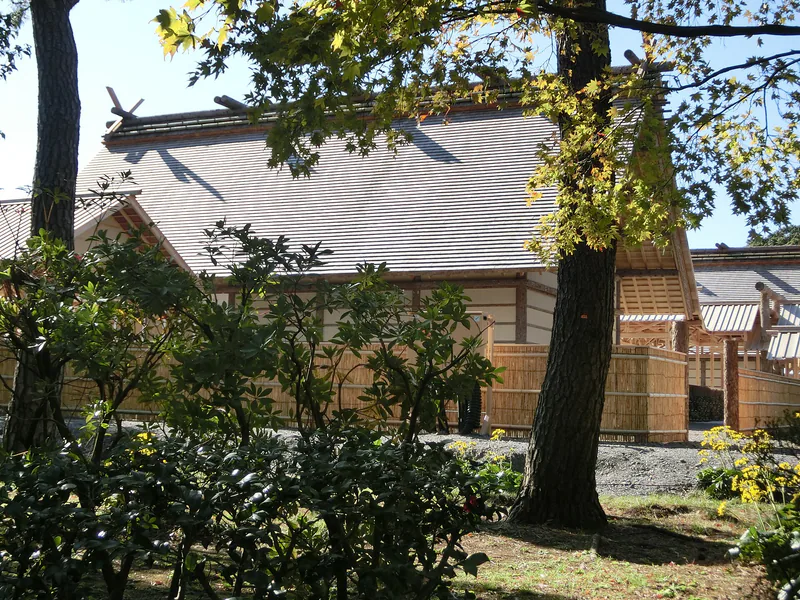
What happens in the inner chamber has attracted much speculation, because each hall contains a ritual couch or bed (shinza) as well as the place of offering. In 1928 the folklorist Orikuchi Shinobu proposed that the emperor lay down on the couch wrapped in a coverlet (madoko ōfusuma), in imitation of the infant Ninigi descending from heaven, and so received the "imperial spirit" (tennōrei) that made him a sacred ruler. This theory was influential in the twentieth century, both among nationalists and among scholars of sacred kingship. Later historians, notably Okada Shōji, have argued that the sources show only a meal shared with the kami and that the couch is reserved for the deity, not for the emperor. The Imperial Household Agency has described the rite as one of offering and thanksgiving for the peace of the nation and abundant harvests.
Suspension, Revival and Modern Controversy§
The Daijōsai was expensive, and in the turmoil of the Ōnin War (1467–1477) and the warring-states period that followed, the court could not afford it. After the Daijōsai of Emperor Go-Tsuchimikado in 1466, it was not held again until 1687, when a simplified form was performed for Emperor Higashiyama with shogunal support; it was performed again from 1738 and became regular thereafter. The Meiji government held the Daijōsai of 1871 in Tokyo for the first time and made it a spectacle of the new state; the Imperial Household Law of 1889 prescribed it as part of every enthronement, and the Daijōsai of 1915 and 1928 were great national events.
Since the postwar constitution separated religion and state, the Daijōsai has posed a legal question. It is a religious rite, yet it is funded from the palace budget for official imperial activities. The governments of 1990, for Emperor Akihito, and of 2019, for Emperor Naruhito, defined it as a ceremony of a "public character" connected to the hereditary throne, while declining to make it a formal state act. Lawsuits challenging the funding were rejected, and in 2018 Prince Akishino publicly questioned whether the rite should be paid for from public money rather than the imperial family's private funds. Critics also note the cost of the Daijōkyū, which was simplified in 2019 with plank roofs in place of thatch.
Harvest Rites Beyond the Palace§
The imperial rites are the best-known examples of a much wider pattern. Many villages once held their own niiname in households, and some regions preserve distinctive harvest customs. On the Noto Peninsula, for example, farmers perform Aenokoto, welcoming the invisible kami of the rice field into the house in winter, guiding it to the bath and serving it a meal as though it were an honoured guest, then returning it to the fields in spring; the rite was inscribed by UNESCO as intangible cultural heritage in 2009. At thousands of shrines the autumn festival, often accompanied by portable shrines and processions, is the main celebration of the year, a reminder that, as discussed in The Kami, the kami are honoured above all as givers of life and food.
Frequently asked questions§
What is the Niinamesai?§
The Niinamesai is the annual Shinto harvest rite held on 23 November, in which the emperor offers newly harvested rice and other foods to Amaterasu and the kami and eats them in communion with the deities. Shrines throughout Japan hold their own Niinamesai at the same season.
What happens during the Daijōsai?§
During the Daijōsai, the first harvest rite of a new reign, the emperor enters two specially built halls at night and offers rice grown in two fields chosen by divination, sharing the food with the kami. The halls are dismantled afterwards, and the details of the rite are not made public.
Why is the Daijōsai controversial?§
Because it is a religious rite, critics argue that funding it from public money conflicts with the postwar constitution's separation of religion and state. The government has treated it as a ceremony of public character connected with the throne, and courts have rejected legal challenges.
Sources and further reading§
- The Feast of Kingship: Accession Ceremonies in Ancient Japan — Robert S. Ellwood, 1973
- Engi-shiki: Procedures of the Engi Era — trans. Felicia G. Bock, 1970
- Rice as Self: Japanese Identities through Time — Emiko Ohnuki-Tierney, 1993
- Nihongi: Chronicles of Japan from the Earliest Times to A.D. 697 — W. G. Aston, 1896
- Shinto and the State, 1868–1988 — Helen Hardacre, 1989
- Shinto: A History — Helen Hardacre, 2017
- A New History of Shinto — John Breen and Mark Teeuwen, 2010