Early Christianity and Rome: Persecution, Martyrs and Constantine
How early Christianity grew in the Roman Empire: house churches, persecution from Nero to Diocletian, martyrs, apologists and Constantine's Christian empire.

Early Christianity grew from a small Jewish movement around Jesus of Nazareth into the dominant religion of the Roman Empire in less than four centuries. Meeting in private houses, Christians faced suspicion, local violence and several waves of imperial persecution, from Nero in 64 CE to the Great Persecution under Diocletian (303–311), before Emperor Constantine adopted the faith after 312 and Theodosius I made Nicene Christianity the official religion of the empire in 380.
From Jewish Movement to Gentile Church§
The first followers of Jesus were Jews in Galilee and Jerusalem, and the story of the first generation is told in Jesus and the Apostles. Through the missionary work of Paul and others, communities formed in the cities of the eastern Mediterranean and in Rome, increasingly made up of Gentiles. The destruction of the Jerusalem Temple in 70 CE, and the growing separation of the synagogue and the church over the following decades, made Christianity visible to outsiders as something other than a form of Judaism; historians speak of a gradual "parting of the ways" that differed from place to place.
Early Christians met in houses, sharing a meal and the Eucharist on the first day of the week. The church-house at Dura-Europos on the Euphrates, decorated around 232–233 with wall paintings of biblical scenes and a baptismal font, is the oldest securely identified Christian building. Around 112 Pliny the Younger, governor of Bithynia, wrote to Emperor Trajan that Christians met before dawn on a fixed day, sang a hymn to Christ quasi deo, "as to a god," and bound themselves by oath not to commit crimes. Trajan replied that Christians were not to be hunted out, but if accused and convicted, and if they refused to sacrifice to the gods, they should be punished.
Persecution and Martyrdom from Nero to Diocletian§
The first known persecution followed the great fire of Rome in 64, when, according to the historian Tacitus, Nero blamed the Christians and had many executed in cruel spectacles. Christian tradition places the deaths of Peter and Paul in Rome in this period. For the next two centuries there was no empire-wide law against Christianity; persecution depended on local hostility, accusers and governors. Romans suspected Christians of "atheism" for refusing the gods, of secret crimes such as cannibalism and incest (misunderstandings of the Eucharist and of the language of "brothers and sisters"), and of disloyalty to the emperor. When disasters struck, crowds blamed them for angering the gods.
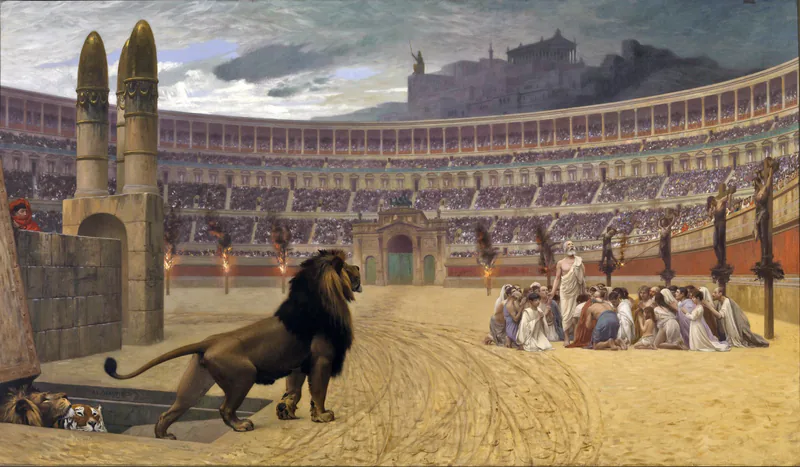
The records of the martyrs became treasured texts. Bishop Ignatius of Antioch wrote letters to churches on his way to execution in Rome, probably in the early second century. The Martyrdom of Polycarp describes the death of the elderly bishop of Smyrna around 155–160. A letter preserved by Eusebius tells of the martyrs of Lyon and Vienne in 177, among them the slave woman Blandina. The Passion of Perpetua and Felicity, partly written by Perpetua herself, records the visions and death of a young noblewoman and her slave in Carthage in 203.
The first empire-wide persecution came in 250, when Emperor Decius ordered all inhabitants to sacrifice to the gods and obtain a certificate (libellus); several such certificates survive on papyrus from Egypt. Valerian (257–258) targeted clergy and wealthy Christians, and Bishop Cyprian of Carthage was beheaded in 258. After four decades of peace, Diocletian and his colleagues launched the Great Persecution in 303, ordering churches destroyed, scriptures surrendered and clergy arrested. It was most severe in the East and ended with Galerius's edict of toleration in 311. Many Christians lapsed under pressure, and disputes over how to readmit them, and over clergy who had handed over scriptures, produced lasting schisms such as Donatism in North Africa. Modern historians debate the scale of the persecutions: the number of martyrs was probably in the thousands rather than the hundreds of thousands, but their memory shaped Christian identity profoundly.
Apologists, Bishops and the Shape of the Early Church§
Alongside the martyrs stood the apologists, educated Christians who defended the faith in the language of Greek philosophy. Justin Martyr, executed in Rome around 165, addressed his Apologies to the emperors and described Christian baptism and Sunday worship. Tertullian of Carthage, writing in Latin around 200, argued that the blood of Christians was a seed that produced more believers. Origen of Alexandria developed a sophisticated biblical scholarship and theology.
The organisation of the churches also took shape. By the late second century most cities had a single bishop presiding over presbyters and deacons, and bishops met in councils. Irenaeus of Lyon, writing against the Gnostics around 180, appealed to the succession of bishops from the apostles, a rule of faith and a recognised body of scriptures; his work and that of other heresy-hunters is discussed in The Heresiologists. The Christian dead were buried in common cemeteries such as the catacombs of Rome, whose paintings of the Good Shepherd, Jonah and the fish, and the anchor show early Christian visual language. The early creeds and the formation of the canon are described in The Christian Bible and Its Canon.
Christianity and Its Rivals: Philosophy, Mysteries and Magic§
Christianity spread in a crowded religious world of civic cults, described in Roman Religion, mystery religions such as that of Mithras, discussed in Mithra and the Roman Mithraic Mysteries, philosophical schools and many forms of magic and divination. Outsiders often classed Christians with magicians. The philosopher Celsus, writing around 170–180, claimed in his True Doctrine that Jesus had learned sorcery in Egypt and that Christians recruited the ignorant; we know his arguments mainly from Origen's reply, Against Celsus (c. 248). In the late third century the Neoplatonist Porphyry wrote a critique of Christian scripture that was later burned on imperial orders.
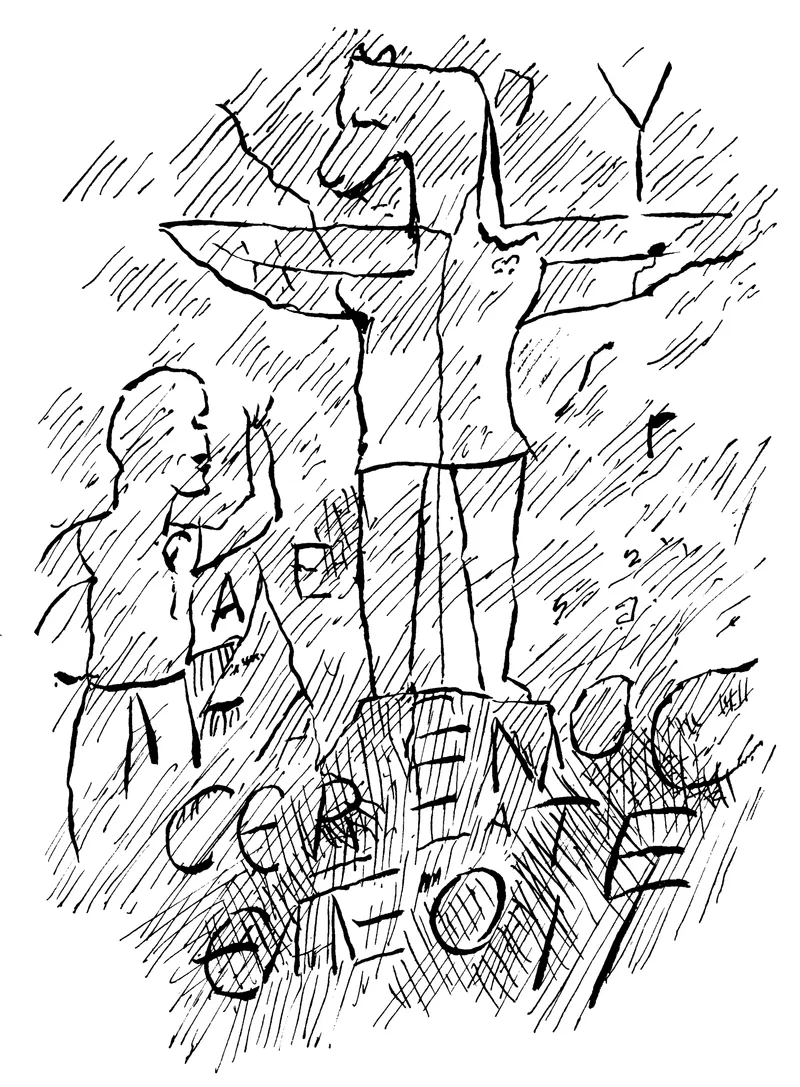
Christian writers, in turn, presented the pagan gods as demons and contrasted Christian miracles worked in the name of Jesus with the deceptions of magicians, a contrast that shaped later Christian thinking about magic, as shown in Augustine's City of God on Magic, Demons and Theurgy. Exorcism was part of the Christian mission and of preparation for baptism, and some scholars, such as Ramsay MacMullen, have argued that the reputation of Christians for power over demons and sickness did much to win converts.
Constantine and the Christian Empire§
In 312 Constantine defeated his rival Maxentius at the Milvian Bridge outside Rome. Two Christian writers describe a divine sign beforehand: Lactantius says Constantine was told in a dream to mark a heavenly sign on his soldiers' shields, while Eusebius, writing decades later in his Life of Constantine, reports the emperor's own account of a cross of light in the sky with the words "by this conquer." The monogram associated with this event is discussed in The Chi-Rho. In 313 Constantine and his co-emperor Licinius agreed at Milan on religious freedom for all and the return of confiscated church property, an agreement known as the "Edict of Milan," although the surviving text is a letter of Licinius.
Constantine endowed great churches in Rome, Jerusalem and his new capital of Constantinople, gave privileges to clergy, made Sunday a day of rest in 321 and summoned the Council of Nicaea in 325, described in Christian Creeds and Ecumenical Councils. He was baptised only on his deathbed in 337. His nephew Julian (361–363) tried to restore traditional worship, but his early death ended the attempt. In 380 Theodosius I declared the faith of Nicaea the religion of the empire, and laws of 391–392 forbade public and private sacrifice. The destruction of the Serapeum of Alexandria around 391 symbolised the end of the old order, although traditional religion survived in many places for generations.
How Did Christianity Grow?§
Historians have long asked why Christianity succeeded. Edward Gibbon, in The History of the Decline and Fall of the Roman Empire (1776–1789), offered five causes, including the zeal of the Christians, their belief in a future life, their miracles, their morals and their organisation. The sociologist Rodney Stark argued that steady growth of around forty per cent per decade, achieved through networks of family and friends, could take a movement of perhaps a thousand people around 40 CE to several million by 300, roughly a tenth of the empire's population; such figures are estimates and are debated. Stark also stressed Christian care for the sick during epidemics and the high proportion of women among converts.
Others emphasise the appeal of a universal community open to all classes, the sense of moral seriousness, the promise of salvation, and the attraction of exorcism and healing. Most scholars agree that Christianity was already a significant minority before Constantine, but that imperial patronage transformed it from a persecuted sect into the religion of the state, with consequences for church and empire alike that are traced in What Is Christianity?.
Frequently asked questions§
When did the Romans stop persecuting Christians?§
Galerius issued an edict of toleration in 311, and Constantine and Licinius confirmed religious freedom and restored church property in 313. Persecution briefly resumed in the East under Maximinus Daia and Licinius, but ended when Constantine became sole emperor in 324.
Did Constantine make Christianity the official religion of Rome?§
No. Constantine favoured and supported Christianity but did not outlaw traditional religion. Nicene Christianity was made the official religion of the empire by Theodosius I in 380, and sacrifice was banned in the early 390s.
How many Christians were martyred in the Roman Empire?§
There is no reliable total. Ancient Christian sources give large but vague numbers, and most modern historians think the martyrs numbered in the thousands over two and a half centuries, with the heaviest losses during the Great Persecution of 303–311.
Sources and further reading§
- Life of Constantine — Eusebius of Caesarea, c. 339
- The Rise of Christianity — Rodney Stark, 1996
- Pagans and Christians — Robin Lane Fox, 1986
- Christianizing the Roman Empire, A.D. 100–400 — Ramsay MacMullen, 1984
- Martyrdom and Persecution in the Early Church — W. H. C. Frend, 1965
- The Christians as the Romans Saw Them — Robert Louis Wilken, 1984
- The Myth of Persecution — Candida Moss, 2013
- Constantine and Eusebius — Timothy D. Barnes, 1981