Liber VI · Christianity · Chapter VII: Jesus & the Apostles
Paul the Apostle: Life, Letters and Theology of Saint Paul
Paul the Apostle explained: his life from Tarsus to Rome, the Damascus road, his authentic and disputed letters, his theology and his legacy in Christianity.

Paul the Apostle, also called Saul of Tarsus, was a first-century Jewish teacher who turned from persecuting the followers of Jesus to become the most influential missionary and writer of the early Church. His letters, written in the 50s CE, are the oldest surviving Christian documents, and his ideas about grace, faith, the Jewish law and life "in Christ" have shaped Christian theology ever since.
Who Was Paul of Tarsus?§
Almost everything known about Paul comes from his own letters and from the Acts of the Apostles, written a generation later by the author of Luke's Gospel. Historians give priority to the letters and use Acts with caution, since its tidy narrative does not always match Paul's own account.
In the letter to the Philippians Paul describes himself as an Israelite of the tribe of Benjamin, circumcised on the eighth day and a Pharisee in his observance of the law. Acts adds that he was born in Tarsus in Cilicia, a prosperous Hellenistic city on the southern coast of modern Turkey, that he held Roman citizenship, and that he studied in Jerusalem under the famous teacher Gamaliel. His birth is usually placed in the first decade CE. He wrote fluent Greek, quoted the scriptures from the Septuagint and supported himself as a tent-maker.
Paul's Jewish name was Saul; "Paul" (Latin Paulus) was probably a Roman name he bore from the start rather than a new name given at conversion. Before his change of direction he was, by his own admission, a zealous persecutor of the young Jesus movement.
Conversion on the Road to Damascus§
The turning point of Paul's life is described three times in Acts (chapter 9, 22 and 26): travelling to Damascus to arrest believers, he was struck down by a light from heaven and heard a voice asking why Saul was persecuting him. Blinded, he was led into the city, healed by a disciple named Ananias and baptised.
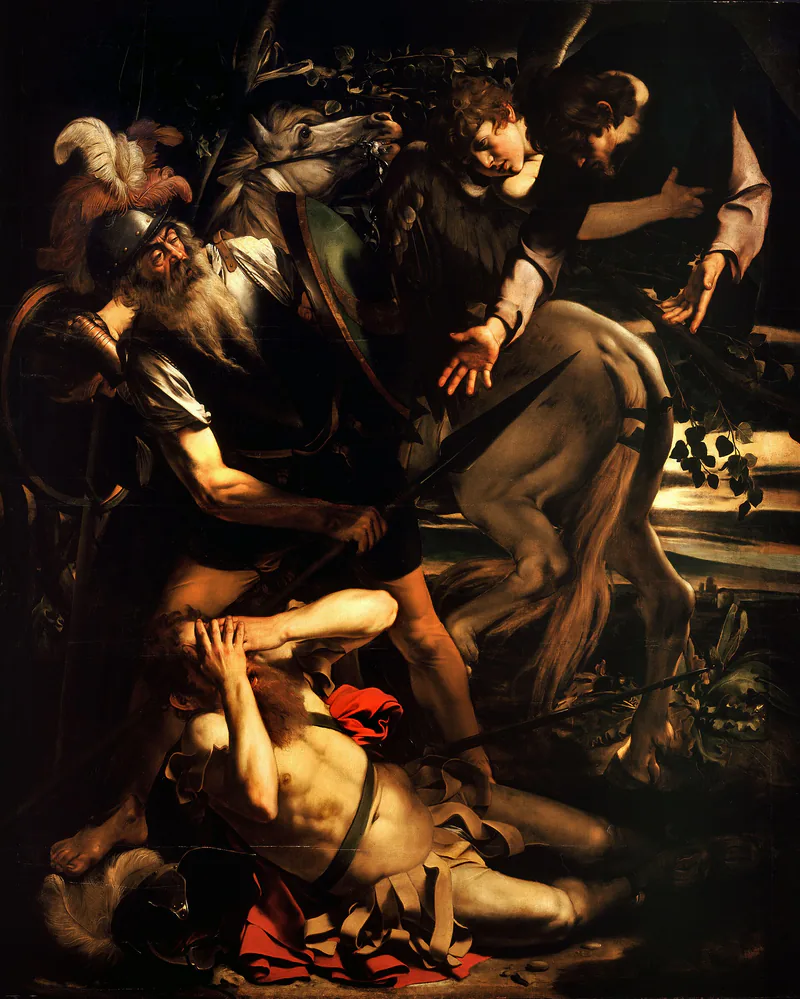
Paul's own references are briefer and frame the event differently. In Galatians 1 he says that God "revealed his Son in me" so that he might preach among the Gentiles, and in 1 Corinthians he lists himself as the last of those to whom the risen Christ "appeared." Many scholars therefore speak of a prophetic call, modelled on those of Isaiah and Jeremiah, rather than a conversion to another religion: Paul never stopped thinking of himself as a Jew. The event is generally dated between about 31 and 36 CE.
According to Galatians, Paul then went to "Arabia" (probably the Nabataean kingdom), returned to Damascus, and only after three years visited Jerusalem to spend fifteen days with Peter (Cephas) and to meet James, the brother of Jesus. Elsewhere he describes a visionary ascent in which he was "caught up to the third heaven" and heard unspeakable words (2 Corinthians 12), a passage that scholars compare with Jewish ascent traditions such as Merkavah and Hekhalot mysticism.
Paul's Missionary Journeys and Churches§
Acts organises Paul's career into three missionary journeys and a voyage to Rome as a prisoner; scholars treat the scheme as literary, but the letters confirm its broad geography. Working first from Antioch in Syria, with companions such as Barnabas, Silas and Timothy, Paul preached in the cities of Galatia, then crossed into Macedonia (Philippi, Thessalonica) and Greece (Corinth), and spent a long period at Ephesus.
The Jerusalem meeting and the Gentile question§
The great controversy of Paul's mission was whether Gentile converts had to be circumcised and keep the law of Moses. Around 48–49 CE Paul and Barnabas met the leaders of the Jerusalem church, who agreed, in Paul's account, that Gentile believers need not be circumcised. Soon afterwards Paul rebuked Peter at Antioch for withdrawing from shared meals with Gentile Christians.
A fixed point in the chronology§
One of the few secure dates in early Christian history comes from Paul's stay in Corinth. Acts 18 says he was brought before the proconsul Gallio, and an inscription found at Delphi allows Gallio's term in Achaia to be dated to around 51–52 CE.
Paul's final visit to Jerusalem, bringing a collection from his Gentile churches, ended in his arrest. After two years' detention in Caesarea he appealed to the emperor and was sent to Rome, surviving a shipwreck on Malta on the way. Acts closes with Paul living under guard in Rome, preaching freely, around 60–62 CE. It says nothing of his death.
The Letters of Paul: Authentic and Disputed§
Thirteen letters in the New Testament bear Paul's name, and they make up almost a quarter of it. They are real letters answering specific problems, often dictated to a scribe and co-signed by companions.
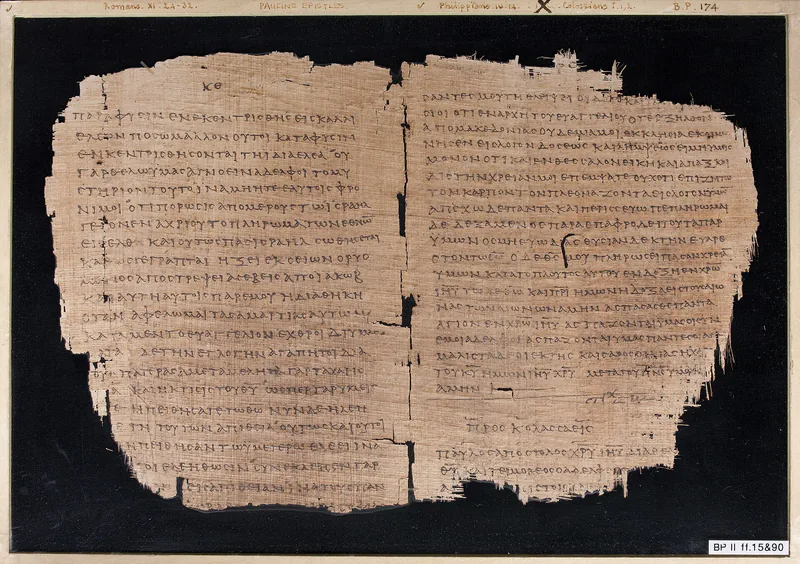
Nearly all scholars accept seven as written by Paul himself: 1 Thessalonians (usually dated around 50 CE and probably the oldest book of the New Testament), Galatians, 1 and 2 Corinthians, Philippians, Philemon and Romans, his longest and most systematic letter. Three more — 2 Thessalonians, Colossians and Ephesians — are disputed, with scholars divided over whether differences of style and thought point to a disciple writing in his name. The three Pastoral Epistles (1 and 2 Timothy and Titus) are widely regarded by critical scholars as products of the next generation, although many traditional scholars still defend Pauline authorship. The Letter to the Hebrews, once attributed to Paul in the East, is anonymous and is not now thought to be his.
The letters circulated early as a collection. The oldest substantial manuscript, the papyrus known as P46, is usually dated to around 200 CE. How that collection entered the New Testament is traced in The Christian Bible and Its Canon.
Core Themes of Pauline Theology§
Paul was not a systematic theologian, but certain convictions recur.
- The cross and resurrection. The death and raising of Jesus are the turning point of history. In 1 Corinthians 15 Paul passes on what he calls an early tradition — that Christ died for our sins, was buried and was raised on the third day — and argues at length for the future bodily resurrection of believers.
- Justification by faith. Paul insists that Gentiles are put right with God (justified) through faith in Christ, not through "works of the law" such as circumcision. Romans quotes the prophet Habakkuk: "The just shall live by faith" (Romans 1:17).
- Life in Christ and the Spirit. Believers are baptised "into Christ," share his death and new life, and receive the Spirit. In Galatians Paul writes: "I am crucified with Christ: nevertheless I live; yet not I, but Christ liveth in me."
- The body of Christ. The community is one body with many members and gifts; the hymn to love in 1 Corinthians 13 belongs to this discussion.
- Israel and the nations. In Romans 9–11 Paul wrestles with the fact that most of his fellow Jews had not accepted Jesus, concluding that God's promises to Israel remain irrevocable.
- The coming end. Paul expected Christ's return soon, which shapes his advice on marriage and work.
Old and new perspectives§
Western readers, following Augustine and above all Martin Luther, long read Paul as answering how a sinner finds a gracious God, and his opponents as legalists trying to earn salvation. In 1977 E. P. Sanders argued that this misrepresented ancient Judaism, which understood the law as a response to God's prior grace. The resulting "New Perspective on Paul," developed by James Dunn and N. T. Wright, reads Paul's polemic as aimed at the boundary markers separating Jews from Gentiles. A "Paul within Judaism" approach, associated with Paula Fredriksen, stresses that Paul remained a law-observant Jew addressing Gentiles.
Paul in Later Christianity, Gnosticism and Legend§
Paul's death is not described in the New Testament. The letter known as 1 Clement, written from Rome around 96 CE, refers to his martyrdom, and later tradition held that he was beheaded on the road to Ostia under Nero, in the mid-60s, at about the same time as Peter was crucified. His traditional tomb lies beneath the Basilica of Saint Paul Outside the Walls.
Paul's letters were contested from the start. In the second century Marcion of Sinope made ten Pauline letters, with an edited Luke, the whole of his scripture, presenting Paul as the only true apostle of a God unknown to the Jewish scriptures. Gnostic teachers, especially the Valentinians, also claimed Paul as their own and read his contrasts of spirit and flesh as hints of secret teaching; Elaine Pagels' The Gnostic Paul studies these readings, and their wider context is described in Valentinian Gnosticism.
A rich apocryphal literature grew around him. The second-century Acts of Paul, which includes the story of his female disciple Thecla, offers the only ancient physical description of Paul: small, bald and bow-legged, with eyebrows meeting. The Visio Pauli, a vision of heaven and hell built on 2 Corinthians 12, shaped medieval ideas of the afterlife. Paul's name was later borrowed by magical literature as well: the Ars Paulina, one of the books of the Solomonic Lemegeton, is named after his heavenly journey, as explained in Ars Paulina and Ars Almadel.
In art Paul is shown bald and bearded, holding a sword and a book. Augustine, Luther, Calvin, Wesley and Barth each found decisive inspiration in his letters, so that much of the history of Christian theology is a history of reading Paul.
Frequently asked questions§
Did Paul ever meet Jesus?§
There is no evidence that Paul met Jesus during his lifetime. Paul himself claims to have seen the risen Christ in a vision and counts this as an appearance equal to those granted to Peter and the other apostles.
How many books of the Bible did Paul write?§
Thirteen New Testament letters carry Paul's name. Scholars almost universally accept seven of them as authentic, debate three more, and widely regard the Pastoral Epistles as written later in his name. Hebrews is anonymous and not by Paul.
Why did Saul change his name to Paul?§
He probably did not. Saul was his Jewish name and Paul a Roman name he likely bore from birth.
How did Paul die?§
The New Testament does not say. Early Christian tradition, beginning with 1 Clement and later writers, holds that he was executed in Rome under Nero in the 60s CE, by beheading as befitted a Roman citizen.
Sources and further reading§
- Paul: Apostle of the Heart Set Free — F. F. Bruce, 1977
- Paul and Palestinian Judaism — E. P. Sanders, 1977
- The First Urban Christians: The Social World of the Apostle Paul — Wayne A. Meeks, 1983
- The Theology of Paul the Apostle — James D. G. Dunn, 1998
- Paul: The Pagans' Apostle — Paula Fredriksen, 2017
- The Gnostic Paul: Gnostic Exegesis of the Pauline Letters — Elaine Pagels, 1975