Liber XXIX · Superstitions · Chapter XII: Superstitions of the Americas
Superstitions of the Americas: From the Ozarks to the Andes
Superstitions of the Americas: Ozark and Pennsylvania Dutch lore, Groundhog Day, Mexican mal de ojo and susto, Brazil's New Year waves and the Andean Ekeko.

The superstitions of the Americas are a meeting of many inheritances: European settlers brought their omens, charms and calendar customs, enslaved Africans brought ideas about spirits and protective power, and both met the religions of Indigenous peoples. The result includes Groundhog Day and Pennsylvania Dutch barn stars, Ozark weather signs and Southern conjure lore, the Mexican mal de ojo and susto, Brazilian New Year offerings to the sea, the Andean Ekeko and the sports curses of modern North America.
A Continent of Many Inheritances§
Every major superstition of Europe crossed the Atlantic. Broken mirrors, black cats and Friday the 13th became staples of North American folk belief; Spanish settlers brought martes 13 and the evil eye; Portuguese settlers brought the figa charm. Alongside these came the beliefs of West and Central Africans carried into slavery, which shaped Southern and Caribbean folklore profoundly, and the religious worlds of Indigenous nations, from the Arctic to Patagonia.
Indigenous traditions deserve particular care. Missionaries and colonial officials routinely dismissed Native ceremonies as superstition, and in the United States and Canada many were suppressed by law into the twentieth century. They are better understood as religions in their own right, as discussed in Native American Religions and Mesoamerican Religion. Some beliefs nevertheless circulate widely across communities: in a number of Native nations, as in Mexican folk tradition, the hooting of an owl near a house is associated with death or the presence of spirits. For the general history of the concept, see What Is Superstition?.
North American Folk Belief: Ozarks, Appalachia and the Pennsylvania Dutch§
The great collections§
American superstition is unusually well documented because folklorists gathered it on an industrial scale. Vance Randolph spent decades among the hill people of the Missouri and Arkansas Ozarks, publishing Ozark Superstitions in 1947: planting by the signs of the moon, water-witching with a forked stick, weather omens and charms against witches. The Frank C. Brown Collection of North Carolina folklore, edited by Wayland D. Hand, devoted two large volumes in the 1960s to thousands of numbered popular beliefs, and Hand went on to plan an encyclopedia of American folk belief. Much of this material came from Scots-Irish and English settlers and survived in isolated mountain communities.
Pennsylvania Dutch traditions§
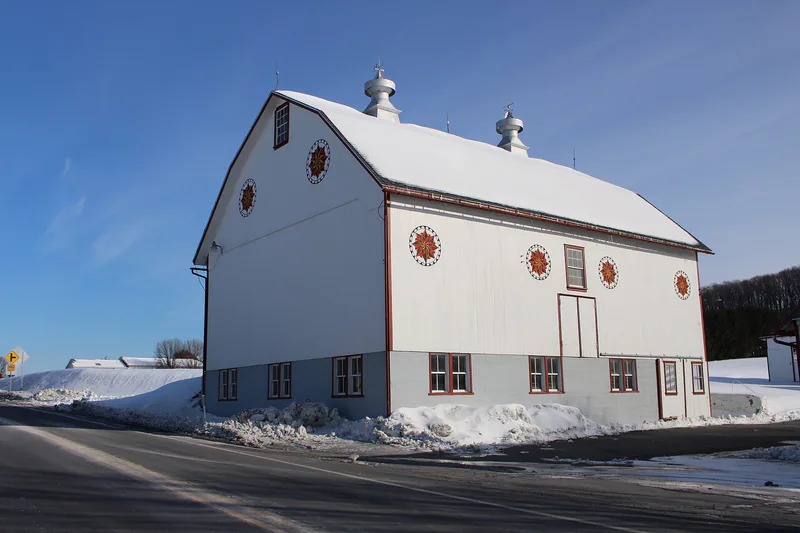
German-speaking settlers in Pennsylvania brought the healing tradition of Braucherei or powwow, described in Folk Magic, as well as the colourful star designs painted on barns. These became famous as "hex signs", supposedly to keep witches away, but the folklorist Don Yoder and his collaborator Thomas Graves showed that the hex interpretation was largely popularised by twentieth-century travel writers and tourism; many farmers had always regarded them as decoration. The story is a good example of how a modern explanation can turn ornament into "ancient" magic.
Groundhog Day§
Groundhog Day, 2 February, derives from European Candlemas weather lore, in which a sunny Candlemas foretold more winter; in German-speaking lands the badger or bear was watched for its shadow. Pennsylvania Germans transferred the role to the groundhog, and the first organised observance at Punxsutawney, Pennsylvania, took place in 1887, promoted by a local newspaper editor and his friends. What began as a club joke became a national ritual.
African American Folk Belief and Its Legacy§
African American communities in the South developed a distinctive body of belief that blended West and Central African ideas with European and Native elements. In 1926 the sociologist Newbell Niles Puckett published a large collection of such beliefs, and Harry Middleton Hyatt later recorded hundreds of interviews with practitioners. Much of this lore belongs to conjure or rootwork, explained in Hoodoo and Rootwork, but it also includes everyday rules: sweeping across someone's feet was said to stop them marrying; a broom laid across a doorway could keep out a witch.
Some beliefs entered mainstream American culture. The rabbit's foot charm drew partly on conjure ideas before it became a mass-produced trinket in the late nineteenth century. In the Lowcountry of South Carolina and Georgia, porch ceilings painted pale blue, "haint blue", are popularly said to keep away haints or restless spirits, and this explanation is often linked to Gullah Geechee tradition, although the colour also has practical and fashionable explanations. Beliefs of this kind are discussed alongside comparable Caribbean lore in African and Caribbean Folk Beliefs.
Mexico and Hispanic America: Mal de Ojo, Susto and Martes 13§
In Mexico and much of Hispanic America, babies and young children are thought to be especially vulnerable to mal de ojo, the evil eye, caused when someone admires them without touching them. Admirers may be asked to touch the child to "neutralise" the gaze, and children wear protective bracelets with a red thread or an ojo de venado, a large seed charm. A traditional folk cleansing, a limpia, may involve passing an egg over the child's body by a family member or curandero, a healer whose role is described in Folk Magic.
Susto, literally "fright", is a folk illness in which a sudden shock is believed to dislodge part of the soul, producing listlessness, poor appetite and disturbed sleep. The anthropologists Arthur Rubel, Carl O'Nell and Rolando Collado-Ardón studied it in Mexican communities in the 1970s and found that sufferers were often under real social stress; medical anthropologists treat it as a culture-bound syndrome with both social and physical dimensions.
The Spanish-speaking world fears Tuesday the 13th rather than Friday, summed up in the proverb en martes, ni te cases ni te embarques, "on Tuesday, neither marry nor set sail". New Year's Eve customs include eating twelve grapes at midnight, wearing yellow underwear for luck or red for love, and walking around the block with a suitcase to ensure travel in the coming year. The ghostly La Llorona, the weeping woman who searches for her drowned children, is a widely told warning legend in Mexico and among Mexican Americans.
Brazil and the Andes: Figas, Waves and the Ekeko§
Brazilians wear or carry the figa, a small carved fist with the thumb between the fingers, an amulet inherited from Portugal and ultimately from the ancient Mediterranean. Other common beliefs hold that leaving a handbag on the floor lets money escape and that one should knock on wood (bater na madeira) to avoid tempting fate. At New Year, many Brazilians dress in white and gather on beaches, where they jump seven waves and offer flowers to Iemanjá, the orixá of the sea. The custom grew from Afro-Brazilian religion, described in Candomblé and Umbanda, and has become a national celebration observed by people of every background.
In the Andes, the Ekeko is a small, smiling figure of abundance loaded with miniature goods. During the Alasitas fair, held in La Paz, Bolivia, from 24 January, people buy miniature houses, cars, banknotes and diplomas, have them blessed, and hope to receive the real thing in the coming year; the fair's ritual was recognised by UNESCO as intangible cultural heritage in 2017. Offerings and libations to Pachamama, Mother Earth, are made especially in August, when the earth is said to be "open". In Ecuador and Colombia, effigies of the old year, años viejos, are burned at midnight on 31 December to leave misfortune behind.
Sports Curses and Modern North American Superstition§
Modern North America has created its own superstitions, and sport is their most fertile ground. The "Curse of the Bambino" was said to have prevented the Boston Red Sox from winning the World Series after they sold Babe Ruth to the New York Yankees around 1920; the phrase was popularised by a 1990 book and the "curse" ended with the Red Sox victory in 2004. The Chicago Cubs' "Billy Goat curse", supposedly laid by a tavern owner whose goat was ejected from Wrigley Field in 1945, lasted until the Cubs won in 2016. Fans speak of a Sports Illustrated cover jinx, players keep personal rituals, as described in Superstitions of Sailors, Actors and Gamblers, and many tall buildings omit a labelled thirteenth floor.
These modern curses are self-consciously playful, yet they show the same pattern that psychologists find in older beliefs: people look for causes and patterns in runs of good and bad luck, as explained in The Psychology of Superstition.
Frequently asked questions§
Are hex signs magical?§
Pennsylvania Dutch barn stars are often described as protective "hex signs", but folklorists have shown that this interpretation was largely promoted by travel writers and the tourist trade in the twentieth century. Many farmers regarded them as decoration, though some individuals did attach protective meanings to them.
What is susto?§
Susto is a folk illness recognised in Mexico and much of Latin America, in which a sudden fright is believed to cause part of the soul to leave the body. Symptoms include fatigue, poor appetite and restless sleep, and it is treated by folk healers with prayers and cleansing rites. Medical anthropologists see it as connected with real stress and illness.
Why do Brazilians jump seven waves at New Year?§
The custom comes from Afro-Brazilian devotion to Iemanjá, the orixá of the sea, to whom offerings of flowers are made at New Year. Jumping seven waves, often while making wishes, is now a popular custom for luck. The meaning of the number seven is explained in different ways by different people, and there is no single authoritative account.
When did Groundhog Day start?§
The first organised Groundhog Day at Punxsutawney, Pennsylvania, took place in 1887. It adapted much older European Candlemas weather lore, in which a sunny 2 February meant more winter, to an American animal.
Sources and further reading§
- Ozark Superstitions — Vance Randolph, 1947
- Popular Beliefs and Superstitions from North Carolina — Wayland D. Hand (ed.), 1961
- Folk Beliefs of the Southern Negro — Newbell Niles Puckett, 1926
- Hex Signs: Pennsylvania Dutch Barn Symbols and Their Meaning — Don Yoder and Thomas E. Graves, 1989
- Susto: A Folk Illness — Arthur J. Rubel, Carl W. O'Nell and Rolando Collado-Ardón, 1984
- The Curse of the Bambino — Dan Shaughnessy, 1990
- The Penguin Guide to the Superstitions of Britain and Ireland — Steve Roud, 2003