Liber XXIX · Superstitions · Chapter XII: Superstitions of the Americas
Día de los Muertos: History, Ofrendas and Folk Beliefs
Día de los Muertos explained: the Day of the Dead calendar, Aztec and Spanish origins, the ofrenda, Posada's Catrina, cemetery vigils and returning souls.

Día de los Muertos, the Day of the Dead, is the Mexican celebration on 1 and 2 November during which families welcome the souls of their dead back to the home and the cemetery with altars, food, flowers, candles and vigils. It coincides with the Catholic feasts of All Saints and All Souls and combines Spanish Christian customs with older Indigenous ways of honouring the dead. Around it has grown a rich body of folk belief: that the dead truly return, that they take the essence of the food offered to them, and that families who neglect them may suffer for it.
The Days of the Dead: Calendar and Order of the Visits§
The Days of the Dead follow the Catholic calendar. All Saints' Day (1 November) and All Souls' Day (2 November) were fixed in medieval Europe as days to honour the saints and pray for the souls of the faithful departed. In Mexico these became days on which the dead were believed to visit the living. In many communities the souls of children, called angelitos, arrive first and are honoured on 1 November, and the adult dead on 2 November. Some regions set aside earlier days, often 28 October or the end of the month, for those who died by accident or violence, or for children who died before baptism.
The visit ends when the dead are believed to depart, often marked by a final meal, by sharing the offerings among the living, or by an all-night vigil in the cemetery. The Haitian festival of the Gede, held on the same days with very different spirits, is discussed in The Gede and Fèt Gede.
Aztec Feasts of the Dead and the Debate over Origins§
Before the Spanish conquest, the Mexica (Aztecs) and other peoples of central Mexico held festivals for the dead within their eighteen-month solar calendar. Sahagún's sixteenth-century informants described two months known as the "Little Feast of the Dead" (Miccailhuitontli) and the "Great Feast of the Dead" (Hueymiccailhuitl), falling roughly in August of the Christian calendar, with offerings of food and flowers. Nahua belief held that most of the dead journeyed to Mictlan, the underworld ruled by Mictlantecuhtli and Mictecacihuatl, while warriors and women who died in childbirth went to the paradise of the sun. The calendar and cosmology behind these rites are described in Mesoamerican Religion and The Aztec Tonalpohualli.
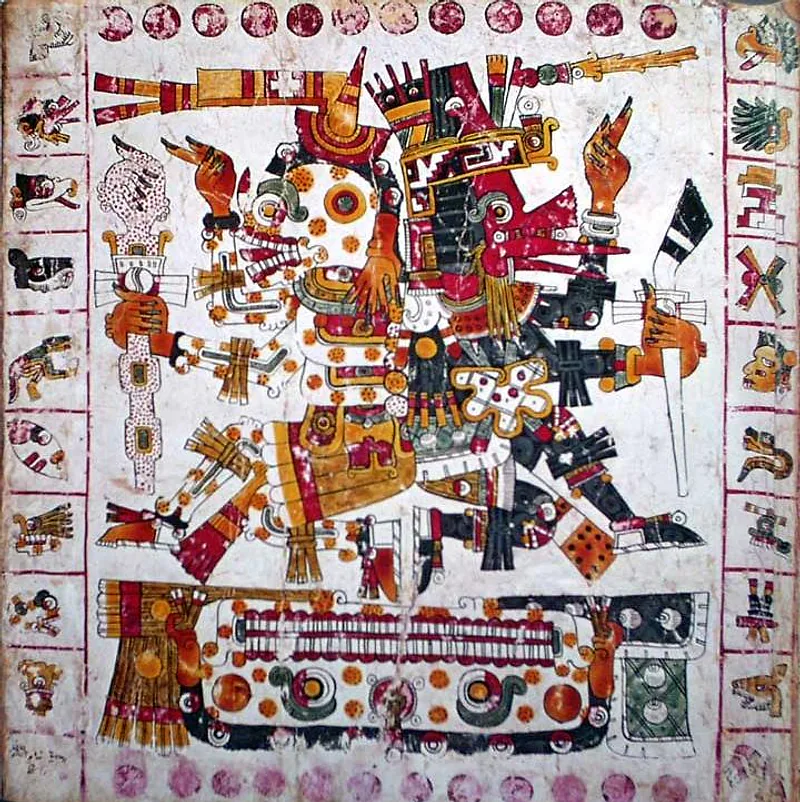
How much of the modern festival descends from these rites is disputed. A popular account holds that Spanish friars simply moved an Aztec festival to November. The anthropologist Stanley Brandes, in Skulls to the Living, Bread to the Dead (2006), argued that many central features, including the bread of the dead, sugar figures and the timing, have clear Spanish antecedents, such as the breads and marzipan "saints' bones" made in Spain for All Saints, and that the emphasis on Aztec origins was strengthened by twentieth-century nationalism. Others stress the continuity of Indigenous practices in rural communities. Most scholars now speak of a genuinely mixed tradition, shaped by Catholic teaching about purgatory and prayer for souls, by Indigenous ideas of reciprocity with the dead, and by later reinterpretation.
The Ofrenda: Marigolds, Bread, Water and Salt§
The heart of the celebration is the ofrenda, the offering altar set up in the home and sometimes in schools, offices and public squares. It is usually built on a table or on stepped tiers and decorated with cut-paper banners (papel picado), candles and the bright orange marigold, cempasúchil, whose name comes from the Nahuatl for "twenty flower". Petals are often scattered in a path from the door or street to the altar, so that the scent and colour can guide the souls home.
On the altar families place photographs of the dead, crosses and images of saints or the Virgin of Guadalupe, the smoke of copal incense, and the foods and drinks the dead enjoyed in life: tamales, mole, fruit, chocolate, tequila or mezcal, cigarettes for those who smoked, and toys for children. Characteristic additions include pan de muerto, a sweet bread decorated with shapes like bones, and sugar skulls made by the alfeñique technique of moulded sugar paste, often bearing a name on the forehead. A glass of water quenches the thirst of souls after their long journey, and a dish of salt is commonly said to purify them or to keep their bodies from corruption.
Many modern guides give symbolic meanings to the number of tiers, but these interpretations vary widely and appear to be largely modern; in practice altars take many forms according to family and region.
Calaveras: Posada, La Catrina and the Satirical Skull§
The playful skeleton, or calavera, is now the most recognisable symbol of the festival. Its modern form owes much to the printmaker José Guadalupe Posada (1852–1913), who produced cheap illustrated broadsheets in Mexico City for the publisher Antonio Vanegas Arroyo. Around the Days of the Dead these sheets carried calaveras literarias, satirical verses imagining well-known living people as dead, illustrated with skeletons going about everyday life.
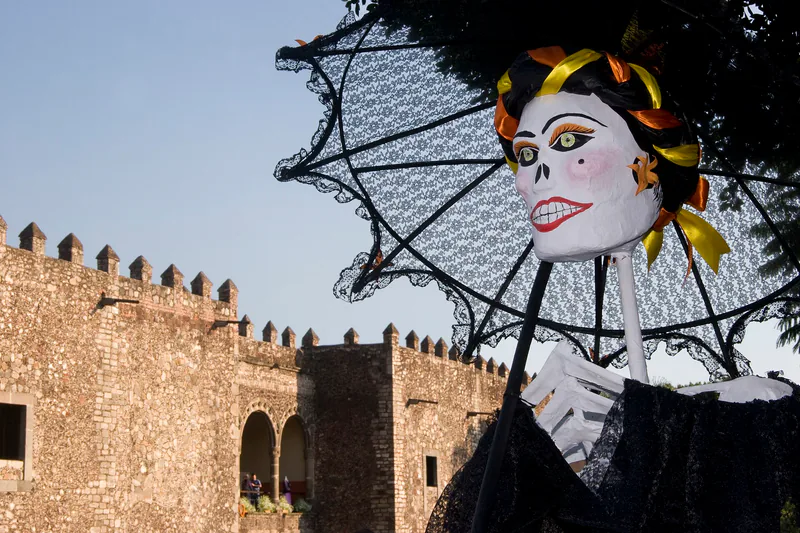
Posada's best-known image, made around 1910–1913, showed a female skull wearing an elaborate European hat. It was originally called La Calavera Garbancera, mocking those who denied their Indigenous roots and aped European fashion. The painter Diego Rivera placed a full-length version in his mural Dream of a Sunday Afternoon in the Alameda Central (1947), dressed as an elegant lady, and named her La Catrina. From there she became an emblem of Mexican identity, reproduced in ceramics, costumes and face painting.
Vigils in the Cemetery: Janitzio, Mixquic and Regional Customs§
In many communities the dead are honoured not only at home but at the grave. Families clean and decorate tombs with marigolds and candles and spend the night of 1–2 November in the cemetery, eating, praying, talking and sometimes playing music for their dead. Among the best known are the vigils of the Purépecha communities around Lake Pátzcuaro in Michoacán, especially on the island of Janitzio, where fishermen's canoes carrying candles cross the dark lake; and the alumbrada, or illumination of graves, at San Andrés Mixquic in the south of Mexico City.
Customs vary across the country. In parts of Oaxaca elaborate altars and sand paintings are made; in the Huasteca region the festival is called Xantolo and includes masked dances; and in some Maya communities of Yucatán the festival of Hanal Pixán, "food of the souls", features a special baked dish. Comparable festivals for the visiting dead elsewhere include the Chinese festival described in The Hungry Ghost Festival and the Celtic-derived observances discussed in Samhain.
Folk Beliefs About the Returning Dead§
Around the ofrenda a body of folk belief has grown that families hold with varying degrees of seriousness. It is widely said that the dead consume the aroma or essence of the food and drink, so that when the living eat the offerings afterwards they taste weaker or have lost their flavour. Candles are believed to light the souls' way, and in some homes a chair, a towel and soap are left so that the visitors can rest and wash.
Many communities tell cautionary tales of people who neglected their dead. In a widespread story, a man who mocks the custom and prepares no offering sees at night a procession of souls returning to the other world laden with gifts, while his own parents walk empty-handed and sorrowful; he falls ill or dies soon afterwards. The story reinforces reciprocity between the living and the dead, a theme shared with other traditions of ancestor veneration, such as those in Chinese Ancestor Veneration. Other beliefs concern omens of death and the souls of those who died badly, connected with the ghostly figures described in La Llorona.
From Village Rite to National Symbol§
In the twentieth century the Days of the Dead were promoted as a symbol of Mexican national culture. Writers such as Octavio Paz, in The Labyrinth of Solitude (1950), presented an intimate, mocking familiarity with death as a defining Mexican trait, a claim the historian Claudio Lomnitz later examined critically in Death and the Idea of Mexico (2005). The state promoted the vigils at Pátzcuaro as tourist spectacles, and in 2008 UNESCO inscribed the "Indigenous festivity dedicated to the dead" on its Representative List of the Intangible Cultural Heritage of Humanity, after first proclaiming it in 2003.
Global popular culture has changed the festival again. Mexico City's large Day of the Dead parade began in 2016, inspired by a scene in the James Bond film Spectre (2015), and the animated film Coco (2017) introduced the ofrenda to a worldwide audience. Mexican American communities in the United States have developed their own forms since the 1970s. For the broader life-cycle customs of which these are part, see Superstitions of Birth, Marriage and Death, and for regional folk belief, Superstitions of the Americas.
Frequently asked questions§
When is Día de los Muertos?§
The main days are 1 November, often dedicated to children, and 2 November, for adults, coinciding with All Saints and All Souls. Some regions honour particular groups of the dead on earlier days at the end of October.
Is the Day of the Dead the same as Halloween?§
No. They fall at the same time of year and both draw on the Christian feasts of All Saints and All Souls, but the Day of the Dead centres on welcoming and feeding the family's own dead, while modern Halloween developed from British and Irish customs into a festival of costumes and trick-or-treating.
What is an ofrenda?§
An ofrenda is an offering altar built for the dead, with photographs, candles, marigolds, incense, water, salt, bread and favourite foods. It is meant to welcome the souls and give them what they enjoyed in life.
Who is La Catrina?§
La Catrina is an elegantly dressed female skeleton based on a print by José Guadalupe Posada from around 1910–1913, originally a satire on Mexicans who imitated European fashion. Diego Rivera named and popularised her in a 1947 mural, and she became a symbol of the festival.
Sources and further reading§
- Skulls to the Living, Bread to the Dead: The Day of the Dead in Mexico and Beyond — Stanley Brandes, 2006
- Death and the Idea of Mexico — Claudio Lomnitz, 2005
- The Skeleton at the Feast: The Day of the Dead in Mexico — Elizabeth Carmichael and Chloë Sayer, 1991
- Todos Santos in Rural Tlaxcala: A Syncretic, Expressive, and Symbolic Analysis of the Cult of the Dead — Hugo G. Nutini, 1988
- The Labyrinth of Solitude — Octavio Paz, 1950
- Florentine Codex: General History of the Things of New Spain — Bernardino de Sahagún, 1577