Liber XXIX · Superstitions · Chapter XI: Sailors, Actors & Gamblers
The Flying Dutchman and Ghost Ship Legends of the Sea
The Flying Dutchman legend: its origins in sailors' lore, Walter Scott and Blackwood's, Wagner's opera, the 1881 Bacchante sighting and other ghost ships.

The Flying Dutchman is a legendary ghost ship said to sail forever off the Cape of Good Hope, condemned never to reach port, and whose appearance to other sailors foretells storm, wreck or death. The legend took shape among European seamen in the eighteenth century, was first written down around 1800, and was turned into literature by Walter Scott, Blackwood's Magazine, Frederick Marryat, Heinrich Heine and Richard Wagner, whose opera Der fliegende Holländer (1843) made it world famous. It is the best known of many phantom-ship traditions, from the Caleuche of Chile to the burning ships of New England.
The Legend of the Flying Dutchman§
In its most familiar form, the story tells of a Dutch captain trying to round the Cape of Good Hope against a fierce gale. When his crew begged him to turn back, he swore that he would round the Cape if it took him until the Day of Judgement, and he was taken at his word. The ship and its ghostly crew still beat against the wind off the southern tip of Africa. Other vessels meet it in heavy weather; sometimes a boat comes across with letters to be carried home to people long dead. To see the Dutchman, or to accept its letters, is to invite disaster.
The legend belongs to the larger world of maritime superstition described in Superstitions of Sailors, Actors and Gamblers, where storms, omens and the dead at sea were constant concerns. It combines several familiar motifs: the wanderer cursed to endless travel, like the Wandering Jew; the blasphemer punished by being taken literally; and the ghost unable to rest because its business is unfinished.
Origins in Print: Sailors' Tales, Scott and Blackwood's Magazine§
No early Dutch source for the legend is known. The first printed references come from English writers. A Voyage to New South Wales (1795), published under the name of the pickpocket and transported convict George Barrington though probably compiled by others, mentions a sailors' story of a Dutch man-of-war lost off the Cape with all hands, whose phantom was later seen by ships in bad weather. The Scottish poet John Leyden alluded to the phantom ship in Scenes of Infancy (1803).

Walter Scott gave the legend wide circulation in a note to his poem Rokeby (1813). He called the Flying Dutchman a well-known superstition of sailors and explained it as a ship laden with treasure on which murder and piracy had been committed, after which plague broke out and no port would receive it, so that it wandered the seas ever since. Here the curse is moral and collective rather than the fault of one captain.
The decisive literary version appeared in Blackwood's Edinburgh Magazine in May 1821: an anonymous story, "Vanderdecken's Message Home", in which a ship near the Cape is approached by a boat from the phantom vessel whose crew try to hand over letters for relatives in Amsterdam who had died long before. It fixed the captain's name and the motif of the undeliverable letters.
Vanderdecken, Fokke and the Making of a Captain§
Over the nineteenth century the focus moved from the ship to its master. Frederick Marryat's novel The Phantom Ship (1839) follows Philip Vanderdecken, son of the cursed captain, as he spends his life trying to lift his father's doom with a holy relic. Later retellings link the story to a real seventeenth-century Dutch East India Company captain, Bernard Fokke, who was reputed to make the voyage between the Netherlands and Java so quickly that he was said to be in league with the Devil. The connection appears in nineteenth-century Dutch and German sources and cannot be traced back earlier, so it is best seen as part of the legend's growth rather than its origin.
Different versions offer different crimes. In some the captain curses God or Christ during a storm; in others he gambles with the Devil, mistreats his crew or refuses to help a ship in distress. All share the idea that defiance at sea brings a punishment fitting the offence: a sailor who would not turn back can never come home.
From Heine to Wagner: The Dutchman Redeemed§
The German poet Heinrich Heine transformed the story in his satirical Memoirs of Herr von Schnabelewopski (1834), where the narrator describes a stage play about the Dutchman. In Heine's version the captain may come ashore once every seven years, and he will be released from his curse if he finds a woman who is faithful to him until death. Heine treated the idea ironically, but it gave the legend a new romantic centre.
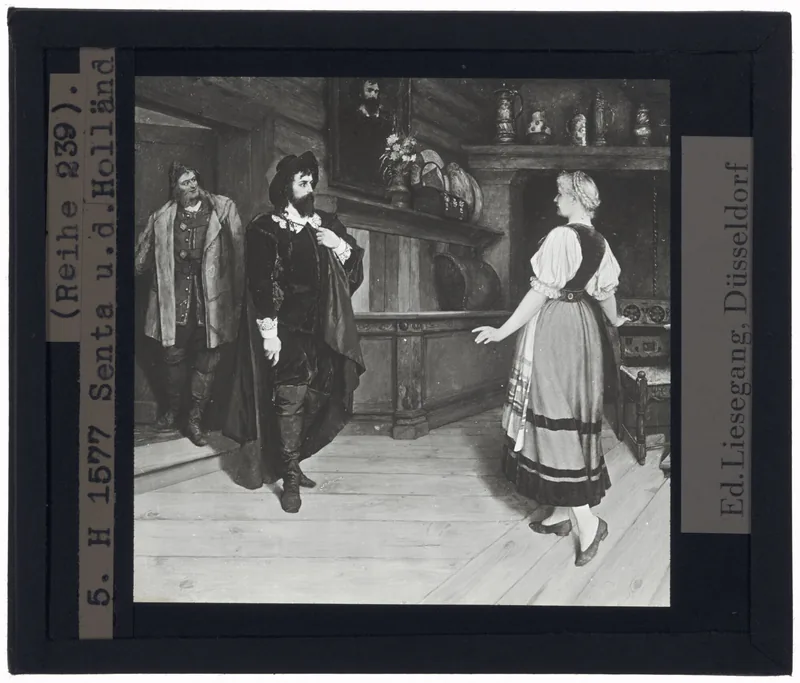
Richard Wagner read Heine and in 1839 experienced a storm at sea himself, on a voyage from the Baltic to London during which his ship took shelter in a Norwegian fjord. His opera Der fliegende Holländer, first performed in Dresden on 2 January 1843, tells of the Dutchman's landing in Norway and of Senta, a young woman who has fallen in love with his legend and who sacrifices herself to save him. The opera, with its storm-tossed overture and the sailors' choruses, has since shaped how most people imagine the ship: blood-red sails, black masts and a crew of the undead.
Sightings and Mirages: The Cruise of HMS Bacchante§
The legend has also been "seen". The most famous record comes from the training cruise of HMS Bacchante, which carried the young Prince Albert Victor and Prince George, later King George V. The published account of the voyage (1886), compiled from the princes' journals, records that at four in the morning on 11 July 1881, off the coast of Australia, the Flying Dutchman crossed the ship's bows, glowing with a strange red light, and that thirteen people saw it. The seaman who first reported it fell from the rigging later that day and was killed, which the account treats as a grim confirmation of the omen.
Meteorologists and historians suggest that such sightings are often mirages. The Fata Morgana, a complex superior mirage that occurs when layers of air of different temperatures bend light, can make distant ships appear to float above the horizon, stretched or inverted, and the "looming" of vessels beyond the horizon was well known to sailors. St Elmo's fire, the glowing electrical discharge on masts in stormy weather, may also lie behind some accounts. Such explanations do not exhaust the meaning of the stories, which, like other apparitions in Ghosts and Hauntings, express fears about the dangers of the sea.
Other Phantom Ships: From the Ancient Mariner to the Caleuche§
The Dutchman has many relatives. Samuel Taylor Coleridge's Rime of the Ancient Mariner (1798) features a skeleton ship on which Death and Life-in-Death dice for the crew. In Norse myth the ship Naglfar, built from the nails of the dead, will carry the forces of chaos at the end of the world, as told in Norse and Germanic Religion. On the island of Chiloé in southern Chile, the Caleuche is a luminous ghost ship crewed by the drowned and associated with local brujos, its music heard across the water at night; see Superstitions of the Americas.
New England has the Palatine Light off Block Island, Rhode Island, said to be the burning ghost of a ship wrecked in 1738 with German emigrants aboard and celebrated in John Greenleaf Whittier's poem "The Palatine" (1867). Real mysteries have fed the genre too. The Mary Celeste was found drifting and abandoned between the Azores and Portugal in December 1872, her crew never found; Arthur Conan Doyle's story "J. Habakuk Jephson's Statement" (1884) invented details that are still repeated as fact. Sailors also sought protection against such fates through charms and rites, among them the wind knots once sold in northern ports.
Frequently asked questions§
What is the Flying Dutchman?§
It is a legendary ghost ship condemned to sail forever, usually off the Cape of Good Hope, unable to make port. Its sighting was regarded by sailors as an omen of disaster, and the name later passed to its cursed captain.
Is the Flying Dutchman based on a real ship?§
No specific ship has been identified. The legend was recorded from sailors in the 1790s, and later writers linked it to the seventeenth-century Dutch captain Bernard Fokke, but that connection appears only in nineteenth-century sources.
What is Wagner's Flying Dutchman about?§
Wagner's opera, first performed in 1843, tells of the cursed Dutch captain who may land every seven years to seek a woman faithful unto death. Senta's devotion and self-sacrifice finally release him, an idea Wagner took from Heine.
What explains ghost ship sightings?§
Mirages such as the Fata Morgana can make real ships appear to hover above the horizon or look distorted, and St Elmo's fire can make rigging glow. Fatigue, fear and expectation in storms also shaped what sailors reported.
Sources and further reading§
- Legends and Superstitions of the Sea and of Sailors in All Lands and at All Times — Fletcher S. Bassett, 1885
- Folklore and the Sea — Horace P. Beck, 1973
- The Phantom Ship — Frederick Marryat, 1839
- Rokeby — Walter Scott, 1813
- The Cruise of Her Majesty's Ship Bacchante, 1879–1882 — John N. Dalton (comp.), 1886
- The Rime of the Ancient Mariner — Samuel Taylor Coleridge, 1798