Liber XXIX · Superstitions · Chapter XI: Sailors, Actors & Gamblers
Superstitions of Sailors, Actors and Gamblers: Luck at Risk
Superstitions of sailors, miners, actors and gamblers: whistling at sea, the Scottish play, the ghost light, lucky dice and where these beliefs came from.

Sailors, miners, actors and gamblers have long been known as the most superstitious of trades, and the reason is simple: each works where skill cannot fully control the outcome and a single bad night can mean ruin or death. Their beliefs, from the ban on whistling at sea to the refusal to name Macbeth in a theatre, are a mixture of genuine old custom, practical caution dressed as luck, and stories invented much later to explain them.
Why Risky Trades Breed Superstition§
The classic explanation comes from the anthropologist Bronisław Malinowski, who worked in the Trobriand Islands during the First World War. He observed that islanders fishing in the calm inner lagoon used no magic, while those who sailed the open sea, where storms and failed catches were real dangers, surrounded the voyage with spells and rites. Magic, he concluded, appears where knowledge and technique run out and anxiety begins.
Later researchers found the same pattern in modern occupations. The anthropologist George Gmelch, himself a former professional baseball player, noted in the early 1970s that hitters and pitchers, whose success is highly uncertain, kept elaborate personal rituals, while fielders, who succeed almost every time, kept very few. The psychology behind this is discussed in The Psychology of Superstition; for the general history of the idea see What Is Superstition?.
Sailors and the Sea: Taboos, Charms and Omens§
Seafaring folklore is vast; the American writer Fletcher S. Bassett filled a large volume with it in 1885, and the folklorist Horace Beck returned to the subject in the 1970s.
Words, whistles and forbidden names§
Whistling aboard was widely thought to raise the wind. In a dead calm an old hand might whistle softly to "call" a breeze, but whistling in a storm was resented as provoking worse. Fishing communities on the east coast of Scotland and elsewhere avoided certain words at sea altogether, substituting euphemisms for the pig, the minister, the salmon or the hare. A remarkable survival is the Isle of Portland in Dorset, where quarrymen and islanders traditionally avoid the word "rabbit", blamed for rockfalls; in 2005 local posters for an animated film about a "were-rabbit" were reportedly altered for the island.
People and animals aboard§
Women were often said to be unlucky aboard working ships, though the female figurehead and the dedication of ships to female saints show that the symbolism was never simple.
Omens and protective charms§
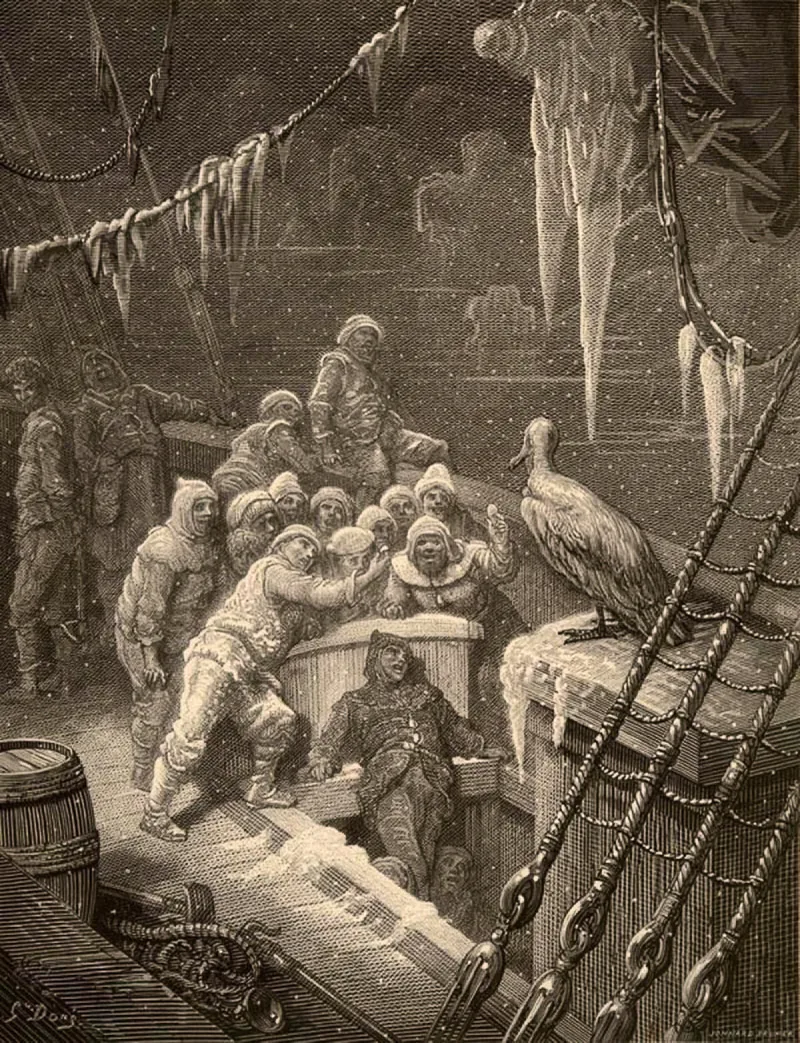
The albatross is the best-known sea omen, but its fame owes much to literature. Samuel Taylor Coleridge built The Rime of the Ancient Mariner (1798) on an incident in George Shelvocke's voyage narrative of 1726, in which a crewman shot a black albatross believing it to be a bad omen. How widespread the belief was before the poem is debated. Better documented is the trade in cauls, the membranes sometimes covering a newborn's head: British newspapers of the eighteenth and nineteenth centuries carried advertisements offering cauls for sale to seamen as protection against drowning.
Legends that are not history§
Sailing on a Friday was widely disliked, but the oft-repeated story of a Royal Navy ship named HMS Friday, launched on a Friday and lost without trace, has no basis in naval records. Nor is there good evidence that sailors wore gold earrings to pay for their burial; it is a modern explanation of a fashion.
Miners and the Spirits Underground§
Mining shared the sea's dangers and many of its taboos. Whistling underground was forbidden in Cornish, Welsh and many other mines, partly because it could mask the creak of timbers that warned of a fall. Cornish miners told of knockers, small beings whose tapping in the rock might lead to rich lodes or warn of collapse; Cornish emigrants carried them to the mining camps of North America, where they became tommyknockers.
German miners spoke of the Kobold and the mountain spirit, the Berggeist. The name of the metal cobalt is usually derived from Kobold, because the ore that yielded it was troublesome and poisonous to smelt and seemed to be the goblins' mischief. It is worth separating such beliefs from practical safety measures: the caged canary, often mistaken for a superstition, was a scientific gas detector promoted by the physiologist John Scott Haldane in the late nineteenth century.
Theatre Superstitions: Macbeth, Whistling and the Ghost Light§
The theatre has a rich and relatively recent body of belief, carefully investigated by the actor and writer Richard Huggett.
The Scottish play§
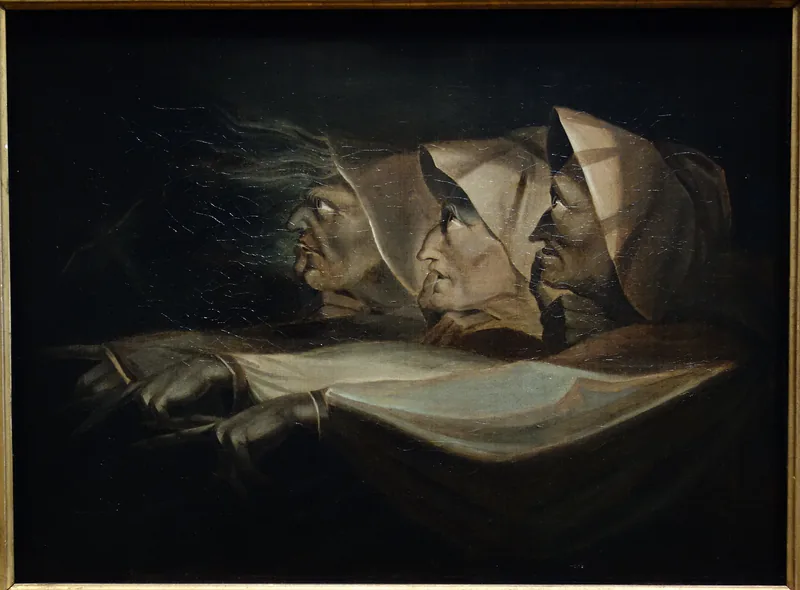
The most famous rule is that Macbeth must not be named or quoted inside a theatre except in performance; actors say "the Scottish play" instead. An offender may be asked to leave the room, turn round three times, spit or swear, and knock to be readmitted. Legends claim the play has been cursed since its first performance, when a boy actor supposedly died, but that story has no contemporary evidence and appears to be a much later invention. The superstition itself is attested from roughly the late nineteenth century, and it was helped along by the play's real misfortunes, such as the 1849 Astor Place Riot in New York, which grew out of rivalry between two actors' productions of Macbeth and left more than twenty people dead.
Whistling, wishes and colours§
Whistling backstage is banned in many theatres. The usual explanation is that stagehands were once recruited from sailors, who signalled scene changes on the ropes by whistle, so an idle whistle could bring a flying piece down on someone's head; this is plausible but hard to prove. Wishing an actor "good luck" is itself thought unlucky, hence "break a leg" in English and merde in French. The origin of "break a leg" is genuinely unknown; it appears in print only in the twentieth century, and the theories about bowing or extra curtain calls are guesses.
Colours vary by country. Green has been considered unlucky on British stages, and in France a legend links it to Molière, who collapsed while performing in 1673 and died hours later. In Italy purple is avoided, a belief often explained by the Lenten season, when performances were once suspended.
The ghost light§
Many theatres leave a single bare lamp burning on an empty stage overnight. It has an obvious safety purpose, preventing anyone from walking into the orchestra pit, but theatre lore adds that it lets resident ghosts perform, or keeps them away. It is a neat example of a practical custom gathering a supernatural meaning of the kind found throughout ghost and haunting traditions.
Gamblers and the Rituals of Chance§
Gambling turns the uncertainty of other trades into the whole point of the activity, and gamblers have produced an endless variety of rituals. Dice players blow on the dice or rub them, roll softly for low numbers and hard for high ones, and keep lucky seats and tables. Card players refuse to count their winnings at the table or turn their chairs to change their luck. Lottery players favour birthdays, dreams and "due" numbers, an instance of the gambler's fallacy.
Charms play their part. In the United States the rabbit's foot became a mass-produced lucky charm in the late nineteenth century, partly drawing on African American conjure traditions in which the left hind foot of a rabbit, taken under particular conditions, was a powerful object. Casinos in Macau and Las Vegas cater to Chinese customers by avoiding the number four, whose name sounds like "death", and favouring eight and red décor. Charms of this kind are surveyed in Amulets and Talismans.
The sociologist Gerda Reith has traced how Western culture has understood chance, from providence to pure randomness. Rituals do not change the odds of any game, and one plain sentence is worth adding: superstition is no protection against gambling losses, and anyone whose gambling has become a problem should seek proper help.
Athletes, Pilots and Modern Risk Professions§
The modern heirs of the old trades are athletes, aviators and soldiers. Baseball is famous for personal rituals, from the third baseman Wade Boggs, who was reported to eat chicken before every game, to players who refuse to step on the foul line.
Second World War airmen in the Royal Air Force spoke of gremlins, mischievous creatures blamed for mechanical failures; Roald Dahl's first book, The Gremlins (1943), took them from RAF slang into popular culture. Soldiers widely held that lighting three cigarettes from one match was unlucky, explained by the idea that an enemy sniper would see the first, aim at the second and fire at the third. The story is usually set in the Boer War or the First World War, but its true origin is uncertain.
Comparable beliefs in particular regions are discussed in European Superstitions and Superstitions of the Americas.
Frequently asked questions§
Why is it unlucky to whistle on a ship or in a theatre?§
At sea whistling was believed to raise or "call" the wind, which could turn a calm into a storm. In theatres the ban is usually explained by the old use of whistle cues by stagehands recruited from sailors, so a stray whistle might trigger a scene change.
Is Macbeth really cursed?§
There is no evidence of a curse. The tale of a death at the first performance in 1606 lacks contemporary support, and the superstition itself is documented only from the later nineteenth century.
Where does "break a leg" come from?§
Nobody knows for certain. The phrase is recorded in the twentieth century, and it belongs to a wider family of expressions that wish someone bad luck in order to avoid tempting fate, such as the French merde. Explanations involving bowing or curtain calls are later guesses.
Do gambling rituals improve the odds?§
No. Dice, cards, roulette wheels and lotteries are not affected by how a player blows, throws or sits. Psychologists study these rituals as examples of the illusion of control, the tendency to feel that personal actions influence outcomes that are actually random.
Sources and further reading§
- Legends and Superstitions of the Sea and of Sailors in All Lands and at All Times — Fletcher S. Bassett, 1885
- Folklore and the Sea — Horace P. Beck, 1973
- The Curse of Macbeth and Other Theatrical Superstitions — Richard Huggett, 1981
- Magic, Science and Religion and Other Essays — Bronisław Malinowski, 1948
- Inside Pitch: Life in Professional Baseball — George Gmelch, 2001
- The Age of Chance: Gambling in Western Culture — Gerda Reith, 1999
- The Penguin Guide to the Superstitions of Britain and Ireland — Steve Roud, 2003
- A Dictionary of Superstitions — Iona Opie and Moira Tatem, 1989