Liber XII · Hermeticism · Chapter IV: Emerald Tablet
Book of the Secret of Creation: Balinus and the Emerald Tablet
The Book of the Secret of Creation attributed to Balinus (Apollonius of Tyana): Arabic cosmology, the sulfur–mercury theory of metals and the Emerald Tablet.
The Book of the Secret of Creation (Arabic Kitāb sirr al-khalīqa) is an Arabic treatise on cosmology and natural philosophy attributed to "Balīnūs the Sage", the Arabic name of Apollonius of Tyana, and probably composed in the late eighth or early ninth century. It explains how all things arise from the word of God through the four natures of hot, cold, moist and dry, and it contains the earliest known formulation of the theory that metals are made of sulfur and mercury. It ends with the earliest datable version of the Emerald Tablet, which Balinus claims to have found in the hands of Hermes in an underground vault.
Title, Attribution and Date§
The Arabic name Balīnūs (also spelled Bulīnās or Abūlūniyūs) renders Apollonius of Tyana, the Pythagorean philosopher and wonder-worker of the first century CE whose life was written by Philostratus (see Apollonius of Tyana). In Byzantine legend Apollonius was famous for making talismans that protected cities from pests and disasters, and in Arabic tradition he became "the master of talismans" (ṣāḥib al-ṭilasmāt). Several Arabic works on talismans and natural magic circulated under his name, and the Secret of Creation is the most important of them.
The book cannot be by the historical Apollonius. Its philosophy combines Aristotelian physics, Neoplatonic emanation and Christian and Islamic ideas of creation by the word of God. The German scholar Ursula Weisser, who edited the Arabic text (1979) and published a detailed study (1980), identified among its sources the treatise On the Nature of Man by the late fourth-century bishop Nemesius of Emesa, which had been translated into Syriac and Arabic. The work was probably compiled from such materials by an author with a Syriac Christian or Arabic-speaking scholarly background.
The date is usually given as the late eighth or early ninth century; some scholars associate it with the age of the caliph al-Ma'mun (r. 813–833), when Greek learning was being translated in Baghdad. It is older than, or contemporary with, the earliest writings of the Jabirian alchemical corpus, which quote and develop its ideas.
The Vault of Hermes: The Frame Story§
The book opens with a first-person account. Balinus tells how, in his native city of Tyana, there stood a statue of Hermes on a pillar, bearing an inscription that invited anyone who wished to know the secret of the creation of beings and the art of nature to look beneath it. Balinus, after long reflection, understood that he must dig under it.
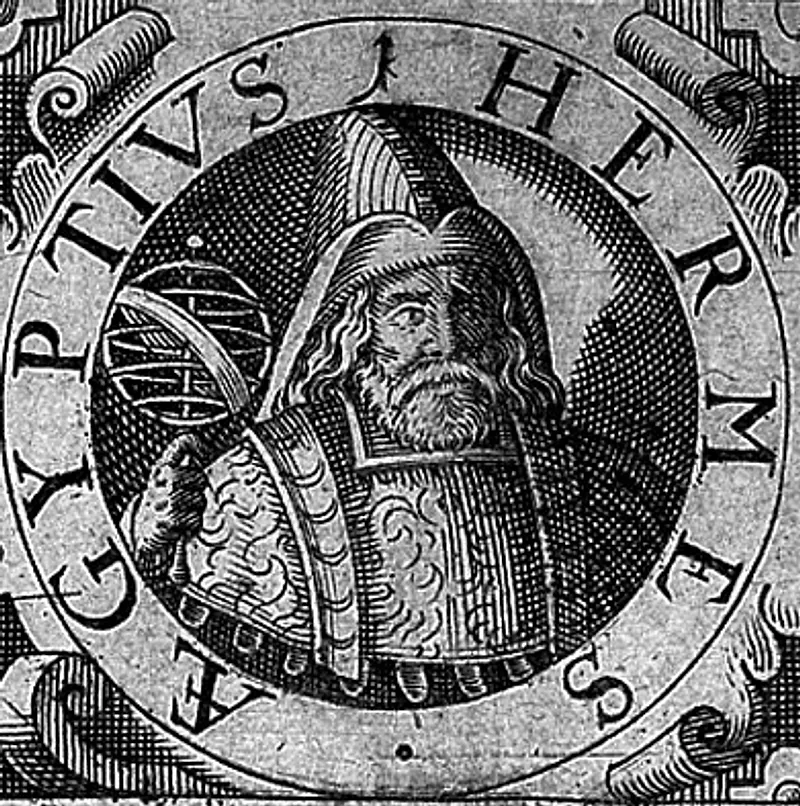
He found an underground passage, but it was so dark and windy that his lamp kept going out. In a dream an old man advised him to place the light inside a transparent vessel, which would shield it from the wind. With this protected lamp he entered the vault and saw an old man seated on a throne of gold, holding a tablet of emerald, with a book lying before him. The tablet bore the text that later became famous as the Emerald Tablet; the book was the Secret of Creation, which Balinus learned and now transmits.
The story uses a familiar motif. Egyptian and Hellenistic tradition told of sacred books of Thoth or Hermes hidden in temples, tombs or under stelae and rediscovered by worthy seekers; the Arabic Hermetic literature took this over and multiplied it (see Hermes Trismegistus). The discovery narrative turns the book into a revelation that is both ancient and newly found, and it explains how a Greek sage could transmit the wisdom of Hermes.
From the Word of God to the Four Natures§
After the frame story the book turns to cosmology. It begins with God, who is one and without cause, and with his creative word. From the divine command comes the first created reality, and from it the four primary qualities or "natures": heat, cold, moisture and dryness. Their combinations produce the four elements (fire as hot and dry, air as hot and moist, water as cold and moist, earth as cold and dry), an Aristotelian scheme going back ultimately to the four roots of Empedocles.
A recurring theme is motion. Heat moves and rises, cold is still and sinks, and from their interaction come the rotation of the heavens and the processes of generation below. The book explains the heavens, the stars and the planets as composed of the subtlest mixtures, and describes how their motion warms and shapes the lower world. It then treats winds, rain, thunder and earthquakes, following Aristotle's Meteorology in terms of the four natures.
The guiding principle is that everything in creation is linked through degrees of the same qualities. A thing is what it is because of the proportion and balance of hot, cold, moist and dry within it, and the sage who knows those proportions knows the "secret" of its being. This is the philosophical foundation of the tablet's claim that the lower and the higher are connected.
Minerals, Metals and the Sulfur–Mercury Theory§
The book's most influential section concerns minerals. Aristotle had taught that minerals and metals form underground from two exhalations: a dry, smoky one and a moist, vaporous one. The Secret of Creation transforms this idea into a theory of two material principles. Metals, it explains, are produced when sulfur and mercury combine inside the earth under the influence of heat and time. The differences between gold, silver, copper, iron, tin and lead result from differences in the purity of the two ingredients and the proportion in which they unite. Gold, the most perfect metal, arises from the purest sulfur and mercury in perfect balance.
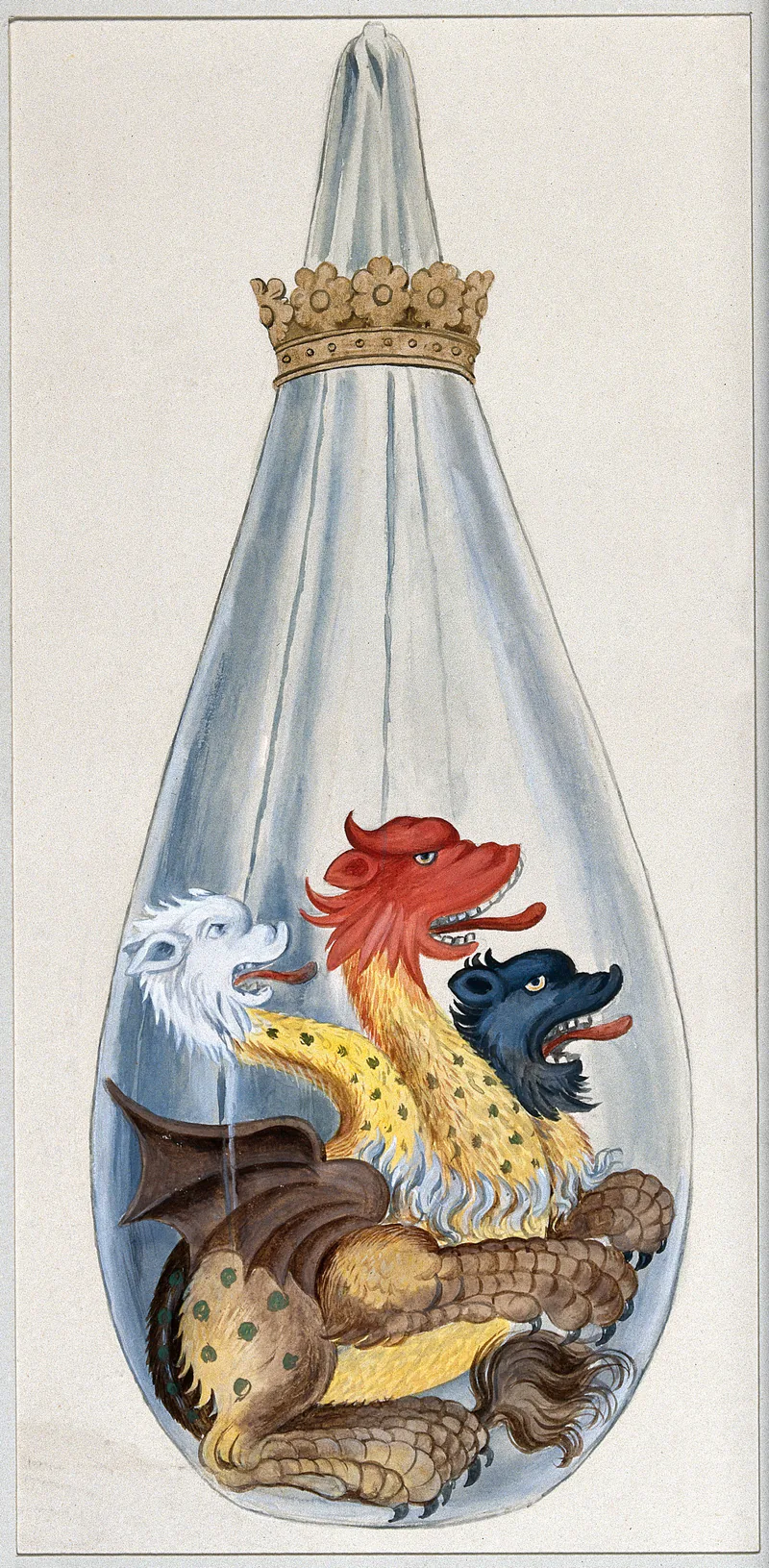
This is the earliest known statement of the sulfur–mercury theory. It was adopted and elaborated by the writings attributed to Jabir ibn Hayyan, discussed by Avicenna, and passed into Latin alchemy through texts such as the Summa perfectionis of pseudo-Geber. If all metals are composed of the same two principles, then the transmutation of a base metal into gold appears possible in principle: it is a matter of purifying and rebalancing what nature has mixed imperfectly. The theory thus underpinned the search for the philosopher's stone throughout the Middle Ages. In the sixteenth century Paracelsus added salt as a third principle, creating the tria prima, but sulfur and mercury remained at the centre of alchemical theory until the rise of modern chemistry.
The book is not a laboratory manual, but it supplies the theoretical frame within which laboratory alchemy made sense (see Western Alchemy).
Plants, Animals and the Human Being as Summary of Creation§
From minerals the book ascends through plants and animals to the human being. Plants are explained as more refined mixtures that take nourishment and grow; animals add sensation and movement.
The human being comes last and is described as the most complete and balanced of creatures, containing in itself something of every level of creation below and above. This idea of the human as a small world, a microcosm, was a commonplace of late antique philosophy, and here it serves as the culmination of a grand ladder of being. Knowing oneself, in this framework, means knowing the composition of the whole cosmos. The theme links the Secret of Creation to the wider doctrine of correspondences discussed in As Above, So Below.
The Emerald Tablet and the Book's Later Life§
The Emerald Tablet appears at the end of the book, as the text Balinus read in the old man's hands. Its short sentences, on the unity of the higher and the lower, on the one thing from which all things come, on the sun as its father and the moon as its mother, and on the separation of the subtle from the gross, read as a condensed summary of the book's cosmology and of the generation of the perfect substance. Another early Arabic version occurs in a treatise of the Jabirian corpus, and scholars debate which is older; the version in the Secret of Creation is the one most closely tied to a narrative and a date.
In the twelfth century Hugh of Santalla, working in the kingdom of Aragon, translated the book into Latin as a treatise on the secrets of nature (De secretis naturae), and Latin readers learned of Balinus as a philosopher of nature. The tablet itself circulated independently, in a separate Latin translation often attached to the Secretum secretorum (see Secretum Secretorum) and in the commentary attributed to Hortulanus, and in that form it became one of the most commented texts in European alchemy.
Modern study of the book began with Julius Ruska's Tabula Smaragdina (1926), which traced the tablet back to its Arabic sources, and was transformed by Weisser's edition. Kevin van Bladel's work on the Arabic Hermes has since placed it within the wider process by which Hermes became, in Islamic culture, a prophet of science and the founder of astrology, alchemy and talismanic magic.
Frequently asked questions§
Who was Balinus?§
Balinus (Balīnūs) is the Arabic name of Apollonius of Tyana, a first-century Greek philosopher and wonder-worker. In Arabic tradition he was regarded as a master of talismans and natural secrets, and many works were attributed to him, though none is genuinely his.
When was the Book of the Secret of Creation written?§
It is usually dated to the late eighth or early ninth century CE, in the early Abbasid period. It is a pseudepigraphic work drawing on late antique sources such as Nemesius of Emesa.
Is the Book of the Secret of Creation the source of the Emerald Tablet?§
It contains the earliest datable version of the Emerald Tablet, which it presents as the inscription Balinus found in the vault of Hermes. Another early Arabic version survives in the Jabirian corpus, and the tablet may have circulated before both.
What is the sulfur–mercury theory?§
It is the idea that all metals are formed underground from two principles, sulfur and mercury, in different degrees of purity and proportion. First stated in this book, it became the basic theory of Arabic and Latin alchemy.
Sources and further reading§
- Das Buch über das Geheimnis der Schöpfung von Pseudo-Apollonios von Tyana — Ursula Weisser, 1980
- Tabula Smaragdina: Ein Beitrag zur Geschichte der hermetischen Literatur — Julius Ruska, 1926
- The Arabic Hermes: From Pagan Sage to Prophet of Science — Kevin van Bladel, 2009
- Jâbir ibn Hayyân: Contribution à l'histoire des idées scientifiques dans l'Islam — Paul Kraus, 1942
- The Secrets of Alchemy — Lawrence M. Principe, 2013
- Apollonius of Tyana in Legend and History — Maria Dzielska, 1986
- The Life of Apollonius of Tyana — Philostratus, 2005