Birth lore · Your birthday
Gemstones · Birthstone of April and September
Sapphire
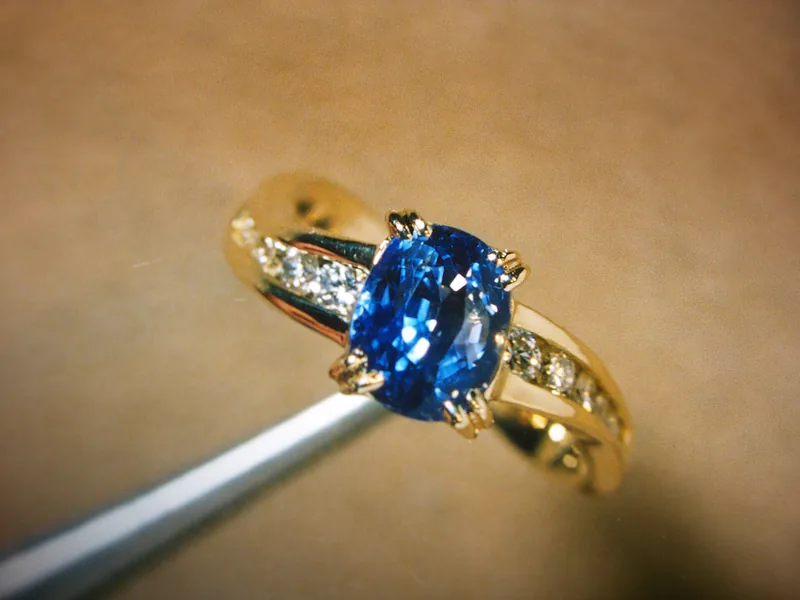
Corundum of every colour except red: blue sapphire (Neelam), the feared and revered Navaratna stone of Saturn, yellow sapphire (Pukhraj), the stone of Jupiter, and in the West the gem of heaven, kings and bishops; September's birthstone.
History and lore
The name comes through Latin sapphirus from Greek sappheiros, but the ancient stone of that name was probably lapis lazuli: Pliny the Elder describes sapphirus as blue flecked with gold, which fits lapis and its pyrite specks, not corundum (see lapis lazuli). Blue corundum was nevertheless known and traded from Sri Lanka, whose gem gravels around Ratnapura have been worked since antiquity, and from the medieval period the name passed to the stone we call sapphire.
In medieval Europe sapphire was the stone of heaven and of rulers. St Edward's Sapphire, now in the Imperial State Crown, is traditionally said to come from a ring of Edward the Confessor, though the story cannot be proved. Famous sources came late: sapphire was found in a remote valley of Kashmir around 1881, and its velvety cornflower blue remains the benchmark; Burma, Thailand, Cambodia, Australia, Montana and Madagascar followed. Large star sapphires such as the Star of India in New York, and royal engagement rings such as the one given to Diana, Princess of Wales, in 1981, kept the stone in the public eye.
In the traditions
Exodus 24:10 describes "a paved work of a sapphire stone" beneath the feet of the God of Israel, and Ezekiel 1:26 sees a throne "as the appearance of a sapphire stone"; the second stone of the breastplate's second row is likewise sappir (Exodus 28:18). Revelation 21:19 makes sapphire the second foundation of the New Jerusalem. In all these the stone was probably lapis lazuli, but medieval readers understood blue sapphire, and Marbode of Rennes and other lapidaries praised it as the noblest gem, fit for kings and clergy.
In Vedic astrology sapphire holds two places among the Navaratna. Blue sapphire, neelam, is the stone of Saturn, Shani, and is regarded as the most powerful and potentially dangerous of the nine, so that astrologers commonly advise a trial period before it is worn. Yellow sapphire, pukhraj, is the stone of Jupiter, Guru or Brihaspati, worn for wisdom and prosperity (see Vedic astrology). In the West, Agrippa listed the sapphire under Saturn and also under Jupiter and Venus.
Meaning and symbolism
Sapphire is the September birthstone in the American list of 1912 and later lists (see September); the old list that follows the breastplate order gives it to April. It symbolises truth, wisdom, faithfulness and heavenly contemplation, and marks the forty-fifth wedding anniversary. These are traditional meanings; studies have not found that gemstones change destiny or health.
The mineral
Sapphire is corundum, aluminium oxide, the same mineral as ruby. Iron and titanium together create blue; iron alone gives yellow; chromium gives pink, and pink-orange stones from Sri Lanka are called padparadscha, from the Sinhala for lotus colour. Some stones show a six-rayed star caused by needles of rutile.
Most sapphires are heated to improve colour and clarity, and some are diffused with beryllium or titanium, treatments that should be disclosed. Synthetic sapphire has been made since the early twentieth century and is common in watch crystals; curved growth lines and gas bubbles reveal flame-fusion stones. Blue spinel, glass and iolite are look-alikes. At hardness 9, sapphire is extremely durable; clean it with warm soapy water.
Sources and further reading
- Natural History, Book 37 — Pliny the Elder, c. 77 CE
- Marbode of Rennes' De lapidibus — ed. John M. Riddle, 1977
- Three Books of Occult Philosophy — Heinrich Cornelius Agrippa, 1533
- Brihat Samhita — Varahamihira, 6th century
- The Curious Lore of Precious Stones — George Frederick Kunz, 1913
- Ruby & Sapphire: A Gemologist's Guide — Richard W. Hughes, 2017