Birth lore · Your birthday
Lapis Lazuli
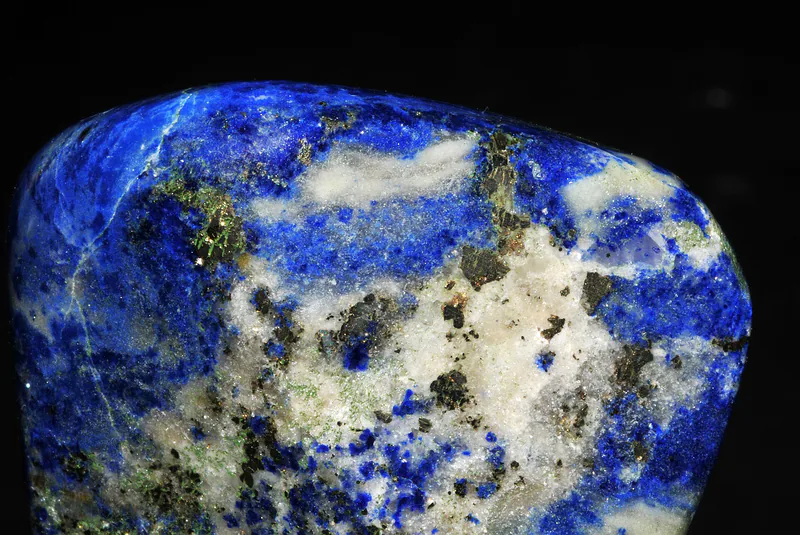
Deep blue lapis lazuli, flecked with golden pyrite, has been mined in Afghanistan for some six thousand years; it adorned Sumerian royalty and Egyptian gods, gave painters ultramarine, and was probably the 'sapphire' of the ancient world.
History and lore
Almost all lapis lazuli used in the ancient world came from one region: the mines of Sar-i Sang in Badakhshan, in the mountains of north-eastern Afghanistan, worked since at least the fourth millennium BCE and still in production. From there the stone travelled thousands of kilometres. In the Royal Cemetery of Ur in Mesopotamia, from around 2600–2500 BCE, it covers the headdress and beads of Queen Puabi, the "Ram in a Thicket" figures and the panels of the Standard of Ur. In the Sumerian poem of Inanna's descent to the underworld, the goddess dresses for her journey in a necklace of lapis beads and carries a measuring rod and line of lapis lazuli.
In Egypt lapis (khesbed) was among the most precious of materials. It was carved into scarabs and amulets and inlaid in royal jewellery, including the funerary mask of Tutankhamun, and Egyptian texts describe the hair of the gods as being of lapis lazuli. The name comes from Latin lapis, "stone", and medieval Latin lazulum, from the Persian lajvard, "blue", the same root as "azure". Ground, washed and purified by a laborious process, lapis yields the pigment ultramarine, "from beyond the sea", used in seventh-century Buddhist cave paintings at Bamiyan and, in late medieval and Renaissance Europe, valued above gold and reserved for the robes of the Virgin. The painter's handbook of Cennino Cennini, around 1400, describes how it was prepared.
In the traditions
The Hebrew Bible's sappir, translated "sapphire", is very probably lapis lazuli. Pliny the Elder describes sapphirus as a blue stone sprinkled with specks of gold, an exact description of lapis with its pyrite, and the "paved work of a sapphire stone" under God's feet in Exodus 24:10 suits lapis far better than corundum. The second-row "sapphire" of the High Priest's breastplate (Exodus 28:18) may likewise have been lapis, though that identification remains uncertain.
In Mahayana Buddhism the Medicine Buddha, Bhaiṣajyaguru, is the "Master of Healing, Lapis Lazuli Light". The Sanskrit word in his title, vaiḍūrya, is conventionally translated as lapis lazuli in Chinese, Tibetan and Japanese tradition, although its exact meaning in earlier Indian sources is debated (see cat's eye). Agrippa lists the "lazul stone" among the stones of Venus, which this entry follows. As a birthstone, lapis was an alternative to turquoise for December on the American list of 1912 but was dropped in 1952; a British list usually dated to 1937 gave it to September.
Meaning and symbolism
With its deep blue and scattered gold, lapis has been read almost everywhere as the night sky and the heavens: a stone of divinity, royalty, truth and wisdom. In Egypt and Mesopotamia it belonged to gods and kings; in Christian painting its pigment clothed the Queen of Heaven. Modern crystal books associate it with intuition and the "third eye"; these associations are recent, and scientific studies have not found that stones heal or confer insight.
The mineral
Lapis lazuli is a rock formed by contact metamorphism, when limestone or marble is altered by heat and fluids from nearby igneous intrusions. Its blue comes from lazurite, coloured by sulphur; white calcite and brassy pyrite are common companions. The finest material, deep blue with little calcite and a fine scattering of pyrite, still comes from Afghanistan; other sources include the Andes of Chile (often paler with more calcite), the region around Lake Baikal in Russia, Pakistan and Myanmar.
At a hardness of 5–5.5, lapis is relatively soft and porous and is sensitive to acids, heat and pressure. Much is waxed, oiled or dyed. Imitations include dyed jasper ("Swiss lapis"), dyed howlite or magnesite, glass and synthetic sintered lapis. Clean only with a soft damp cloth, and keep it away from ultrasonic cleaners, cosmetics and household chemicals.
Sources and further reading
- Exodus 24 and 28 — King James Bible, 1611
- Natural History, Book 37 — Pliny the Elder, c. 77 CE
- Il libro dell'arte — Cennino Cennini, c. 1400
- Three Books of Occult Philosophy — Heinrich Cornelius Agrippa, 1533
- Inanna, Queen of Heaven and Earth — Diane Wolkstein and Samuel Noah Kramer, 1983
- Ancient Egyptian Materials and Industries — Alfred Lucas, 1926
- The Curious Lore of Precious Stones — George Frederick Kunz, 1913