Liber XVI · Indigenous & Ancient Religions · Chapter VIII: Norse & Germanic Religion
Thor: Norse God of Thunder, Mjölnir, Myths and Viking Cult
Thor (Þórr, Donar, Thunor) in Norse and Germanic religion: his name, Mjölnir, the myths of the Midgard Serpent and Thrym, hammer amulets and Viking-age cult.

Thor (Old Norse Þórr) is the thunder god of Norse and wider Germanic religion: the red-bearded defender of gods and humans against the giants, armed with the hammer Mjölnir, who rides a chariot drawn by goats. In the late Viking Age he was probably the most widely worshipped of the Scandinavian gods, honoured with temples, hammer amulets and countless personal and place names. His myths survive mainly in the thirteenth-century Icelandic Poetic Edda and Snorri Sturluson's Prose Edda, while archaeology and earlier writers show his cult reaching back across the Germanic world.
The Name and Origins of Thor§
Þórr derives from a Proto-Germanic word reconstructed as *Þunraz, "thunder". The god appears as Thunor in Old English and Donar in Old High German, and his name survives in the English "Thursday", Thunor's day, a translation of the Latin dies Iovis, Jupiter's day. Germanic speakers thus equated their thunder god with the Roman sky god. Roman writers, however, sometimes identified a Germanic god with Hercules instead, as Tacitus does in the Germania (98 CE); many scholars think this refers to Donar, the strong, club-wielding defender, though the identification is not certain.
Early medieval evidence from the continent and England confirms his importance. A sixth- or seventh-century brooch from Nordendorf in Bavaria carries a runic inscription often read as including the name Thonar. The Old Saxon baptismal vow, from around 800, required converts to renounce "Thunaer, Woden and Saxnote" with all their works. In 723 the missionary Boniface felled a great oak at Geismar in Hesse that his biographer calls the oak of Jupiter, generally taken to be a sanctuary of Donar.
Comparative scholars link Thor with other Indo-European storm gods who fight serpents or monsters, such as the Vedic Indra and the Baltic Perkūnas, though the details of such reconstructions are debated.
Mjölnir and Thor's Attributes§
Thor's hammer, Mjölnir, was the most powerful weapon of the gods. In the Prose Edda Snorri tells how the god Loki, after cutting off the hair of Thor's wife Sif, was forced to have dwarves forge replacement treasures. The dwarf brothers Brokkr and Eitri made a golden boar, the ring Draupnir and the hammer, whose handle came out short because Loki, in the form of a fly, bit Brokkr during the work. Mjölnir never missed its target and returned to Thor's hand; it could also hallow, blessing a bride, a funeral pyre or slaughtered goats.

Thor also owned a belt of strength (megingjörð) and iron gloves for gripping the hammer. He travels in a chariot pulled by two goats, Tanngnjóstr and Tanngrisnir, which he can kill and eat at night and restore to life with his hammer the next morning. His hall is Bilskírnir in Þrúðvangr, "fields of strength". His sons are Magni and Móði, and his daughter Þrúðr. In the poems and sagas he is quick to anger, enormous in appetite and plain-spoken, a contrast to the cunning and ambiguous Odin.
Thor's Myths in the Eddas§
Most of Thor's stories pit him against the giants (jötnar), the forces of chaos threatening the ordered world of gods and humans.
The Fishing for the Midgard Serpent§
In the eddic poem Hymiskviða and in Snorri's account, Thor goes fishing with the giant Hymir, baits his hook with the head of an ox, and hooks Jörmungandr, the World Serpent coiled around the earth. He hauls the monster up until they glare at each other, but the terrified giant cuts the line. The scene is carved on several stones of the Viking Age: the Altuna runestone in Uppland, the Hørdum stone in Denmark, a picture stone from Ardre on Gotland, and the "fishing stone" at Gosforth in Cumbria, which stands in a churchyard beside a cross. These carvings show that the myth was known centuries before it was written down.
The Theft of the Hammer§
Þrymskviða, one of the liveliest poems of the Poetic Edda, tells how the giant Þrymr steals Mjölnir and demands the goddess Freyja as his bride in exchange. Freyja refuses with fury, so Thor is dressed as a bride, with Loki as his maid. At the wedding feast the "bride" eats an ox and eight salmon, and Loki explains that she has fasted for eight nights from longing. When the hammer is laid in the bride's lap to hallow the marriage, Thor seizes it and kills the giants.
Útgarða-Loki, Hrungnir and Other Tales§
In Snorri's Gylfaginning, Thor visits the giant king Útgarða-Loki and fails three tests: he cannot empty a drinking horn, lift a grey cat or defeat an old woman at wrestling. Afterwards he learns that the horn was connected to the sea, the cat was the World Serpent and the old woman was Old Age itself. In another story he duels the stone-hearted giant Hrungnir, and a fragment of the giant's whetstone lodges in his head. The poem Hárbarðsljóð shows him trading insults with a disguised Odin, and Alvíssmál has him detain a dwarf with questions until the sun turns him to stone.
At Ragnarök, according to Völuspá, Thor and the Midgard Serpent kill one another: he strikes it dead, walks nine paces and falls, poisoned by its venom.
Thor's Cult in the Viking Age§
Several kinds of evidence show that Thor was widely worshipped. The German chronicler Adam of Bremen, writing around 1075, described a temple at Uppsala in Sweden with statues of three gods, Thor in the centre flanked by Wodan and Fricco. Thor, he reported, governed the air, thunder and lightning, winds and rain, fair weather and crops, and sacrifices were made to him in times of plague and famine. Adam wrote from hearsay and with a missionary purpose, and archaeologists debate whether such a temple existed in the form he described, but his association of Thor with weather and harvest is widely accepted.
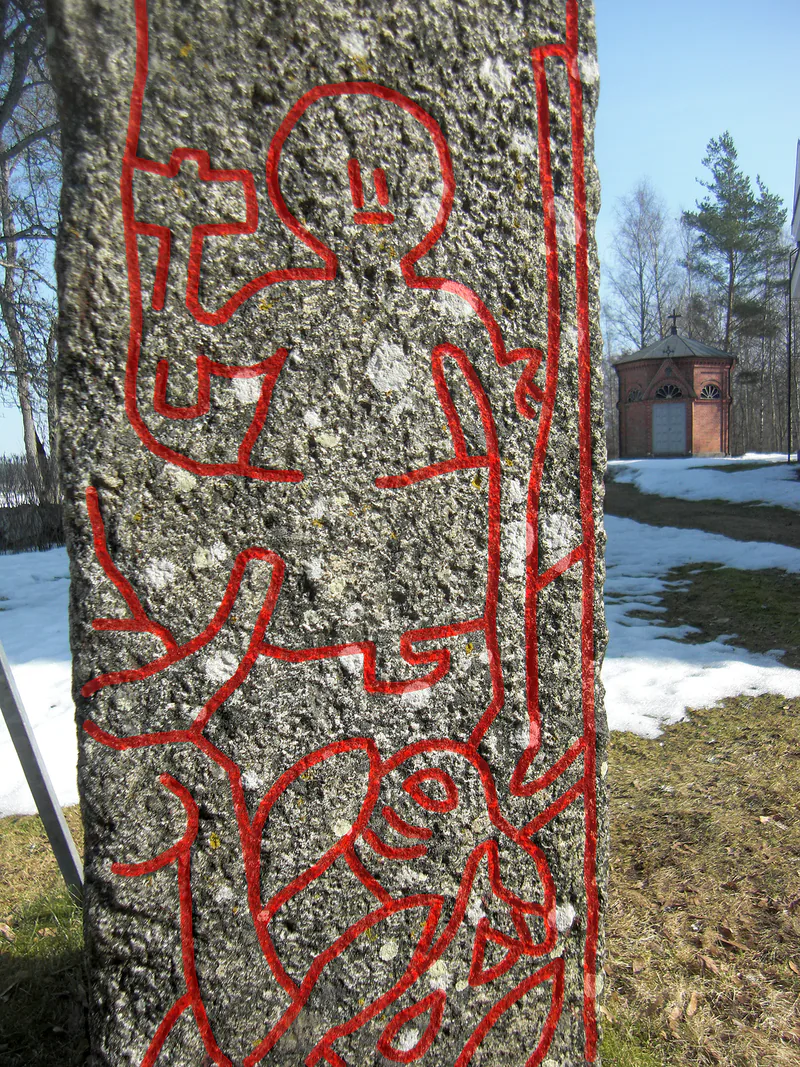
Personal names compounded with Thor, such as Thorstein, Thorkell and Thorgerðr, were extremely common in Viking-age Scandinavia and Iceland, and place names such as Torslunda in Sweden and Thorsager in Denmark suggest sites of his worship. Several Danish runestones of the tenth century, including the Glavendrup stone, carry the formula "may Thor hallow these runes", an invocation that may reflect the hammer's blessing power.
Icelandic sagas, written later by Christians, describe settlers devoted to him. Eyrbyggja saga tells of Thórólfr Mostrarskegg, who threw the carved pillars of his high seat, bearing Thor's image, into the sea off Iceland and settled where they came ashore. Landnámabók records that Helgi the Lean was "very mixed in his faith", believing in Christ but calling on Thor for sea voyages and hard times.
Hammer Amulets and the Conversion§
The most widespread material sign of Thor's cult is the small hammer pendant. More than a thousand are known, made of silver, iron, bronze or amber, found mainly in Scandinavia and dating chiefly from the tenth and eleventh centuries. Many scholars interpret them as a response to Christian missions, a pagan counterpart to the cross worn by converts. A soapstone casting mould from Trendgården in Jutland could produce both crosses and hammers, suggesting that a craftsman served customers of both faiths. Iron rings hung with small hammers, found especially in central Sweden, are an older and more local form, often placed in cremation burials.
The conversion period also produced stories of direct contest. Skaldic verses attributed to the Icelandic poet Steinunn claim that Thor wrecked the ship of the missionary Þangbrandr, and sagas describe idols of Thor broken by Christian kings such as Olaf Tryggvason. Thor was the god most often presented as Christ's rival, perhaps because he was the most popular protector of ordinary people, a point developed in the overview of Norse and Germanic religion.
Thor in Modern Times§
Thor reappeared in Romantic literature, in Richard Wagner's Ring cycle as Donner, and in twentieth-century popular culture, including comic books and films that bear little resemblance to the medieval sources. In modern Heathenry, discussed in Heathenry and the runes, Thor is one of the most honoured gods, and the hammer is a common religious symbol worn much as a cross or star is worn in other religions. Organisations such as Iceland's Ásatrúarfélagið have rejected the misuse of Norse symbols by racist groups, and the United States Department of Veterans Affairs approved the hammer as an emblem of belief for veterans' gravestones in 2013.
Frequently asked questions§
What is Thor the god of?§
Thor is the god of thunder and storms in Norse religion, and the protector of gods and humans against the giants. Medieval sources also link him with weather, harvests, sea voyages and the hallowing of marriages and graves.
What is the name of Thor's hammer?§
His hammer is Mjölnir, made by the dwarves Brokkr and Eitri according to Snorri Sturluson. It never misses, returns to his hand, and can also bless and restore life.
Was Thor more popular than Odin?§
Many scholars think Thor was the most widely worshipped god in late Viking-age Scandinavia, especially among farmers and seafarers, judging from personal names, place names and amulets. Odin was particularly associated with kings, poets and warriors.
How does Thor die?§
According to the poem Völuspá, Thor and the World Serpent kill each other at Ragnarök. He strikes the serpent dead, walks nine steps and then falls, overcome by its poison.
Sources and further reading§
- The Prose Edda — Snorri Sturluson, 1987
- The Poetic Edda — Carolyne Larrington, 1996
- Gods and Myths of Northern Europe — H. R. Ellis Davidson, 1964
- Myth and Religion of the North — E. O. G. Turville-Petre, 1964
- Dictionary of Northern Mythology — Rudolf Simek, 1993
- Norse Mythology: A Guide to the Gods, Heroes, Rituals, and Beliefs — John Lindow, 2001
- History of the Archbishops of Hamburg-Bremen — Adam of Bremen, 1959