Birth lore · Your birthday
Hematite
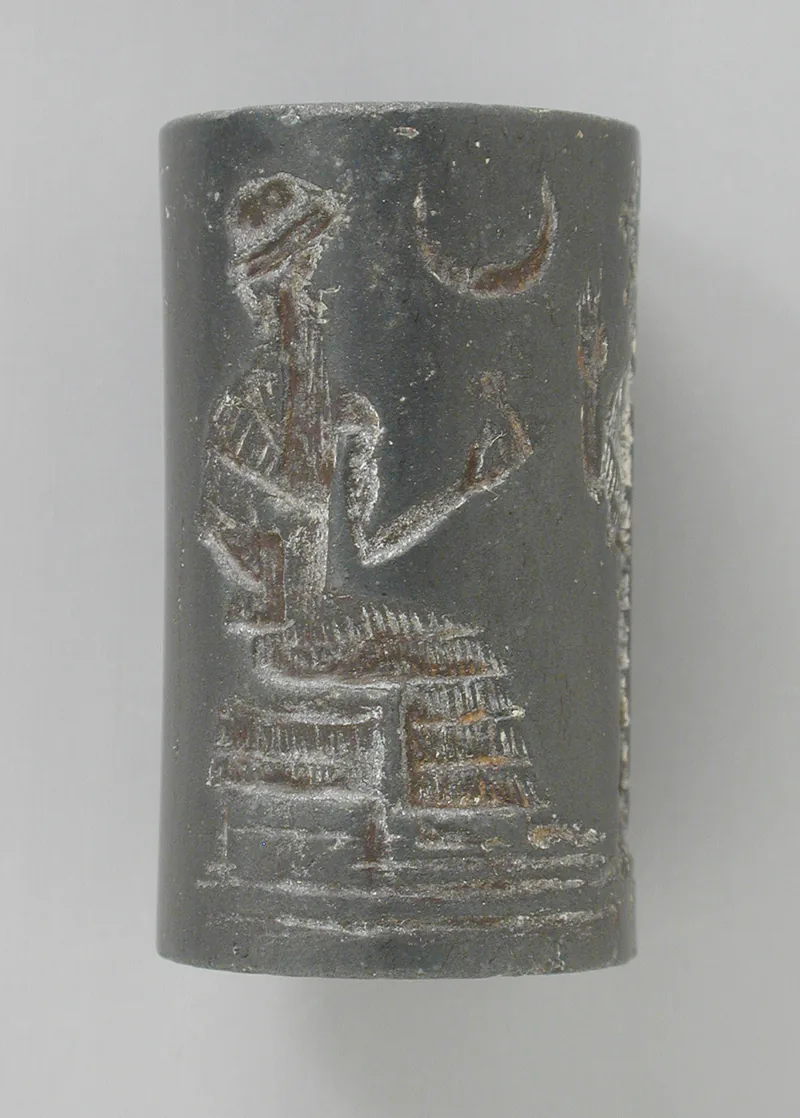
Hematite is the blood-red-streaked iron oxide behind red ochre, Old Babylonian cylinder seals and Egyptian amulets, traditionally placed under Mars.
History and lore
Hematite is iron oxide, the most important ore of iron and one of the oldest substances in human ritual. Its name, from the Greek haima, "blood", refers to a striking property: though polished hematite is a metallic grey-black, its powder is blood-red, and the water used in cutting it turns red. The red ochre that early humans used to paint caves, colour bodies and line graves is largely earthy hematite; engraved pieces of ochre from Blombos Cave in South Africa, around 75,000 years old, are among the earliest known symbolic objects.
As a carved stone, hematite reached its height in the ancient Near East. During the Old Babylonian period (roughly 1900–1600 BCE) it was a favourite material for cylinder seals, rolled across clay to mark ownership and authority, many showing worshippers before deities. In Egypt, small headrest amulets were often made of hematite and placed with the dead to protect and raise the head, in keeping with a spell of the Book of the Dead (see ancient Egyptian religion). Theophrastus discusses haematitis in his treatise On Stones (about 315 BCE), and Pliny the Elder reports that a Babylonian writer named Zachalias claimed it helped those petitioning kings and pursuing lawsuits.
In the traditions
Because of its blood-red powder, hematite was linked in ancient and medieval medicine with bleeding, wounds and eye complaints; such remedies are of historical interest only and are not to be used. Medieval lapidaries in the tradition of Marbode of Rennes include it among their stones. In older English "bloodstone" could mean hematite as well as the green, red-spotted heliotrope now called bloodstone, a confusion worth remembering when reading Renaissance tables. Iron and blood belong to Mars in Western astrological magic, and the lists of martial things in the Agrippa tradition include a "bloodstone" that may refer to hematite; modern crystal books pair hematite with Aries and Scorpio, the signs Mars rules (see amulets and talismans).
In the nineteenth century hematite was carved into intaglios and cameos for men's signet rings and, being dark and sober, into mourning jewellery.
Meaning and symbolism
Modern crystal writers call hematite a grounding stone, associated with strength, courage, focus and the root chakra, and say that it deflects negativity, perhaps because its mirror-bright surface reflects. Its older symbolism remains bound up with blood, iron and endurance. Scientific studies have not found that hematite or magnetic jewellery improves circulation or health.
The mineral
Hematite forms in many settings: the banded iron formations laid down in ancient seas, hydrothermal veins and the weathering of iron-bearing rocks. Crystalline forms include platy, mirror-like specularite, the rounded "kidney ore" of Cumbria and the rosette-shaped "iron roses" of the Alps. Important sources include Brazil, Australia, England, Michigan and Minnesota. Hematite also colours much of the surface of Mars, a fitting coincidence for the planet's stone.
Hematite is 5.5 to 6.5 on the Mohs scale, heavy for its size and only weakly magnetic. A simple test is its red-brown streak on unglazed porcelain. Shiny, strongly magnetic beads sold as "magnetic hematite" are usually a manufactured ceramic, sometimes called hematine. Hematite can develop rust spots with long exposure to water, so dry it after cleaning with a soft cloth.
Sources and further reading
- On Stones — Theophrastus, c. 315 BCE (ed. Earle R. Caley and John F. C. Richards, 1956)
- Natural History, Books 36–37 — Pliny the Elder, c. 77 CE
- First Impressions: Cylinder Seals in the Ancient Near East — Dominique Collon, 1987
- Amulets of Ancient Egypt — Carol Andrews, 1994
- Three Books of Occult Philosophy — Heinrich Cornelius Agrippa, 1533