Birth lore · Your birthday
Chalcedony
Chalcedony is the waxy, translucent microcrystalline quartz that includes carnelian, sard, agate and onyx; it is the third foundation stone of the New Jerusalem in Revelation 21.
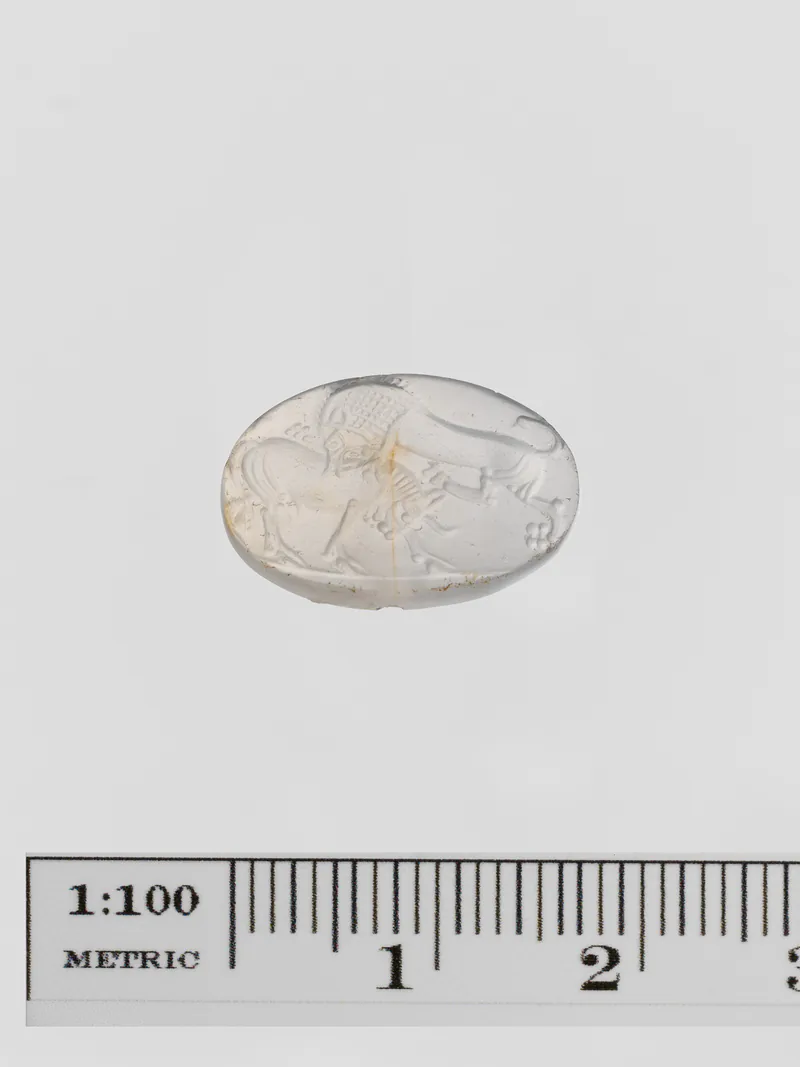
History and lore
Chalcedony is the family name for microcrystalline quartz: silica made of fibres too small to see, which gives the material a soft, waxy, translucent glow rather than the glassy sparkle of crystal quartz. In the narrow sense the name is used for the plain milky, grey or lavender-blue variety; in the broad sense it covers a whole group of ancient gem materials, including carnelian, sard, agate, onyx, chrysoprase and bloodstone.
No stone family mattered more to the craftsmen of the ancient world. Chalcedony is tough, takes a fine polish and holds engraved detail, so it was a preferred material for seals and intaglios from Mesopotamian cylinder seals and Minoan sealstones to Greek, Persian and Roman gem engraving. The Harappan cities of the Indus valley made long red chalcedony beads that reached Mesopotamia. The name is traditionally connected with Chalcedon, the Greek city on the Asian shore of the Bosporus opposite Byzantium, though the derivation is not certain.
In the traditions
The word appears in Revelation 21:19, where the third foundation of the New Jerusalem is "a chalcedony" (KJV). Whether the Greek chalkēdōn meant the stone we now call chalcedony is uncertain. Pliny mentions a "Chalcedonian" green stone from copper mines near Chalcedon, and some scholars think the biblical stone was green. This illustrates a general problem: ancient gem names described colour and place of origin rather than mineral species, so the biblical stones cannot be matched with confidence to modern minerals. Among the twelve stones of the High Priest's breastplate in Exodus 28, several were probably chalcedonies, such as the sard and the agate, though chalcedony itself is not named (see the Christian Bible and its canon).
Medieval lapidaries in the tradition of Marbode of Rennes wrote of chalcedony as a stone that strengthened the wearer, helped in disputes and lawsuits and drove away melancholy. In the Islamic world, the agates and carnelians called 'aqīq hold a special place: ring stones of 'aqīq are worn by many Muslims, encouraged by sayings attributed to the Prophet Muhammad and, in Shi'i tradition, to the Imams, with Yemeni 'aqīq especially esteemed (see Islamic occult sciences).
Meaning and symbolism
Modern crystal writers associate blue chalcedony with calm and clear communication, sometimes calling it a "speaker's stone", and link it with the throat chakra and the Moon. The family as a whole stands for steadiness, goodwill and protection. These are symbolic meanings; scientific studies have not found that chalcedony affects health or temperament (see crystals, auras and energy).
The mineral
Chalcedony forms at low temperatures from silica-rich water filling cavities in volcanic rocks and veins, which is why it often occurs as rounded nodules, crusts and stalactitic shapes. Its fibres leave tiny pores, so it readily absorbs dyes. Pliny already mentions stones improved by boiling in honey, and from the nineteenth century the cutting centre of Idar-Oberstein in Germany perfected the dyeing of Brazilian agate and chalcedony. Bright blue, pink or green stones may therefore be dyed; colour concentrated along bands or in cracks is a clue.
Chalcedony is 6.5 to 7 on the Mohs scale and very tough. Major sources include Brazil, Uruguay, India, Madagascar, Namibia, Turkey and the western United States. Clean it with warm soapy water, and avoid harsh chemicals with dyed pieces.
Sources and further reading
- The Holy Bible, King James Version (Exodus 28; Revelation 21) — 1611
- Natural History, Book 37 — Pliny the Elder, c. 77 CE
- Liber de lapidibus — Marbode of Rennes, c. 1090
- Gems: Their Sources, Descriptions and Identification — Robert Webster, 1962
- Gemstones of the World — Walter Schumann, 1977