Birth lore · Your birthday
Gemstones · Birthstone of May and June
Agate
Banded chalcedony named after a river in Sicily, agate is one of the oldest worked stones; it is a breastplate stone in the King James Bible, a stone of Mercury in Agrippa, and a traditional May or June birthstone.
History and lore
Agate takes its name from the river Achates in Sicily (usually identified with today's Dirillo), where, according to Theophrastus in On Stones (around 315 BCE) and Pliny the Elder, the stone was first found. It is among the oldest materials people have shaped: agate and related chalcedonies were chipped into tools and drilled into beads in prehistory, carved into seals in Mesopotamia, Greece and Rome, and hollowed into the hardstone vessels collected by Byzantine emperors and Renaissance princes.
The modern agate trade grew up at Idar-Oberstein in the German Rhineland, where local stones were cut and polished on water-driven grinding wheels from at least the sixteenth century. When local supplies ran low in the nineteenth century, emigrants from the region found vast deposits in southern Brazil and Uruguay, and Idar-Oberstein became the world's centre for cutting and dyeing agate. In Tibet and the Himalaya, dzi beads, agates decorated with "eyes" and stripes by an ancient etching process, are treasured as protective heirlooms; their age and place of manufacture are still debated.
In the traditions
The King James Bible names agate as the eighth stone of the High Priest's breastplate, in the third row: "a ligure, an agate, and an amethyst" (Exodus 28:19). The Hebrew word is shebo, and as with most breastplate stones its identification is uncertain. Pliny reports, with evident scepticism, claims attributed to the Persian magi that certain agates could turn aside storms, and he and later writers credited various agates with protection against scorpions and snakes. Medieval lapidaries in Marbode's tradition say agate made its wearer agreeable, persuasive and favoured by God.
In Renaissance magic, Agrippa places achates among the stones of Mercury, the planet of speech and exchange, and modern tables accordingly link it with Gemini and Virgo. In Arabic, aqiq covers both agate and carnelian, and agate rings have long been worn as a mark of piety and blessing in the Islamic world. In older month lists agate appears for June, as in the Gregorian birthstone rhymes, and sometimes for May; modern American lists do not include it.
Meaning and symbolism
Agate's bands, laid down layer upon layer, have made it an emblem of balance, patience and steady strength. Eye agates, whose rings resemble a pupil and iris, were widely used across the Mediterranean, the Middle East and Central Asia as charms against the evil eye. Moss agate, with its plant-like inclusions, became a gardener's and farmer's stone in later European folklore. These are traditional associations; scientific studies have not found that stones protect or heal.
The mineral
Agate forms when silica-rich water seeps into cavities in volcanic rock, such as gas bubbles in lava or the hollow nodules called thundereggs, and deposits chalcedony in successive layers; exactly how the regular banding arises is still discussed by mineralogists. Straight-banded material is called onyx. Other varieties include moss agate, lace agate, fire agate with iridescent layers, and named regional types from Botswana, Mexico and the Lake Superior region. Major sources today are Brazil, Uruguay, Mexico, India, Madagascar and the United States.
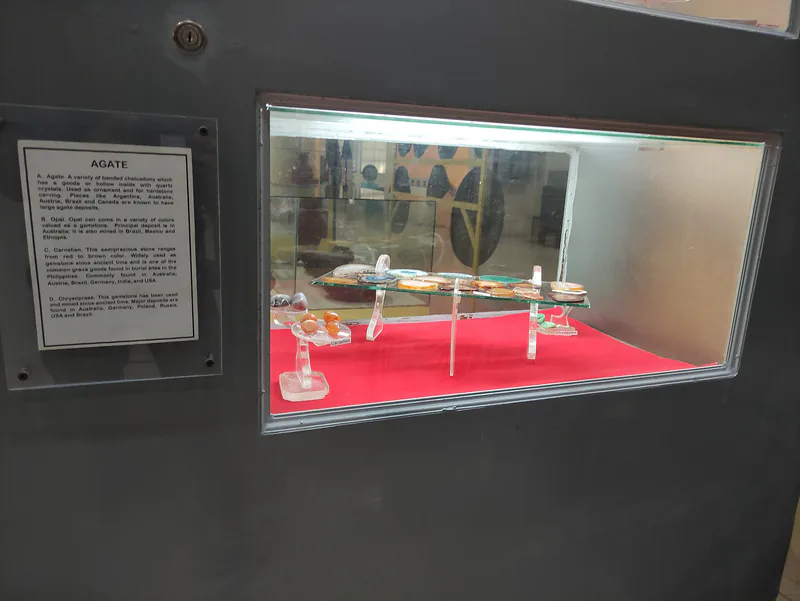
Agate has a hardness of 6.5–7 and is very tough. It is porous enough to absorb dye: the bright blue, pink, purple and green slices sold as decorations are dyed, while natural agate runs to greys, browns, whites and reds. Imitations in glass or plastic are lighter and warmer to the touch. Clean with warm soapy water; dyed pieces may fade in strong sunlight.
Sources and further reading
- Exodus 28 — King James Bible, 1611
- On Stones — Theophrastus, c. 315 BCE
- Natural History, Book 37 — Pliny the Elder, c. 77 CE
- De lapidibus — Marbode of Rennes, c. 1090
- Three Books of Occult Philosophy — Heinrich Cornelius Agrippa, 1533
- The Curious Lore of Precious Stones — George Frederick Kunz, 1913
- Gemstones of the World — Walter Schumann, 1977