Liber II · Ancient Magic · Chapter III: Egyptian Magic
Cippi of Horus: Egyptian Healing Stelae and the Metternich Stela
Cippi of Horus explained: Egyptian healing stelae showing Horus on the crocodiles, the Metternich Stela, Isis and the seven scorpions, and healing water.

A cippus of Horus is an Egyptian healing stela showing the child-god Horus standing on crocodiles and grasping snakes, scorpions and other dangerous animals, its surfaces covered with spells against bites, stings and poison. Water poured over the carved images and texts was believed to absorb their power and was drunk or applied to the patient. Cippi were made from the late New Kingdom into the Roman period, and the finest surviving example, the Metternich Stela in New York, dates from the reign of Nectanebo II in the fourth century BCE.
What a Cippus of Horus Is§
The word cippus (plural cippi) is a Latin term for a post or pillar, applied by modern scholars to these objects; Egyptologists also speak simply of "Horus stelae". They range in size from small amulets a few centimetres high, which could be carried or kept at home, to monuments around a metre tall set up in temples and public places. Most are carved in hard dark stone, such as steatite, schist or greywacke.
The central image is remarkably consistent. Horus the Child, naked and wearing the sidelock of youth, stands frontally on two crocodiles. In his hands he holds snakes, scorpions, a lion and an oryx or gazelle, all creatures associated with the desert and with chaotic, dangerous forces. Above his head is the grotesque face of Bes, a dwarf god who protected households, women in childbirth and children. Beside Horus there are often standards of papyrus and lotus, the latter crowned with plumes. The back and sides of the stela, and sometimes its base, are filled with hieroglyphic spells.
The message is visual as well as textual: the young god has overcome every source of venom and attack, and the person treated by the stela shares in his victory. Cippi thus belong to the broader Egyptian tradition of heka, the divine power of effective speech discussed in What Is Ancient Magic?, and sit alongside the protective objects described in Ancient Egyptian Amulets.
The Metternich Stela§
The most famous cippus is the Metternich Stela, now in the Metropolitan Museum of Art in New York. It was found in 1828 during building work in Alexandria and presented by Muhammad Ali, the ruler of Egypt, to the Austrian statesman Prince Klemens von Metternich, who kept it at his castle of Königswart in Bohemia. The museum acquired it in 1950.
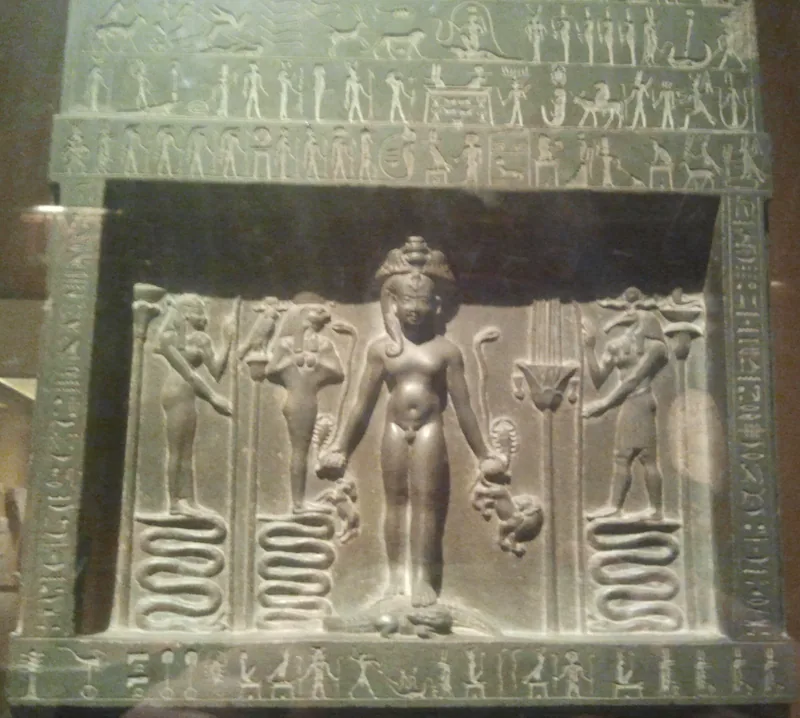
The stela is carved in a dark green stone and dates to the reign of Nectanebo II (about 360–343 BCE), the last native pharaoh of Egypt. An inscription records that it was made under the direction of a priest who had found older texts and had them copied anew, a reminder that Late Period temples carefully preserved and recopied magical literature. Above the usual figure of Horus on the crocodiles, the upper part of the stela is crowded with rows of tiny deities: protective gods, a solar disc with adoring baboons, and many composite beings that embody concentrated divine power. Every surface carries text, and the whole object functions as an encyclopaedia of protection against poison.
The stela's inscriptions include some of the most vivid narrative passages in Egyptian magic, and they have been translated by several scholars, notably J. F. Borghouts in his anthology of magical texts.
Isis, the Seven Scorpions and the Healing of Horus§
Egyptian healing spells often work through historiolae, short mythical stories in which a god once suffered and was healed. By reciting the story over a patient, the healer identified the sufferer with the divine child and claimed the same cure. The cippi draw on the cycle of myths in which Isis, having lost her husband Osiris, hides her son Horus in the marshes of Chemmis in the Delta to protect him from Seth (see The Osiris Myth).
In one story on the Metternich Stela, Isis travels escorted by seven scorpions. A wealthy woman refuses her hospitality and shuts the door, while a poor woman of the marshes takes her in. In anger, the scorpions combine their venom in one of them, which stings the rich woman's son. The mother's grief moves Isis, who lays her hands on the child and recites a spell naming each scorpion and commanding the poison to leave. The child recovers, and the rich woman, repenting, gives her goods to the poor woman.
In another, Horus himself is stung while his mother is away. Isis's cries reach the sky, and the boat of the sun god Ra halts in its course, plunging the world into darkness. Thoth descends from the boat and, speaking with the authority of Ra, drives the poison out of Horus. The threat implicit in the story, that the cosmos itself stands still until the child is healed, gave the spell enormous force. The patient, too, was understood to be under the protection of the gods who ordered the world.
Water, Basins and Healing Statues§
The cippi were not only read; they were used. Water was poured over the carved surface so that it ran across the images and texts, and was then collected, either in a basin cut into the base or in a separate vessel. The water, now believed to carry the power of the words and of Horus's victory, was drunk by the patient or used to bathe the wound. Larger cippi set up in temple courts or public places would have served many people, while small ones could be used in the household.
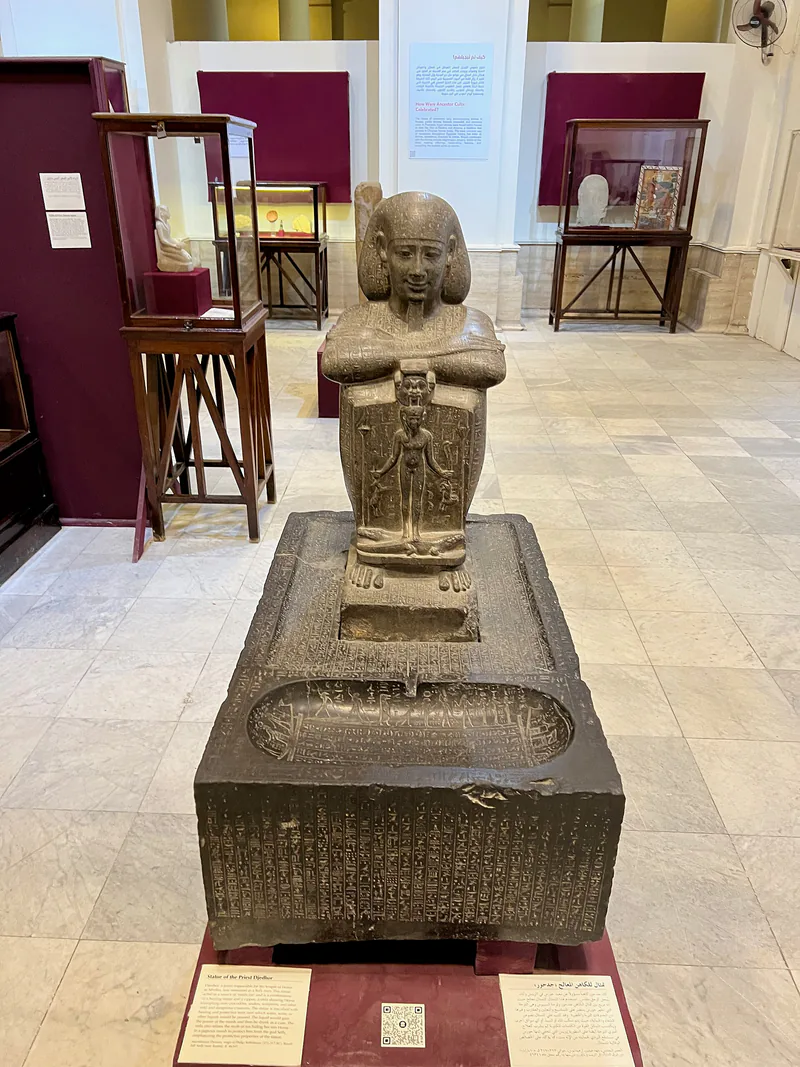
The same principle produced the so-called healing statues. These are statues of kings or private individuals, their bodies and robes covered with the same spells, often holding a cippus in front of them and standing on a base with a channel or basin. A statue of Ramesses III found near Heliopolis carries protective texts against snakes, and the statue of Djedhor, called "the Saviour", from Athribis in the Delta, made in the early Ptolemaic period, is one of the best-known private examples. Its inscriptions record Djedhor's pious works, including provision for the burial of the sacred falcons of his city, and its basin made the healing water available to visitors. The statue made its owner a perpetual benefactor and kept his name in the mouths of those he helped.
These practices fitted into a wider professional world. Late Egyptian medical-magical handbooks, such as the Brooklyn Papyrus on snakes, list species of serpents and their bites with remedies, and specialists known as "controllers of Serqet", after the scorpion goddess, combined practical treatment with recitation.
Origins: Shed, Horus the Child and the Development of the Cippi§
Spells against snakes and scorpions are among the oldest Egyptian religious texts; a number of them appear already in the Pyramid Texts of the Old Kingdom. The image of a youthful god mastering dangerous animals, however, developed later. In the New Kingdom, a god called Shed, "the Saviour", was shown as a young hunter in a chariot or on foot subduing snakes, scorpions and lions, and was popular in private devotion, including at the workers' village of Deir el-Medina and at Amarna. Over time Shed was increasingly identified with Horus.
The classic cippus form, with Horus standing on crocodiles beneath the Bes face, appears by the end of the New Kingdom or in the Third Intermediate Period and becomes common from the Late Period onward. The German Egyptologist Heike Sternberg-el Hotabi traced this development in detail, showing how the repertoire of images and texts was gradually standardised. Cippi reached their greatest popularity in the Late and Ptolemaic periods and continued to be made under Roman rule.
Cippi in the Wider Egyptian and Mediterranean World§
Cippi travelled. Examples have been found well beyond Egypt, in the Levant and the Mediterranean, carried by traders, soldiers and devotees of Egyptian gods. Their imagery fed into the Graeco-Roman world, where Harpocrates, the Greek name for Horus the Child, became one of the most popular figures on amulets and on Graeco-Egyptian magical gems.
Some historians have compared the image of Horus treading on crocodiles and grasping serpents with later Christian images of Christ trampling beasts, which illustrate the promise of Psalm 91 that the righteous will tread upon the lion and the adder (Psalm 91). Whether there is a direct line of influence is debated, but the comparison shows how durable the idea of a divine protector who masters venomous creatures proved to be. For Egyptologists, the cippi remain key evidence for how temple learning, personal piety and practical medicine converged in the hands of priests and healers.
Frequently asked questions§
What is a cippus of Horus?§
It is an Egyptian stela or plaque showing Horus the Child standing on crocodiles and holding snakes, scorpions and other animals, inscribed with spells against bites and stings. It was used to heal and protect, usually by pouring water over it and giving the water to the patient.
Where is the Metternich Stela?§
The Metternich Stela is in the Metropolitan Museum of Art in New York, which acquired it in 1950. It was found in Alexandria in 1828 and owned for more than a century by the family of Prince Metternich.
Why is Horus shown standing on crocodiles?§
Crocodiles, like snakes and scorpions, represented dangerous and chaotic forces. Showing the child Horus standing on them and holding other dangerous creatures expressed his victory over everything harmful, a victory the stela was meant to extend to the patient.
Was the water from cippi actually drunk?§
Yes. The inscriptions and the basins carved into many cippi and healing statues indicate that water poured over the texts was collected and either drunk or applied to wounds, so that the patient absorbed the power of the spells.
Sources and further reading§
- Ancient Egyptian Magical Texts — J. F. Borghouts, 1978
- Magic in Ancient Egypt — Geraldine Pinch, 1994
- The Mechanics of Ancient Egyptian Magical Practice — Robert K. Ritner, 1993
- Untersuchungen zur Überlieferungsgeschichte der Horusstelen — Heike Sternberg-el Hotabi, 1999
- The Art of Medicine in Ancient Egypt — James P. Allen, 2005
- Ancient Egyptian Medicine — John F. Nunn, 1996