Liber II · Ancient Magic · Chapter III: Egyptian Magic
Egyptian Execration Texts: Cursing Enemies in Ancient Egypt
Egyptian execration texts explained: red pots and bound figurines naming foreign rulers and rebels, the Berlin and Brussels finds, and rites against Apophis.

The Egyptian execration texts are lists of enemies, foreign and domestic, written on pottery vessels and clay or stone figurines of bound captives, which were then broken, buried or burned in rituals meant to destroy the power of everyone named. Best known from the Middle Kingdom (about 2050–1650 BCE), they are an official, state-sponsored form of cursing and an important source for the political geography of Nubia, Libya and the Levant.
What the Execration Texts Are§
The term "execration texts" was coined by modern Egyptologists for inscriptions that curse, or execrate, enemies. The Egyptians themselves did not group these objects under a single name. What unites them is a ritual pattern: the names of those who might threaten the order of the world were written on a breakable object, often shaped as a kneeling prisoner with arms tied behind the back, and the object was then ritually destroyed or buried.
In Egyptian thought the king's chief duty was to maintain ma'at, the right order of the cosmos and society, against the forces of chaos. Foreign enemies, rebels and hostile spirits were all manifestations of that chaos. Military campaigns and border fortresses defended Egypt in the physical world, while execration rites defended it in the unseen world through heka, the power of effective ritual and speech, introduced in What Is Ancient Magic?. Robert Ritner has argued that these rites were not marginal sorcery but a regular part of state religion, performed by priests on behalf of the crown.
The practice is attested over a long span. Simple examples appear in the Old Kingdom, the great lists date from the Middle Kingdom, and related rites survive in temple papyri of the Late and Ptolemaic periods. Its background in Egyptian cosmology and kingship is described in Ancient Egyptian Religion.
Old Kingdom Figurines and the Berlin Bowls§
The earliest execration figures date from the later Old Kingdom, around the Sixth Dynasty (about 2345–2180 BCE). Rough clay figurines of bound prisoners, inscribed with names, were found buried in cemeteries at Giza and elsewhere. They show that the essential idea, the destruction of a named enemy through an image, was already established in the age of the pyramids, when the Pyramid Texts were also inscribed with spells against hostile beings.
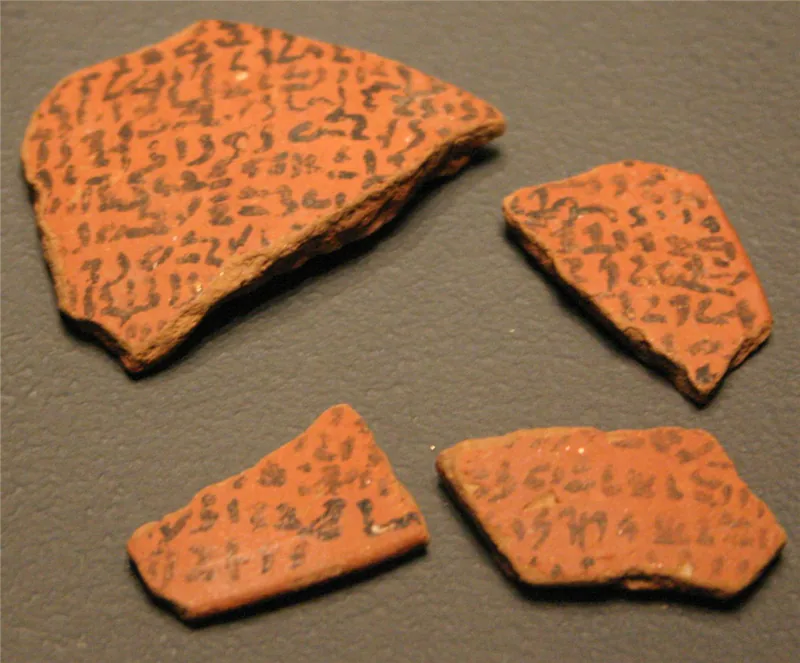
The first large group to be published came from the antiquities market. In 1926 the German Egyptologist Kurt Sethe edited several hundred inscribed fragments of red pottery bowls acquired by the Berlin Museum and said to come from Thebes. The so-called Berlin bowls, generally dated to the Twelfth Dynasty, carry hieratic inscriptions listing rulers of Nubia, of Asiatic city-states in the Levant and of Libyan groups, together with Egyptians and general categories of evil. Sethe recognised that the bowls had been deliberately smashed and that the texts were curses rather than ordinary records.
The Brussels Figurines and the Mirgissa Deposit§
A second major group consists of clay figurines of bound captives from the cemetery of Saqqara, acquired by the Royal Museums in Brussels and published by Georges Posener in 1940. These are usually dated somewhat later than the Berlin bowls, to the late Twelfth or Thirteenth Dynasty. Because they name more places in the Levant, often with more than one ruler per city, historians have used the two groups together to trace changes in the political organisation of Syria-Palestine during the Middle Bronze Age. Among the names are Byblos, Ashkelon and Shechem, and many scholars identify one name as an early reference to Jerusalem, though the reading is debated.
The most dramatic find was made in 1962 at Mirgissa, an Egyptian fortress at the Second Cataract of the Nile in Nubia. Excavators uncovered a deposit containing several hundred inscribed red pots, many uninscribed vessels, mud and limestone figurines, and a flint knife. Nearby lay a human skeleton whose head had been removed and buried separately. Ritner has argued that this was an executed person included in the rite, which would make Mirgissa evidence that execration could occasionally involve a real victim alongside the symbolic ones. Other scholars are more cautious about connecting the burial so directly to the ritual, and the interpretation remains a matter of discussion.
The Formulas: Rebels, Places and Evil Speech§
The texts follow standard formulas. A typical entry names a foreign ruler, his land and his followers, sometimes with his father's or mother's name, and then extends the curse to all his strong men, runners and allies "who may rebel, who may plot, who may fight". Lists of Nubian, Asiatic and Libyan rulers are followed by Egyptian names, apparently of individuals regarded as disloyal or dangerous, some of them already dead and therefore able to harm as spirits.
The lists end with a sweeping catalogue of abstract dangers: every evil word, every evil speech, every evil plot, every evil dream and every evil slumber. This conclusion shows that the rite aimed not only at named enemies but at hostility as such, including the invisible threats of slander and nightmare. The formulas were copied with little change across many objects, which indicates that they came from a standard ritual handbook maintained by temple scribes.
Breaking the Red Pots: Ritual Actions§
The physical actions matter as much as the words. Red was the colour of the desert, of blood and of the god Seth, and therefore of danger and disorder; writing enemies' names on red vessels assimilated them to these forces. Breaking the vessels destroyed them. A ritual called "breaking the red pots" is mentioned in the Pyramid Texts and shown in tomb scenes as part of funerary offerings, where it seems to have protected the deceased and the offerings from hostile powers.
Figurines were treated in a variety of ways described in ritual texts and visible in the objects themselves: binding, piercing, trampling, spitting upon, burning and burial. Burial in a cemetery placed the enemy among the dead and under the authority of the gods of the underworld; deposit at a frontier fortress such as Mirgissa placed the curse at the boundary it was meant to defend. These methods recall the destruction of figurines in Mesopotamian anti-witchcraft rites such as Maqlû and the pierced figures that sometimes accompany Greek and Roman curse tablets, though each tradition had its own aims and assumptions.
Apophis, Seth and the Later Temple Rituals§
In the Late Period and under the Ptolemies, the logic of execration was applied with particular intensity to the cosmic enemy Apophis (Apep), the great serpent who threatened the sun god's barque every night. The best-known source is the Papyrus Bremner-Rhind in the British Museum, written in the late fourth century BCE, which contains a ritual book often called the Book of Overthrowing Apophis. It prescribes that images and names of Apophis be drawn or modelled in wax, spat on, trampled with the left foot, cut with a knife and burned, while hymns and spells are recited.
The same papyrus extends the rite to the enemies of the king and of Egypt, so that the defeat of the cosmic serpent and the defeat of political enemies were enacted together. Similar rituals were directed against Seth, who in the later periods became increasingly identified with foreign invaders and disorder. Temples performed these rites regularly, which shows how central the ritual destruction of enemies remained to Egyptian religion until its final centuries.
Execration and Royal Power§
The execration rites have a counterpart in royal art. From an early date the king was shown smiting bound captives, and the "Nine Bows", a traditional collective term for Egypt's enemies, were depicted on footstools, sandals and throne bases so that the king literally trod them underfoot. Painted figures of bound Nubians and Asiatics on the soles of sandals from the tomb of Tutankhamun are a well-known example. Images of this kind did not merely celebrate victory; like the inscribed pots, they were thought to effect it.
For historians, the execration texts are therefore doubly valuable. They are a primary source for the place names and political structures of Egypt's neighbours in the second millennium BCE, and they reveal how Egyptian magic served the state. The protective side of the same worldview, visible in the amulets worn by ordinary people, was matched by an aggressive side directed outward against everything that threatened ma'at.
Frequently asked questions§
What are Egyptian execration texts?§
They are curses against enemies of Egypt and the king, written on pottery or clay figurines that were then broken, buried or burned. They name foreign rulers, Egyptian rebels and abstract evils, and were part of official religious practice.
What does "breaking the red pots" mean?§
It was an Egyptian ritual in which red pottery vessels were smashed to destroy hostile forces. Red was associated with Seth and danger, and the rite appears in the Pyramid Texts and in funerary scenes as well as in the execration deposits.
Do the execration texts mention Jerusalem?§
Many scholars read one of the place names in the Middle Kingdom execration texts as an early form of the name Jerusalem, which would make it among the earliest references to the city. The identification is widely accepted but not certain.
Who performed execration rituals?§
They were performed by priests and ritual specialists acting for the king and the state. The standard formulas and the large deposits at sites such as Mirgissa show an organised, official practice rather than private sorcery.
Sources and further reading§
- The Mechanics of Ancient Egyptian Magical Practice — Robert K. Ritner, 1993
- Magic in Ancient Egypt — Geraldine Pinch, 1994
- Die Ächtung feindlicher Fürsten, Völker und Dinge auf altägyptischen Tongefässscherben des Mittleren Reiches — Kurt Sethe, 1926
- Princes et pays d'Asie et de Nubie — Georges Posener, 1940
- Egypt, Canaan, and Israel in Ancient Times — Donald B. Redford, 1992
- Ancient Egyptian Magic — Bob Brier, 1980