Liber XXVIII · Solomonic Magic · Chapter VI: Lemegeton
Ars Theurgia-Goetia: The Aerial Spirits of the Lemegeton
The Ars Theurgia-Goetia, second book of the Lemegeton: its 31 aerial spirits of the compass, its debt to Trithemius's Steganographia, and its manuscripts.
The Ars Theurgia-Goetia is the second of the five books of the Lemegeton or Lesser Key of Solomon, a seventeenth-century English compilation. It describes thirty-one chief "aerial spirits", partly good and partly evil, arranged around the points of the compass under four emperors of the East, South, West and North, each with seals and countless subordinate dukes. Most of its names and much of its structure were taken from the Steganographia of the abbot Johannes Trithemius, a work that is now known to be a disguised treatise on secret writing.
Place in the Lemegeton§
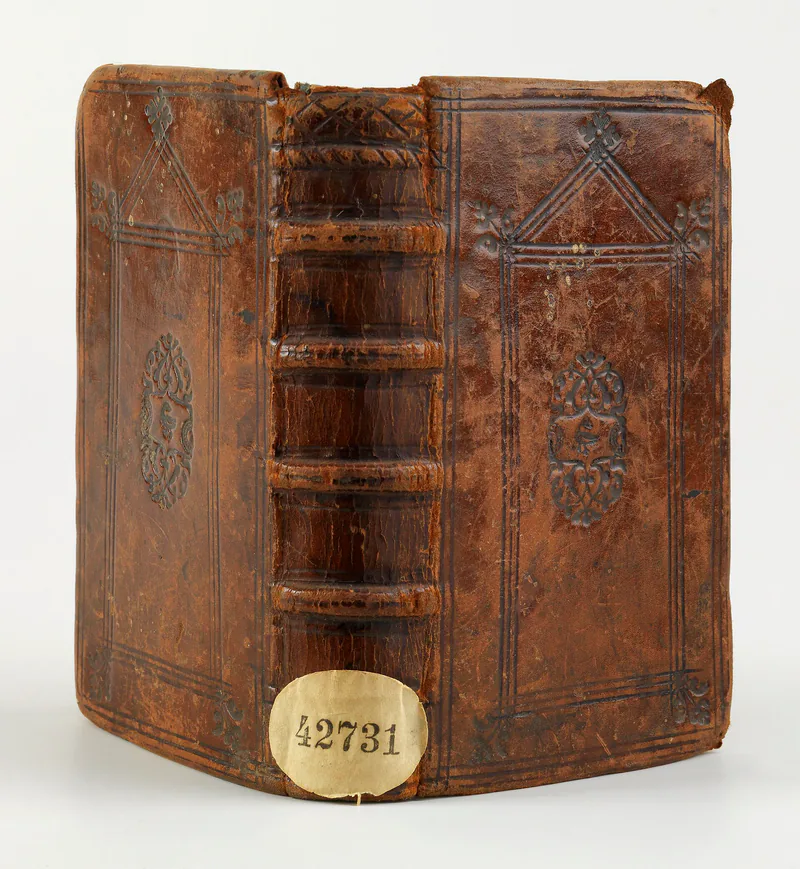
The Lemegeton, discussed in detail in Lesser Key of Solomon (Lemegeton): Its Five Books Explained, is a compilation in English that survives in manuscripts of the later seventeenth century in the British Library, among them Sloane MS 3825 and Sloane MS 2731, the latter dated 1687. Its five parts are the Ars Goetia, the Theurgia-Goetia, the Ars Paulina, the Ars Almadel and the Ars Notoria.
The order of the books follows a rough ascent. The first, the Ars Goetia, deals with seventy-two spirits presented as fallen and evil. The second, the Theurgia-Goetia, deals with spirits of the air who are of mixed nature. The third and fourth, described in Ars Paulina and Ars Almadel, concern angels of the hours, the zodiac and the "altitudes". The fifth, the Ars Notoria, is a medieval art of acquiring knowledge through prayer. The Theurgia-Goetia thus sits between the demonic and the angelic, which is exactly what its name says.
Meaning of the Name: Between Theurgy and Goetia§
"Theurgy" and "goetia" are Greek words with a long history of opposition. In late antique Neoplatonism, theurgy (theourgia, "divine work") was the ritual elevation of the soul toward the gods, defended by philosophers such as Iamblichus, while goēteia meant low sorcery, the work of the goēs or wailing enchanter. Christian writers adopted the contrast, and Renaissance magicians used it to distinguish lawful dealings with angels from unlawful dealings with demons; the background is set out in Neoplatonism and Theurgy.
The compiler of the Lemegeton fused the two words. The introduction to the second book explains that the spirits it describes are not all of one kind: some are good and some evil, and they dwell in the air rather than in hell. The combined title is a frank admission that the work occupies a grey zone between angel magic and demonic magic, a grey zone that theologians had always considered dangerous because it allowed demons to pass as angels.
The Thirty-One Spirits of the Compass§
The organising idea of the Theurgia-Goetia is geographical. The horizon is divided like a mariner's compass, and several manuscripts include a compass-rose figure showing the quarter in which each spirit rules.
The four emperors§
At the four cardinal points stand four emperors: Carnesiel in the East, Caspiel in the South, Amenadiel in the West and Demoriel in the North. Each is said to command enormous numbers of dukes and ministering spirits, given in figures so large that they serve mainly to suggest the unimaginable size of the invisible world.
The sixteen dukes§
Between and beside the emperors are sixteen spirits assigned to the intermediate points: Pamersiel, Padiel, Camuel, Aseliel, Barmiel, Gediel, Asyriel, Maseriel, Malgaras, Dorochiel, Usiel, Cabariel, Raysiel, Symiel, Armadiel and Baruchas. Each has his own subordinate dukes, often divided into those who serve by day and those who serve by night, and each is said to be good, evil or mixed in character.
The eleven wandering princes§
Finally, eleven spirits — Geradiel, Buriel, Hydriel, Pirichiel, Emoniel, Icosiel, Soleviel, Menadiel, Macariel, Uriel and Bidiel — are said to have no fixed place but to wander through the air with their companies. Their inclusion completes the number thirty-one.
Each spirit is given a seal, a distinctive figure of lines and loops. The book also describes in general terms how the spirits were believed to appear, often in a crystal stone or glass receptacle, and supplies a conjuration in which the name of the desired spirit is inserted. It shares with the rest of the Lemegeton the assumption that spirits answer to angelic and divine names. As with the other demonic sections of the grimoires, this article describes the work historically and does not reproduce its operative formulas; the four directional rulers are compared with other systems in The Kings of the Four Directions.
The Source: Trithemius's Steganographia§
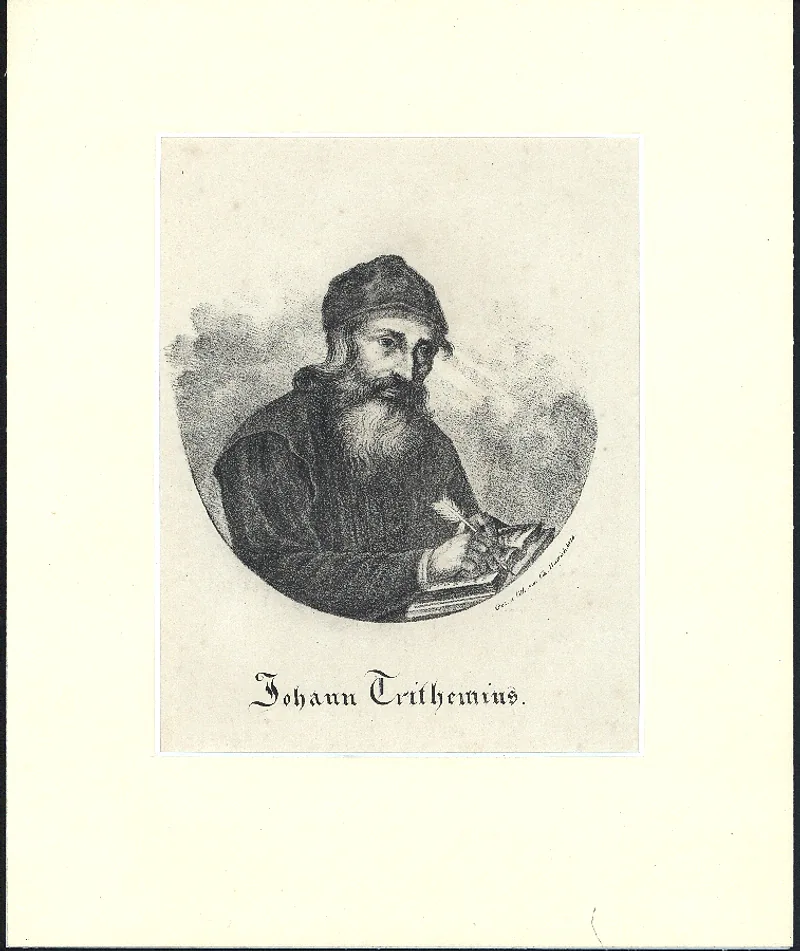
The names of the Theurgia-Goetia did not originate in the seventeenth century. They come from the Steganographia of Johannes Trithemius (1462–1516), the learned Benedictine abbot of Sponheim, which he began around 1499. Trithemius described the project in a letter to the Carmelite Arnold Bostius, claiming that he could send messages over great distances with the help of spirits. When the letter became known after Bostius's death, and when the French scholar Charles de Bovelles saw part of the manuscript in 1504, Trithemius was accused of demon magic. His own catalogue of condemned books, discussed in Antipalus Maleficiorum, shows how sensitive he was to that charge.
The Steganographia circulated in manuscript for a century and was printed only in 1606 at Frankfurt; it was soon placed on the Index of Prohibited Books. Its first book presents a series of spirits — Pamersiel, Padiel, Camuel, Aseliel and the rest, under emperors such as Carnesiel and Caspiel — each with a conjuration made of strange words. The compiler of the Theurgia-Goetia took over these names, added seals and fuller descriptions, and recast them as aerial spirits to be called by a magician.
A Code Book Read as a Grimoire§
The irony of this borrowing became clear only in modern times. Already in 1676 the German scholar Wolfgang Ernst Heidel argued that the Steganographia's first books were cryptographic. In the 1990s the Germanist Thomas Ernst and the mathematician Jim Reeds independently showed that the work is indeed a treatise on secret writing. The apparently meaningless "conjurations" are cipher texts that hide ordinary sentences, recoverable by selecting letters according to simple rules, and Reeds went on to decipher the numerical tables of the supposedly unfinished third book.
Scholars still debate how far Trithemius himself mixed cryptography with genuine spiritual magic. He was deeply interested in angelology and in the secrets of names, and the spirit framework may have been more than a disguise for him. What is clear is that the seventeenth-century compiler of the Lemegeton read the spirit language literally. The Theurgia-Goetia therefore offers a striking example of how a text can change genre in transmission: a manual for encoding messages became, in English manuscripts, a catalogue of the powers of the air.
The catalogue entry on the Steganographia gives details of its editions, and the Theurgia-Goetia is catalogued separately.
Reception and Modern Editions§
The Theurgia-Goetia never achieved the fame of the first book of the Lemegeton. When S. L. MacGregor Mathers and Aleister Crowley published The Goetia in 1904, they printed only the seventy-two spirits, and for most of the twentieth century the second book was known chiefly to readers of the British Library manuscripts. Complete editions of the Lemegeton, above all Joseph H. Peterson's The Lesser Key of Solomon (2001), made it widely available, with its seals and its compass diagram, and Stephen Skinner and David Rankine discussed related material in The Goetia of Dr Rudd (2007).
Since then the Theurgia-Goetia has attracted attention both from historians, who value it as evidence for the reworking of Renaissance learned magic in seventeenth-century England, and from modern practitioners of ceremonial magic, who often prefer its mixed spirits to the explicitly infernal ones of the Goetia. Its history is part of the wider rediscovery described in The Grimoire Revival.
Frequently asked questions§
What is the Ars Theurgia-Goetia?§
It is the second book of the Lemegeton or Lesser Key of Solomon. It describes thirty-one aerial spirits, good and evil, arranged by the points of the compass under four emperors, with their seals and subordinate spirits.
Who are the four emperors of the Theurgia-Goetia?§
Carnesiel rules the East, Caspiel the South, Amenadiel the West and Demoriel the North. Below them are sixteen dukes of the intermediate points and eleven wandering princes.
Where do the spirits of the Theurgia-Goetia come from?§
Almost all their names come from the first book of Johannes Trithemius's Steganographia, written around 1500 and printed in 1606. The seventeenth-century compiler of the Lemegeton added seals and descriptions and presented the spirits as beings to be called.
Is the Steganographia really about spirits?§
Modern research by Thomas Ernst and Jim Reeds has shown that it is largely a work of cryptography, in which the spirit conjurations conceal coded messages. How far Trithemius also believed in the spirits he named remains debated.
Sources and further reading§
- The Lesser Key of Solomon — Joseph H. Peterson, 2001
- Steganographia — Johannes Trithemius, 1606
- Trithemius and Magical Theology: A Chapter in the Controversy over Occult Studies in Early Modern Europe — Noel L. Brann, 1999
- The Goetia of Dr Rudd — Stephen Skinner and David Rankine, 2007
- Grimoires: A History of Magic Books — Owen Davies, 2009
- The Goetia: The Lesser Key of Solomon the King — S. L. MacGregor Mathers and Aleister Crowley, 1904