Liber XXVIII · Solomonic Magic · Chapter III: Goetic Spirits
The Four Kings of the Directions: Amaymon, Paymon, Oriens, Egyn
The demon kings of the four directions in the grimoires: Amaymon, Corson, Ziminiar and Gaap, Agrippa's Oriens, Paymon and Egyn, their sources and meaning.

The kings of the four directions are the four great demon rulers whom the grimoires place over the East, South, West and North, with the lesser spirits of hell arranged beneath them. Their names vary from source to source: Johann Weyer and the Goetia name Amaymon, Corson, Ziminiar and Gaap (or Goap), while Agrippa and many manuscripts name Oriens, Paymon, Amaymon and Egyn. Behind them lies a very old idea — that the world has four quarters, each with its own ruling powers, good or evil.
A Geography of Hell§
Medieval and early modern demonology imagined the invisible world as a kingdom, with ranks of kings, dukes, marquises and presidents modelled on earthly courts. It also gave that kingdom a map. Just as the angels were assigned to the quarters of heaven and the winds, the fallen spirits were distributed over the four parts of the world, each part governed by a king. The idea gave magicians a way of locating spirits — of knowing where a spirit "lived" and in which direction to face — and it gave demonologists a framework for the vast numbers of demons their sources described.
The four kings rarely appear as fully developed characters. They are named, assigned a direction and placed above other spirits, and much of their importance lies in the hierarchy they complete. The broader development of such hierarchies is described in Demonology: A Complete Guide.
Ancient Roots: Four Winds and Four Quarters§
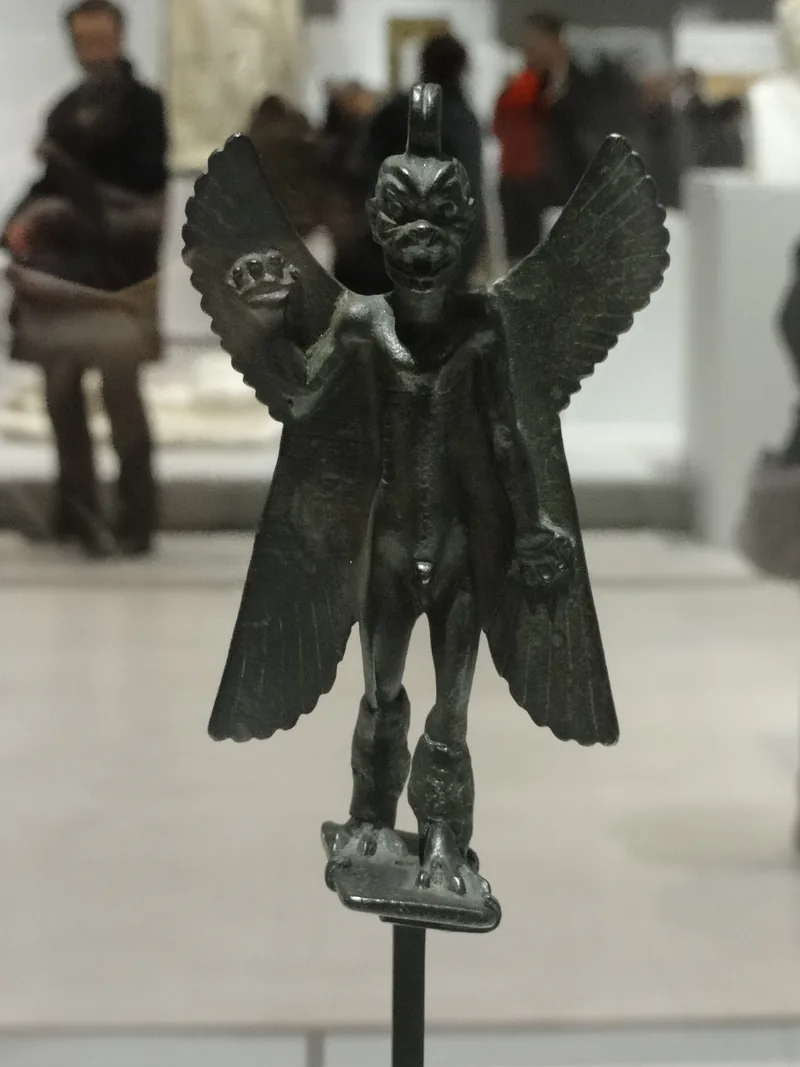
The division of the world into four quarters is ancient. Mesopotamian kings styled themselves "king of the four quarters", and the four winds were personified as powers that could bring health or harm; the demon Pazuzu, described in Lamashtu and Pazuzu, was lord of the wind-demons. In the Hebrew Bible the "four winds of heaven" appear in prophetic visions, and the four living creatures of Ezekiel face in four directions.
Jewish tradition assigned four archangels to the quarters around the divine throne and around the faithful. A familiar bedtime prayer places Michael on the right, Gabriel on the left, Uriel before and Raphael behind. Christian magic inherited this pattern, and it survives today in the archangels called to the quarters in the Golden Dawn's Lesser Banishing Ritual of the Pentagram. The kings of the four directions are the shadow of this angelic arrangement: a demonic counterpart to the guardians of the quarters.
Agrippa's Four Kings and Their Hebrew Names§
The most influential learned statement came from Heinrich Cornelius Agrippa's Three Books of Occult Philosophy (1533). In the third book, chapter 24, Agrippa explains that as good spirits are set over the four parts of the world, so among evil spirits four most powerful kings rule the four quarters: Urieus over the East, Amaymon over the South, Paymon over the West and Egin over the North. He adds that the Hebrew doctors perhaps name them more correctly as Samael, Azazel, Azael and Mahazael. In the scale of the number four in the second book, he lists "four princes of spirits" over the four angles of the world as Oriens, Paymon, Egyn and Amaymon.
The Hebrew equivalents connect the kings with older Jewish demonology. Samael is the angel of death and adversary of rabbinic and kabbalistic literature; Azazel is the scapegoat figure of Leviticus 16 and a leader of the fallen Watchers in the Book of Enoch; Azael is closely related to him; Mahazael is more obscure. Agrippa's passage, which can be read in the English translation of 1651 in the Three Books of Occult Philosophy, made the four kings standard furniture of Renaissance learned magic, discussed further in Agrippa's Three Books of Occult Philosophy.
Oriens, Paymon, Amaymon and Egyn in the Manuscripts§
Agrippa did not invent these names. The quartet of Oriens, Paymon, Amaymon and Egyn (also spelled Egin or Egyn) appears in late medieval and early modern manuscripts of ritual magic, where the four kings stand at the head of the spirits to be called. Elizabethan English collections such as the Book of Oberon include them, and they recur in Continental manuscripts with varying spellings and directions. The name Oriens simply means "rising" or "the East" in Latin, which suggests that at least one of the four began as a personification of a direction.
The same names surface in a different context in The Book of the Sacred Magic of Abramelin the Mage, translated by S. L. MacGregor Mathers in 1898 from an eighteenth-century French manuscript. There Oriens, Paimon, Ariton and Amaimon appear among the eight sub-princes under the four superior spirits Lucifer, Leviathan, Satan and Belial; Ariton is usually understood as a form of Egyn. In the Abramelin system these powers are to be subdued only after the aspirant has attained the knowledge and conversation of the guardian angel, as explained in The Holy Guardian Angel.
Weyer and the Goetia: Amaymon, Corson, Ziminiar and Gaap§
A second set of names comes through Johann Weyer's Pseudomonarchia Daemonum (1577), described in its own article on the Pseudomonarchia Daemonum. Weyer's catalogue repeatedly places spirits "under the power of Amaymon", and it calls the spirit Gaap the guide of the four principal kings. Reginald Scot's English version in The Discoverie of Witchcraft (1584) adds a passage that names the four as Amaymon, king of the East; Corson, king of the South; Zimimar, king of the North; and Goap, king and prince of the West, and states the hours at which they were believed to be most easily constrained.
The seventeenth-century Ars Goetia, drawing on Weyer and Scot, keeps the same four names — Amaymon, Corson, Ziminiar and Gaap or Goap — but in Mathers' edition the directions are rearranged, with Corson in the West and Goap in the South. The four kings are not themselves among the seventy-two spirits of the catalogue, although Gaap, under that name, is the thirty-third. The text treats them as greater powers above the catalogue, to be dealt with only in matters of great importance. The relation between the two lists is discussed in Ars Goetia: The 72 Spirits.
The two traditions therefore share only Amaymon, who is the East in one and the South in the other. Such inconsistencies are typical of the grimoires, which were copied and recombined by many hands, and they warn against treating any single list as the authentic "original".
Other Directional Rulers: Emperors, Kings of the Air and Jinn§
Directional rulers appear in other magical systems as well. The Heptameron attributed to Peter of Abano assigns to each day of the week a king of the "angels of the air" with his ministers and the wind under which they serve; Sunday's king is Varcan, under the north wind. The Ars Theurgia-Goetia, the second book of the Lemegeton, places four emperors — Carnesiel, Caspiel, Amenadiel and Demoriel — at the cardinal points of a compass of aerial spirits, as described in Ars Theurgia-Goetia. John Dee's angelic Great Table, the basis of Enochian magic, is likewise divided into four quarters, each governed by a king and seniors.
In the Islamic occult sciences, seven kings of the jinn rule the days of the week; in many lists Maymun is the king of Saturday. Some historians have suggested a connection between Maymun and the European Amaymon, though the route of borrowing, if any, remains uncertain. The comparison illustrates how widely the notion of spirit-kings tied to time and space was shared across the medieval Mediterranean, a theme treated in Jinn and the Unseen in Islam.
Amaymon in Literature and the Meaning of the Scheme§
The four kings were familiar enough in Elizabethan England to be mentioned on the stage. In Shakespeare's The Merry Wives of Windsor, the jealous Ford lists "Amaimon" with Lucifer and Barbason as names of devils, and in Henry IV, Part 1 Falstaff jokes about the Welshman Glendower who "gave Amaimon the bastinado". The audience was expected to recognise the name as a famous demon.
For historians, the four kings show how demonology borrowed the forms of cosmology and politics. A world ordered by quarters, winds and planets could be governed by angels or misgoverned by demons, and the magician who knew the hierarchy believed he could appeal from lesser spirits to greater ones and, above all, to the divine names that ruled them all. Theologians condemned this whole enterprise, as described in How Theologians and Inquisitors Judged Demonic Magic; this article presents the kings as figures in the history of ideas, not as beings to be contacted.
Frequently asked questions§
Who are the four kings of the directions in the Goetia?§
The Ars Goetia names Amaymon, Corson, Ziminiar and Gaap (or Goap). In Mathers' edition Amaymon rules the East, Corson the West, Ziminiar the North and Goap the South, though Scot's earlier text assigns Corson to the South and Goap to the West.
Who are Oriens, Paymon, Amaymon and Egyn?§
They are a second set of four demon kings of the quarters found in Agrippa and in many magical manuscripts. Agrippa assigns Oriens (Urieus) to the East, Amaymon to the South, Paymon to the West and Egyn to the North, and gives Samael, Azazel, Azael and Mahazael as their Hebrew names.
Is Amaymon king of the East or the South?§
Both, depending on the source. Weyer, Scot and the Goetia make him king of the East, while Agrippa and related manuscripts make him king of the South. The grimoires were never consistent on this point.
Sources and further reading§
- Three Books of Occult Philosophy — Heinrich Cornelius Agrippa, 1533
- The Discoverie of Witchcraft — Reginald Scot, 1584
- The Goetia: The Lesser Key of Solomon the King — S. L. MacGregor Mathers and Aleister Crowley, 1904
- The Book of the Sacred Magic of Abramelin the Mage — S. L. MacGregor Mathers, 1898
- The Book of Oberon: A Sourcebook for Elizabethan Magic — Daniel Harms, James R. Clark and Joseph H. Peterson, 2015
- Forbidden Rites: A Necromancer's Manual of the Fifteenth Century — Richard Kieckhefer, 1997
- Grimoires: A History of Magic Books — Owen Davies, 2009