Liber XXVIII · Solomonic Magic · Chapter VIII: The Ring & Seal
The Seal of Solomon in Islamic Magic: Khatam Sulayman
The Seal of Solomon (khatam Sulayman) in Islamic magic: the ring legend, hexagram and pentagram, the seven signs, amulets, bowls, coins and Morocco's flag.

In the Islamic world the Seal of Solomon — khātam Sulaymān, "the ring" or "seal of Sulayman" — is the signet with which the prophet-king was believed to command the jinn, and its image, usually a six- or five-pointed star, became one of the most widespread protective signs from Morocco to India. It appears on amulets, healing bowls, talismanic shirts, seal rings, coins, buildings and even a national flag, and in learned occult manuals it heads a sequence of seven mysterious signs associated with the Greatest Name of God.
The Ring of Sulayman as a Model of Power§
The Qur'an presents Sulayman as a prophet to whom God gave a kingdom unlike any other, with power over the wind and the jinn, who built for him "whatever he wished" (Qur'an 34:12–13). It does not mention a ring. The ring belongs to the commentaries and to the "stories of the prophets" (qiṣaṣ al-anbiyāʾ), which explain a cryptic verse about a body placed on Sulayman's throne (38:34) through the tale of a jinni who stole the ring and ruled in the king's place until it was recovered from the belly of a fish. These narratives, told more fully in Sulayman in Islam, make the ring the very instrument of Sulayman's sovereignty.
Commentators disagreed about what was engraved on it. Many accounts say it bore the Greatest Name of God (al-ism al-aʿẓam), the hidden name whose utterance commands all creation; others give a confession of faith. Either way, the ring's power was understood to derive from God's name and not from the metal or the stone. This theological framing is important for everything that follows: Muslim amulet-makers who drew the seal understood themselves to be invoking divine authority over the jinn, the theme of Jinn and the Unseen in Islam, rather than practising sorcery.
Hexagram, Pentagram and the Meaning of Khatam§
The Arabic word khātam (also khātim) means a signet ring and, by extension, the impression it makes. When medieval writers and craftsmen spoke of the seal of Sulayman, they could mean the ring, its inscription or a geometric sign believed to represent it. In practice the sign was most often a hexagram of two interlaced triangles, but pentagrams appear frequently as well, sometimes on the same object. Unlike modern usage, which tends to assign the hexagram to Judaism and the pentagram to Western occultism, medieval Islamic culture used both as forms of one seal. The general history of the symbol is traced in Seal of Solomon: The Ring, Its Legends and Its Symbol.
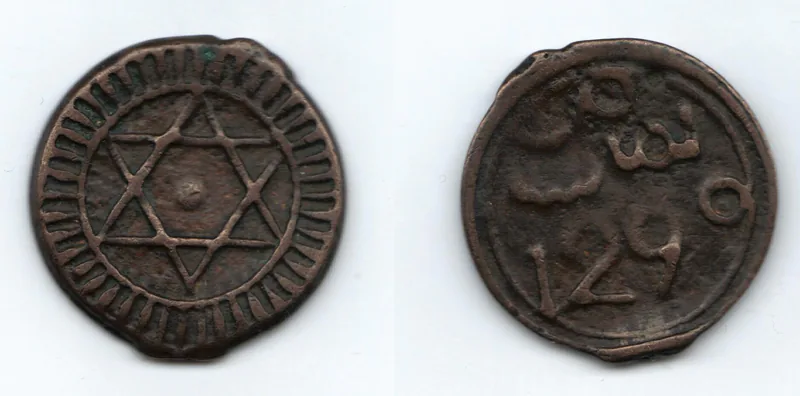
The geometric star had many layers of meaning. It was a decorative motif in a civilisation that delighted in geometry; it was a sign of completeness and of the union of opposites; and it was a seal in the literal sense, closing off a space or object against intrusion. A sealed bottle, a sealed letter and a sealed house were all protected in the same way, which is why the image of jinn imprisoned in flasks stoppered with Sulayman's seal, familiar from the Thousand and One Nights, fitted so naturally into popular belief.
The Seven Signs and the Greatest Name§
In the learned occult sciences the seal of Sulayman took a more technical form. Manuals of the science of letters (ʿilm al-ḥurūf), above all those circulating under the name of the thirteenth-century Sufi Ahmad al-Buni, describe a sequence of seven signs (al-khawātim al-sabʿa or simply "the seven seals"). The first is usually a pentagram or hexagram, the seal proper. It is followed by three vertical strokes under a horizontal line, a letter mīm, a ladder-like figure, four upright strokes, the letter hāʾ and an inverted wāw. A short riddling poem, often attributed to ʿAli ibn Abi Talib, describes the signs and was copied in many manuscripts.
The signs were understood as a representation of the Greatest Name, or as the seals of the angels and jinn of the seven days. They were written on amulets, engraved on rings and incorporated into larger talismanic compositions alongside magic squares (awfāq), Qur'anic verses and divine names. The German orientalist Hans Alexander Winkler devoted a classic study, Siegel und Charaktere in der muhammedanischen Zauberei (1930), to these signs, showing that several resemble the "ring letters" — characters ending in small circles — found in Greek, Jewish and Christian magic of late antiquity. The seal thus links Islamic magic to the wider Mediterranean tradition of charaktêres discussed in Al-Buni and the Shams al-Ma'arif.
Bowls, Shirts and Amulets§
The seal is abundantly attested in material culture, and museum collections now preserve thousands of examples.
Magic-medicinal bowls§
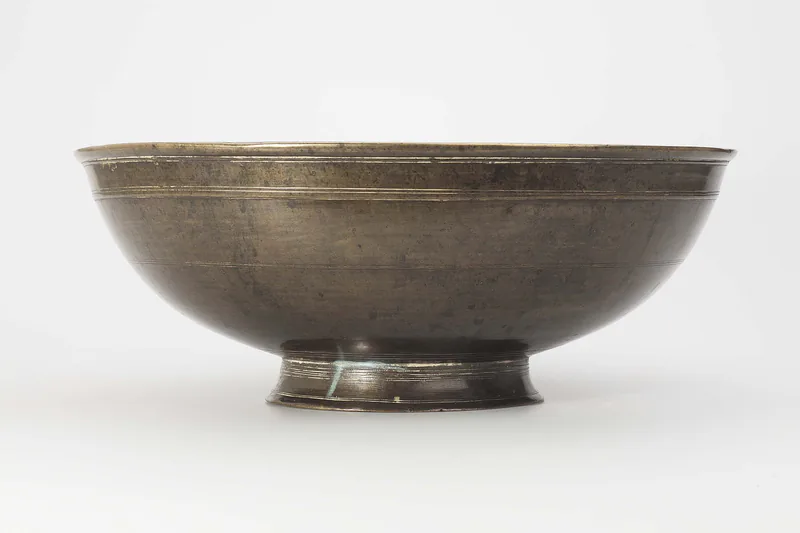
From at least the twelfth century, metal "magic-medicinal" bowls were made in Syria, Iraq and later Iran and the Arabian Peninsula. Their surfaces carry Qur'anic verses, lists of afflictions such as snakebite, scorpion sting and difficult childbirth, zodiacal images, magic squares and often the seal. Water poured into the bowl and drunk by the sufferer was believed to carry the blessing of the inscriptions. One of the best-known early examples bears the name of the Zengid ruler Nur al-Din (d. 1174).
Talismanic shirts and armour§
In the Ottoman, Safavid and Mughal worlds, shirts were painted or inscribed with the whole Qur'an or chosen chapters, divine names, squares and seals, and worn under armour or in times of illness. Helmets, banners and sword blades also carried protective inscriptions, and the six-pointed star appears among them.
Personal amulets and seal rings§
Small amulets of paper in metal cases, engraved stones and rings with the seal were worn for protection against the evil eye, jinn and disease. Collections such as the British Museum's, catalogued by Venetia Porter, show the seal side by side with ordinary personal seals, prayers and names. These objects are part of the wider history in Amulets and Talismans; like all protective magic, they expressed hope and piety and were never a substitute for medical care.
The Seal on Coins, Buildings and Flags§
The six-pointed star also became a public emblem. It appears in the geometric ornament of mosques, madrasas and tombs from Anatolia to India; Humayun's Tomb in Delhi, completed in the 1570s, displays large hexagrams in its façades. In the Islamic context such stars carried no Jewish connotation; they were seals of Sulayman and signs of cosmic order.
In Morocco the hexagram appeared on coins of the Alaouite sultans into the early twentieth century, and it is still a common motif in Moroccan crafts. In 1915 Sultan Yusuf added a green interlaced pentagram to the plain red flag of Morocco; Moroccans commonly call this star the seal of Sulayman, though official explanations today often relate its five points to the five pillars of Islam. In colonial Nigeria the British badge of the protectorate was a green six-pointed star enclosing a crown, commonly described as Solomon's seal, a sign already familiar from the amulets and crafts of the Muslim north.
Debates on Legitimacy§
Muslim scholars never agreed about amulets. A well-known hadith condemns the hanging of tamāʾim (amulets), and some jurists concluded that all amulets were forbidden as a form of reliance on something other than God. Others distinguished between amulets containing only the Qur'an, divine names and recognised prayers, which they allowed, and those containing unknown words, signs or the names of jinn, which they rejected. The seven signs, whose meaning was obscure, were particularly vulnerable to this criticism.
Reformist movements of the eighteenth to twentieth centuries took a stricter line, condemning much traditional talismanic practice as superstition or idolatry. In many communities, however, the seal of Sulayman continued to be drawn by religious specialists, and it remains a living part of popular piety in North and West Africa, the Middle East and South Asia. Modern scholarship, gathered in collections such as Islamicate Occult Sciences in Theory and Practice (2021), treats these practices as a serious part of Islamic intellectual and religious history rather than a marginal survival, as described in Islamic Occult Sciences: A History.
Frequently asked questions§
What is the khatam Sulayman?§
It is the "seal" or "ring" of Sulayman (Solomon), which Islamic tradition says enabled him to command the jinn. As an image it is usually drawn as a six- or five-pointed star and used on amulets and protective objects.
Is the Seal of Solomon in Islam a hexagram or a pentagram?§
Both forms were used, and medieval Muslims did not sharply distinguish them. The hexagram is more common in art and on coins, while Morocco's flag carries an interlaced pentagram that is popularly called the seal of Sulayman.
What are the seven seals of Solomon in Islamic magic?§
They are a sequence of seven signs found in occult manuals of the al-Buni tradition: a star-shaped seal, three strokes under a line, the letter mīm, a ladder-like sign, four strokes, the letter hāʾ and an inverted wāw. They were believed to represent the Greatest Name of God and were used in amulets.
Do Muslim scholars approve of the Seal of Solomon as an amulet?§
Opinions differ. Some scholars permit amulets containing only Qur'anic verses and divine names, while others forbid all amulets; signs of unknown meaning such as the seven seals were often criticised. Practice varies widely between regions and communities.
Sources and further reading§
- Siegel und Charaktere in der muhammedanischen Zauberei — Hans Alexander Winkler, 1930
- Arabic and Persian Seals and Amulets in the British Museum — Venetia Porter, 2011
- Science, Tools & Magic — Francis Maddison and Emilie Savage-Smith, 1997
- Power and Protection: Islamic Art and the Supernatural — Francesca Leoni, 2016
- Islamicate Occult Sciences in Theory and Practice — Liana Saif, Francesca Leoni, Matthew Melvin-Koushki and Farouk Yahya (eds.), 2021
- Magic and Divination in Early Islam — Emilie Savage-Smith (ed.), 2004
- An Account of the Manners and Customs of the Modern Egyptians — Edward William Lane, 1836