Liber XXIII · Rastafari · Chapter VI: Origins: Garvey & Ethiopianism
Origins of Rastafari: Garvey, Ethiopianism and the First Rastas
The origins of Rastafari: Afro-Jamaican Revival, Ethiopianism, Marcus Garvey and the UNIA, the Holy Piby, and Leonard Howell and the first Rasta preachers.

Rastafari emerged in Jamaica in the early 1930s from three older currents: the Afro-Christian Revival religion of the island's poor, the Ethiopianism that read biblical "Ethiopia" as a name for Black Africa and its coming redemption, and the pan-African movement of Marcus Garvey. When Ras Tafari Makonnen was crowned Emperor Haile Selassie I in November 1930, a handful of Jamaican street preachers, above all Leonard Howell, joined these currents into a new faith centred on the Ethiopian king.
This article expands on the overview of Rastafari; the emperor himself is treated in Haile Selassie I in Rastafari.
Slavery, Revival and Afro-Jamaican Religion§
Jamaica was an English, later British, colony from 1655, and for nearly two centuries its sugar economy depended on enslaved Africans. Under slavery, Africans and their descendants built religious forms of their own. Myal, a healing and spirit-possession tradition, set itself against harmful sorcery, and Black preachers reworked the Baptist missions into a "Native Baptist" religion of dreams, possession and prophecy. The Baptist deacon Samuel Sharpe led the great slave rising of 1831–32, and slavery ended in stages between 1834 and 1838.
After emancipation the island's poor kept these traditions alive. The Great Revival of 1860–61 produced the Revival religion, divided into Zion Revival and Pukumina (Pocomania), with its spirit-filled services, healing tables and prophets. In 1865 the Morant Bay Rebellion, led by the Native Baptist deacon Paul Bogle, was crushed with great brutality. Religion, land and justice were bound together in the memory of the poor, a pattern shared with other African diasporic religions.
The most famous Revival prophet was Alexander Bedward, leader of the Jamaica Native Baptist Free Church at August Town near Kingston. Tried for sedition in 1895, he announced that he would ascend to heaven at the end of 1920; after a march on Kingston in 1921 he was committed to an asylum, where he died in 1930, the year of Haile Selassie's coronation. The anthropologist Barry Chevannes showed how many early Rastas, including Robert Hinds, came from Bedwardism and Revival, and how Rastafari inherited from them the prophet-preacher, the open-air meeting and a reading of the Bible as a story of Black suffering and deliverance.
Ethiopianism and the Biblical Africa§
In the King James Bible, "Ethiopia" often renders the Hebrew Kush, the land south of Egypt. For Black Christians in the eighteenth and nineteenth centuries, it was the one name in Scripture that clearly meant Africa. One verse, Psalm 68:31, became a prophecy of their future:
Princes shall come out of Egypt; Ethiopia shall soon stretch out her hands unto God.
The movement scholars call Ethiopianism read this verse as a promise that Africa and its scattered children would rise again. It gave its name to independent "Ethiopian" churches founded by Africans who left white-led missions, especially in South Africa from the 1890s. In Jamaica the link was early: George Liele, a formerly enslaved Baptist preacher from Georgia who arrived in Kingston in 1783, is said to have called his congregation the Ethiopian Baptist Church.
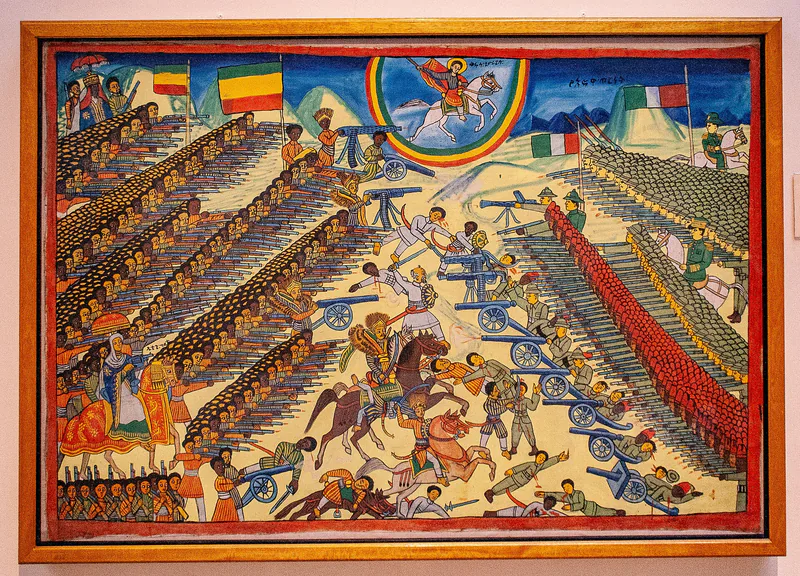
Ethiopia was also a real kingdom with an ancient Christian church, its own scripture in the Ge'ez language and a royal line that claimed descent from Solomon and the Queen of Sheba through the Kebra Nagast. When the army of Emperor Menelik II defeated Italy at Adwa on 1 March 1896, Ethiopia became, with Liberia, the only African state to remain independent through the European scramble for the continent. Pan-African writers such as Edward Wilmot Blyden made Ethiopia a byword for African dignity.
Marcus Garvey and the UNIA§
Marcus Mosiah Garvey was born at St Ann's Bay, Jamaica, on 17 August 1887. A printer and journalist who had worked in Central America and London, he founded the Universal Negro Improvement Association (UNIA) in Kingston in 1914. In 1916 he moved to New York, where the UNIA grew into the largest mass movement of people of African descent in modern history, with branches across the Americas, the Caribbean and Africa.
Programme and symbols§
Garvey preached race pride, self-reliance and "Africa for the Africans". His newspaper, the Negro World (from 1918), carried his message across the Atlantic; the Black Star Line (1919) was a shipping company meant to link the African world in trade and, eventually, to carry settlers to Africa. At the UNIA convention of 1920 in New York, delegates adopted a Declaration of Rights of the Negro Peoples of the World and a red, black and green flag. They also adopted the "Universal Ethiopian Anthem", by Benjamin Burrell and Arnold Ford, which addresses Ethiopia as the land of the fathers. Garvey encouraged his followers to imagine God and Christ as Black, and the UNIA's chaplain-general, George Alexander McGuire, founded the African Orthodox Church in 1921.
Fall and return to Jamaica§
Convicted of mail fraud over the Black Star Line in 1923, Garvey was imprisoned in 1925 and deported to Jamaica in 1927. He founded the People's Political Party there in 1929, then left for London in 1935 and died there in June 1940. His remains were returned to Jamaica in 1964, and he was proclaimed the island's first National Hero.
Garvey and the Rastafari§
Garvey never became a Rastafarian. He was a Christian, and when Italy invaded Ethiopia in 1935–36 he criticised Haile Selassie sharply in his London magazine The Black Man for leaving his country and for failing to prepare it. Yet the early Rastas were steeped in Garveyism, and most Rastafari honour him as a prophet, in some traditions as a forerunner like John the Baptist. A saying often attributed to him, that his hearers should "look to Africa" for the crowning of a Black king as the sign of deliverance, is central to Rastafari memory; historians have not found it in this form in his published speeches or writings, and it is best treated as oral tradition.
Texts Before Rastafari: The Holy Piby and Its Successors§
Several 1920s texts fed directly into Rastafari. The Holy Piby, compiled by Robert Athlyi Rogers, an Anguillan preacher, and published in Newark, New Jersey, in 1924, is a scripture for his Afro-Athlican Constructive Church. Often called "the Black man's Bible", it presents Garvey as an apostle and calls Ethiopians, meaning Africans, to unity. A related work, The Royal Parchment Scroll of Black Supremacy, by the Jamaican preacher Fitz Balintine Pettersburg, appeared around 1926.
Leonard Howell's own pamphlet, The Promised Key, published around 1935 under the pen name G. G. Maragh, borrows heavily from both works, as the historian Robert A. Hill has shown. E. A. Wallis Budge's English translation of the Kebra Nagast (1922) made the Solomonic legend of the Ethiopian kings available to Jamaican readers.
The First Rasta Preachers, 1930–1940§
The coronation of 2 November 1930 at St George's Cathedral, Addis Ababa, was covered widely in the press, including in Jamaica. Over the next few years at least four men, working apart from each other, began to preach that Haile Selassie was the returned Messiah or God himself.
- Leonard Percival Howell (1898–1981), from the parish of Clarendon, had lived in New York during the Garvey years and returned to Jamaica in 1932. He began preaching in Kingston and then in St Thomas, reportedly selling photographs of the emperor to followers as tokens of allegiance. In 1934 he and Robert Hinds were tried for sedition for urging loyalty to Haile Selassie rather than the British king, and Howell was sentenced to two years in prison.
- Joseph Nathaniel Hibbert had spent years in Costa Rica, where he belonged to a fraternal "Ancient Mystic Order of Ethiopia", and returned to Jamaica in 1931.
- Archibald Dunkley, a seaman, said he had studied the Bible for two years before concluding that Haile Selassie was the Messiah; he founded the King of Kings Mission.
- Robert Hinds, a former follower of Bedward, became Howell's deputy and later led his own group.
The 1930s were a decade of depression and unrest in Jamaica, ending in the labour rebellion of 1938, and the Italian invasion of Ethiopia in 1935 roused anger across the Black world. The Ethiopian World Federation, founded in New York in 1937 to rally support for Ethiopia, soon had a branch in Jamaica. In 1940 Howell founded the commune of Pinnacle in St Catherine, the movement's first home until police broke it up in 1954.
How Scholars Explain the Origins of Rastafari§
Early studies, such as the 1960 report by M. G. Smith, Roy Augier and Rex Nettleford, saw Rastafari as a response to poverty, racism and the closed doors of colonial society. Leonard Barrett placed it in a longer history of Jamaican messianic movements, and Horace Campbell, in Rasta and Resistance, read it as part of the political struggle against slavery and colonialism.
Barry Chevannes stressed continuity with the island's own religion: Rastafari, in his view, kept much of the worldview of Revival while rejecting spirit possession and recentring its Christianity on an Ethiopian king. Robert A. Hill, in Dread History, emphasised Howell's millenarian vision and the Black press that carried news of Ethiopia, and Hélène Lee's biography brought Howell back into public memory. Students of new religious movements cite it as a classic movement born of crisis that reworked an older scripture.
Frequently asked questions§
Was Marcus Garvey a Rastafarian?§
No. Garvey was a Christian, and he criticised Haile Selassie in the late 1930s. Rastafari nevertheless honour him as a prophet whose pan-African teaching prepared the way for the movement, and his red, black and green colours remain part of Rasta symbolism.
What is Ethiopianism?§
Ethiopianism was a religious and political current among Black Christians, from the eighteenth century onward, that read biblical "Ethiopia" as a name for Africa and Psalm 68:31 as a prophecy of African redemption. It inspired independent "Ethiopian" churches and fed into pan-Africanism and Rastafari.
Who was the first Rastafarian?§
Leonard Howell is usually called "the first Rasta" because he was the most prominent early preacher and founded the Pinnacle commune. Joseph Hibbert, Archibald Dunkley and Robert Hinds, however, reached similar conclusions independently in the early 1930s.
Sources and further reading§
- Rastafari: Roots and Ideology — Barry Chevannes, 1994
- The Rastafarians — Leonard E. Barrett, 1977
- Dread History: Leonard P. Howell and Millenarian Visions in the Early Rastafari Religion — Robert A. Hill, 2001
- The First Rasta: Leonard Howell and the Rise of Rastafarianism — Hélène Lee, 2003
- Philosophy and Opinions of Marcus Garvey — Marcus Garvey (ed. Amy Jacques Garvey), 1923
- Black Moses: The Story of Marcus Garvey and the Universal Negro Improvement Association — Edmund David Cronon, 1955
- Race First: The Ideological and Organizational Struggles of Marcus Garvey and the Universal Negro Improvement Association — Tony Martin, 1976
- The Holy Piby — Robert Athlyi Rogers, 1924
- Rasta and Resistance: From Marcus Garvey to Walter Rodney — Horace Campbell, 1985