Birth lore · Your birthday
Jet
Jet is fossilised wood polished to a deep black, worked since the Bronze Age, carried by pilgrims to Santiago, worn against the evil eye and made famous as the stone of Victorian mourning.
History and lore
Jet is not a crystal but a fossil: wood from ancient trees, related to the modern monkey-puzzle family, buried in marine mud and compressed into a hard, light black material that takes a brilliant polish. The finest European jet comes from the Jurassic shales around Whitby on the Yorkshire coast; Asturias in northern Spain and the Aude in southern France were other historic sources.
People have worked it for a very long time. Early Bronze Age Britain produced elaborate necklaces of jet beads and spacer-plates, found in burials in Scotland and northern England. In Roman Britain, workshops at York (Eboracum) carved jet into beads, rings, hairpins and pendants, some bearing the protective head of Medusa. The Greek and Latin name gagates came, according to Pliny the Elder, from the river and town of Gages in Lycia; through Old French jaiet it became "jet".
In the traditions
Ancient and medieval writers noticed two striking properties. Rubbed, jet attracts straws as amber does, and burnt, it gives off a pungent, bituminous smoke. Pliny reports that the fumes drove away serpents and could reveal epilepsy, and the Venerable Bede, describing Britain in the opening chapter of his Ecclesiastical History (731), notes the island's black, gleaming jet and its power, when burnt, to drive off snakes. Medieval lapidaries in the tradition of Marbode of Rennes repeated these virtues and added that water in which jet had been steeped could serve as a test of virginity, a notion passed on from book to book without question.
In Spain jet (azabache) became a pilgrim's stone. From the late Middle Ages carvers at Santiago de Compostela made jet figures of Saint James, scallop shells and rosaries for pilgrims to take home. Jet was also the classic material of the higa or figa, a small clenched-hand amulet against the evil eye, and in much of Latin America babies still receive an azabache bracelet or charm for the same purpose (see protective magic and amulets and talismans).
Modern occult correspondence tables place jet under Saturn, the planet of endings and restraint, and modern crystal books, following Saturn's rulerships, pair it with Capricorn and Aquarius; these are recent attributions rather than ancient ones.
Meaning and symbolism
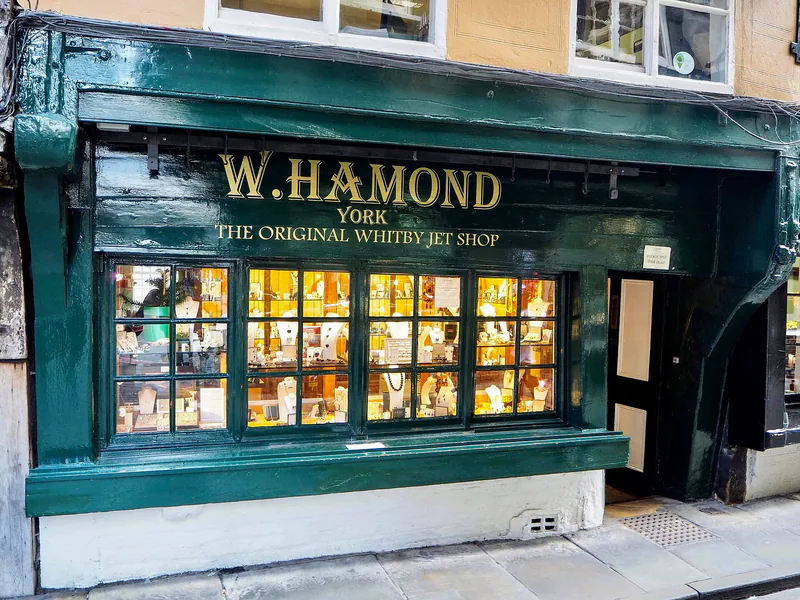
Jet's blackness and its long association with burial made it the stone of mourning. After Prince Albert died in 1861, Queen Victoria's long mourning made Whitby jet fashionable across Britain and its empire, and by the 1870s well over a thousand people worked in the Whitby trade. Brooches, lockets and beads carved with flowers, crosses and compartments for a lock of hair carried remembrance and grief. In folk magic jet protects, absorbs ill will and guards the vulnerable. Such beliefs are cultural; there is no scientific evidence that jet protects or heals.
The mineral
Jet is about 2.5 to 4 on the Mohs scale and light in weight. It feels warm in the hand, can take an electric charge when rubbed, and leaves a brown streak on unglazed porcelain. A hot needle touched to a hidden spot gives a coal-like smell, a test best left to professionals because it marks the piece.
Imitations were rife even in Victoria's day. "French jet" is black glass, which is cold, heavy and glassy where chipped; vulcanite (hardened rubber) smells of rubber when warmed; bog oak is brownish and woody; plastics are common today. Jet is brittle and can crack with sudden changes of temperature. Clean it with a soft dry cloth, keep it from solvents and heat, and store it apart from harder stones.
Sources and further reading
- Natural History, Book 36 — Pliny the Elder, c. 77 CE
- Ecclesiastical History of the English People — Bede, 731
- Jet — Helen Muller, 1987
- The Curious Lore of Precious Stones — George Frederick Kunz, 1913